Why does she need presence when I already provide security?
6 min read
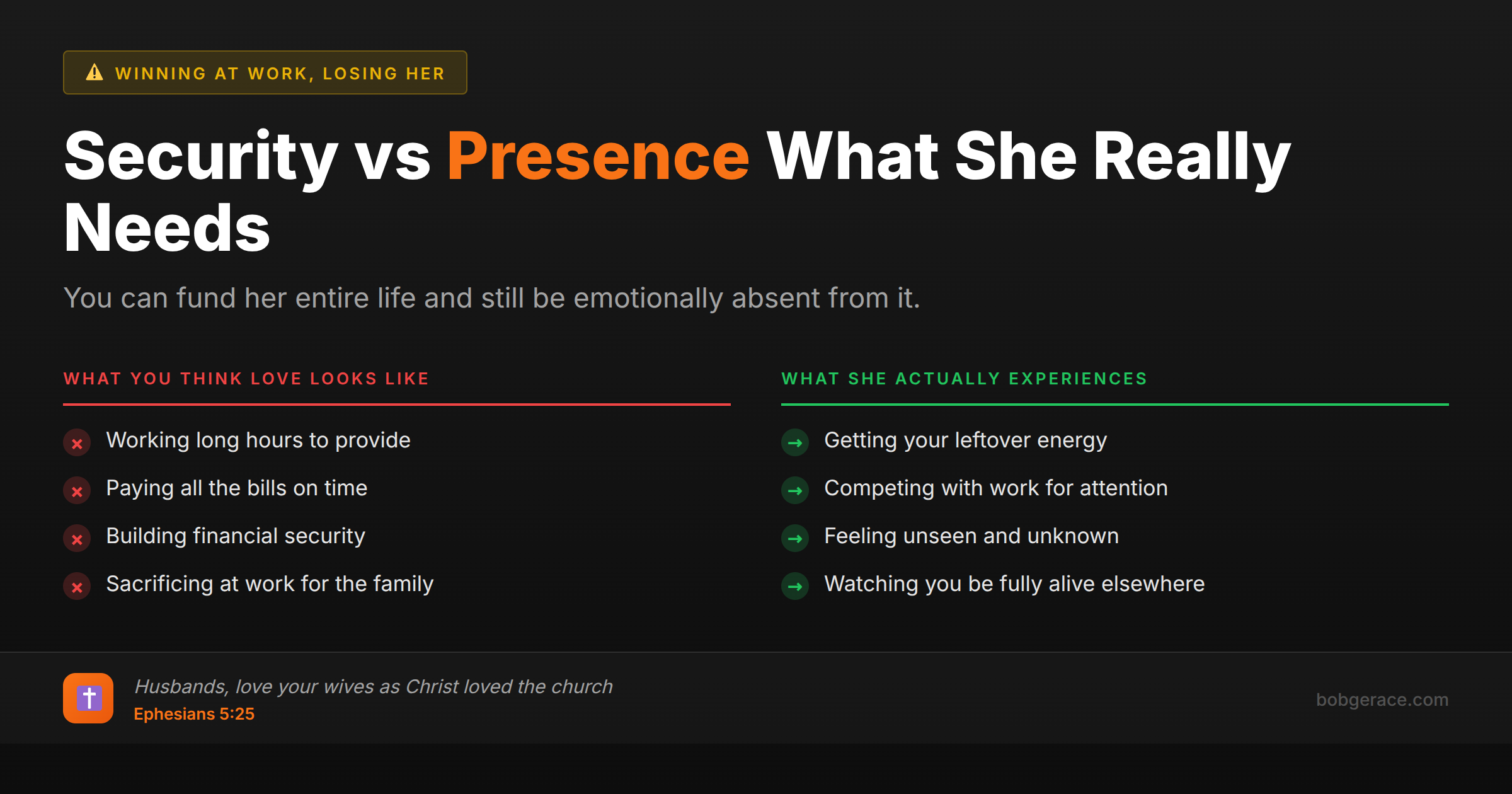
Because security and presence are not the same thing. You can fund her entire life and still be emotionally absent from it. Provision is a form of love, but it's not a substitute for attunement, emotional availability, or being known. Your wife doesn't doubt your work ethic. She doubts whether you see her, whether you're affected by her, whether she matters beyond the role she plays in the life you built. Most high-performing men operate like this: sacrifice at work equals love at home. But she experiences it differently. She sees a man who is fully alive at the office and half-present in the living room. She feels you give your best energy to clients, your sharpest focus to deals, and your leftovers to her. You think you're building for her. She feels like she's losing you to it.
The Provider Trap: When Sacrifice Becomes Distance
You're not lazy. You're not selfish in the classic sense. You work sixty-hour weeks, carry the financial weight, solve problems all day, and come home depleted. You think the house, the vacations, the stability, the lack of financial stress—these are your love language. And they are. But they're not the whole language.
Here's what happens in many provider-driven marriages: You optimize for output. You solve, you build, you produce. Your nervous system is tuned for performance. At work, that makes you valuable. At home, it makes you unavailable. You listen to her like you're triaging a ticket. You touch her when you want sex. You talk about logistics, not longing. You're home, but you're not present. You're in the room, but not in the moment.
Your wife doesn't resent your success. She resents that the man she married is now a ghost in a good life. She feels like a project manager in her own marriage—coordinating, reminding, managing your calendar and your mood. She doesn't feel pursued. She feels accommodated. And over time, that distance hardens into resentment. She stops reaching for you. She stops complaining. She just starts living like you're a good roommate who pays the bills.
You didn't mean for this to happen. But intent doesn't override impact. Provision is necessary. It's biblical. It's masculine. But it's not sufficient. She needs you to be moved by her, to be curious about her inner world, to bring the same intensity you bring to your work into the space between you. Presence isn't about hours. It's about attention, attunement, and being emotionally alive when you're with her.
Why Provision Alone Triggers Attachment Injury
From an attachment perspective, your wife's nervous system is wired to detect emotional availability, not just resource availability. When she reaches for connection and gets logistics, task management, or distraction, her brain registers that as rejection. Over time, that creates what clinicians call attachment injury—a pattern where she learns that you're not a safe place to bring her heart.
Here's the cycle: She bids for connection. You respond with problem-solving or half-attention. She feels unseen. She withdraws or criticizes. You feel unappreciated or attacked. You double down on work, where you do feel competent. The distance grows. She stops bidding. You think things are fine because the conflict stopped. But what actually stopped was her hope that you'd show up.
This is compounded by the fact that high-performing men often have avoidant attachment patterns. You learned early that performance equals worth, that feelings are distractions, that you're safest when you're competent and in control. So you pour yourself into work, where the rules are clear and the scoreboard is visible. But marriage doesn't work that way. Marriage requires vulnerability, presence, and the willingness to be affected by another person. It requires you to step into emotional risk, not just financial risk.
When your wife says she needs presence, she's not asking you to quit your job. She's asking you to bring your full self home. She's asking you to be curious, to attune, to let her impact you. She's asking for the man, not just the machine. And if you don't learn to do that, provision becomes a very expensive way to lose your wife.
Provision and Presence: The Full Call of Headship
Scripture is clear: a man provides. "If anyone does not provide for his relatives, and especially for his immediate family, he has denied the faith and is worse than an unbeliever" (1 Timothy 5:8). That's not optional. But provision is never presented as the totality of love. Paul tells husbands to love their wives "as Christ loved the church" (Ephesians 5:25). Christ didn't just fund the church. He gave Himself. He was present. He knew His people. He was moved by them.
Jesus didn't send the disciples a check and call it intimacy. He walked with them. He wept with them. He noticed them. He was fully present in their lives. That's the model. Provision without presence is a truncated gospel. It's duty without devotion. Your wife doesn't just need your paycheck. She needs your heart.
Consider Proverbs 5:18-19: "Rejoice in the wife of your youth... may you ever be intoxicated with her love." That's not transactional. That's relational. It's presence, delight, attention. It's being captivated by her, not just responsible for her. God calls you to lead, provide, and protect. But He also calls you to love her the way He loves you—with attention, tenderness, and the willingness to be interrupted by her needs. Presence isn't a luxury. It's obedience.
Action Steps
-
1
Tonight, put your phone in another room for 30 minutes and ask her one question about her day. Don't fix it. Just listen and stay curious.
-
2
Identify one recurring moment when you're physically home but mentally at work. Name it. Then practice a 60-second reset: breathe, notice her, and choose to be here.
-
3
Schedule one hour this week where you do something with her that she enjoys, not because it's efficient, but because she matters.
-
4
Ask her this week: 'What's one way I could be more present with you that would make you feel seen?' Then do it without defending your current effort.
-
5
Audit your energy: Are you giving your best to work and your leftovers to her? If yes, name it before God and ask Him to reorder your priorities.
Related Questions
- I make six figures, so why is my wife still unhappy?
- Am I a workaholic husband or just a responsible provider?
- Can a good provider still be an emotionally unavailable husband?
- Why do successful men miss the warning signs at home?
- What marriage mistakes do high-achieving men make?
- Why does achievement not protect my marriage?
Also find Bob on
Subscribe for weekly videos on Christian marriage.
You Built the Life. Don't Lose the Marriage.
If you're realizing that provision isn't enough and you don't know how to show up differently, let's talk. I work with men like you every week—successful, driven, and finally ready to lead at home the way they lead at work.
Talk to Bob →