Did she ever love me?
6 min read
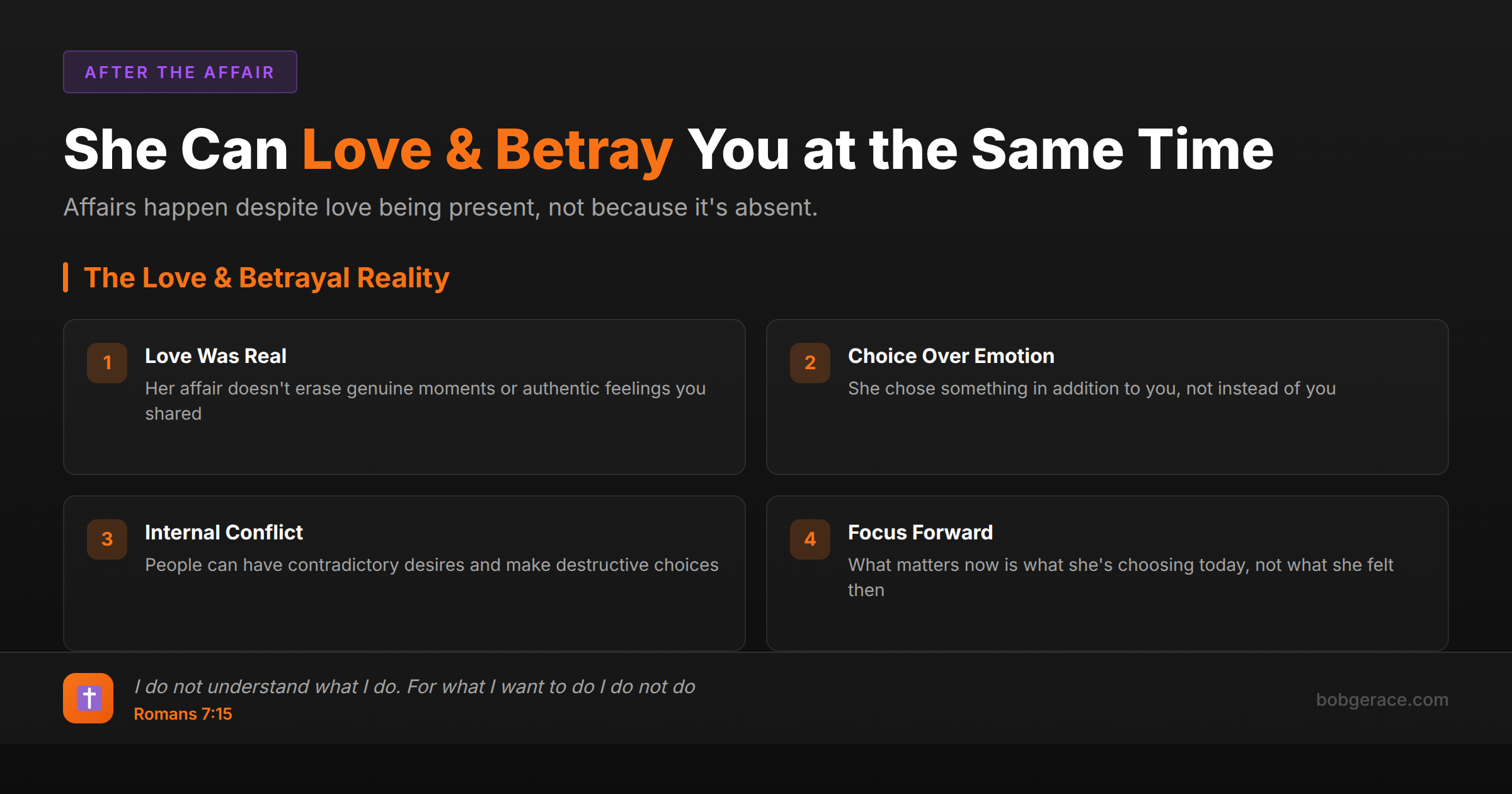
Yes, she did love you - and likely still does. This is one of the hardest truths for betrayed husbands to accept, but affairs rarely happen because love is absent. They happen despite love being present. The affair isn't evidence that her love was fake; it's evidence that she made destructive choices that violated that love. Love and betrayal can coexist in the same person, as painful as that reality is. Her affair doesn't erase the genuine moments, the real connection, or the authentic feelings you shared. It means she chose something else in addition to you, not instead of you. Understanding this distinction is crucial for your healing and for any potential restoration of your marriage.
The Full Picture
Your question cuts to the core of every betrayed husband's deepest fear: Was our entire relationship a lie? I understand why you're asking this. When someone you love betrays you at the deepest level, it's natural to question everything that came before.
But here's what I've learned from working with hundreds of couples: Affairs don't happen because love is missing - they happen because boundaries are missing. The woman who chose to have an affair is the same woman who chose to marry you, who shared intimate moments with you, who built a life alongside you. Those experiences were real.
The affair represents a compartmentalized choice, not a negation of her love for you. Think of it this way: people can simultaneously love their children deeply while making terrible parenting decisions. They can love their jobs while stealing from their employers. Love doesn't prevent poor choices - it makes those choices more tragic.
Your wife likely experienced what psychologists call cognitive dissonance - holding two conflicting realities in her mind. She loved you AND she pursued something else. Rather than resolve this conflict by ending the affair, she managed it by compartmentalizing her life.
This doesn't excuse her choices. Love should motivate us toward faithfulness, not provide cover for betrayal. But understanding that her love was real helps you process what happened more accurately. You weren't married to someone incapable of love - you were married to someone capable of love who made devastating choices despite that capacity.
The real question isn't whether she loved you then, but whether she's willing to choose you now. Love is both a feeling and a decision, and while the feeling may have been genuine, her decisions were destructive. Moving forward requires both the feeling AND the commitment to make different decisions.
What's Really Happening
From a clinical perspective, questioning the authenticity of love after betrayal is a normal trauma response. When our attachment system is violated, our brain attempts to make sense of the contradiction by rewriting history. If she never loved me, then this makes sense. If our love was fake, then I can process this betrayal more easily.
But research consistently shows that affairs typically occur in relationships where love exists alongside unmet needs, poor boundaries, or underdeveloped coping mechanisms. The betraying partner often reports feeling genuine love for their spouse even while engaging in infidelity.
This phenomenon is called 'splitting' - the tendency to see things as all good or all bad when the reality is more complex. Your wife's capacity for love and her capacity for betrayal coexisted. Understanding this helps you process the betrayal more accurately and avoid the additional trauma of questioning every positive memory.
Neurologically, when we experience betrayal trauma, our brain's threat detection system becomes hypervigilant. We scan our memories for signs we missed, often reinterpreting neutral or positive interactions as evidence of deception. This is your brain trying to protect you, but it can also distort your perception of what was real.
The //blog.bobgerace.com/divine-healing-christian-marriage-beyond-therapy/:healing process involves integrating these contradictory truths: she loved you AND she betrayed you. Both can be true simultaneously. This integration is essential for your emotional recovery, whether your marriage survives or not.
What Scripture Says
Scripture provides profound insight into the coexistence of love and betrayal within human nature. The Bible doesn't shy away from this complexity - it addresses it directly.
Romans 7:15 captures this internal conflict: *'I do not understand what I do. For what I want to do I do not do, but what I hate I do.'* Even the apostle Paul acknowledged the capacity for contradictory desires and actions within the same person.
Jeremiah 17:9 reminds us: *'The heart is deceitful above all things and beyond cure. Who can understand it?'* This doesn't mean love is fake, but that human hearts are complex and capable of self-deception. Your wife could genuinely love you while making choices that violated that love.
Consider Peter's relationship with Jesus. In Matthew 26:35, Peter declares: *'Even if I have to die with you, I will never disown you.'* Yet hours later, he denies knowing Jesus three times. Did Peter not love Jesus? Of course he did. But love didn't prevent his failure in a moment of weakness and fear.
1 Corinthians 13:4-7 defines love as a series of choices: patient, kind, not self-seeking, keeping no record of wrongs. Your wife's affair violated these principles, but that doesn't mean her feelings were fabricated - it means her choices were wrong.
Finally, Hosea 3:1 shows God commanding Hosea to love his unfaithful wife: *'Go, show your love to your wife again, though she is loved by another man and is an adulteress.'* This demonstrates that love can persist even after betrayal, and that betrayal doesn't negate the reality of previous love.
The biblical framework acknowledges both human capacity for genuine love and human tendency toward destructive choices. These aren't mutually exclusive realities.
What To Do Right Now
-
1
Stop interrogating your memories - resist the urge to rewrite your entire relationship history based on her current choices
-
2
Acknowledge the complexity - accept that she could have loved you genuinely while still choosing to betray you
-
3
Focus on current reality - the question isn't what she felt then, but what she's choosing now and going forward
-
4
Separate feelings from actions - recognize that love is both emotion and decision, and her decisions were wrong regardless of her feelings
-
5
Protect your mental health - don't let questioning past love prevent you from processing present betrayal appropriately
-
6
Seek professional support - work with someone who can help you integrate these complex truths without minimizing the betrayal
Related Questions
You Don't Have to Figure This Out Alone
These questions are too heavy to carry by yourself. Let me help you process this betrayal and find clarity about your next steps.
Get Support →