He's not even as good as me — why him?
6 min read
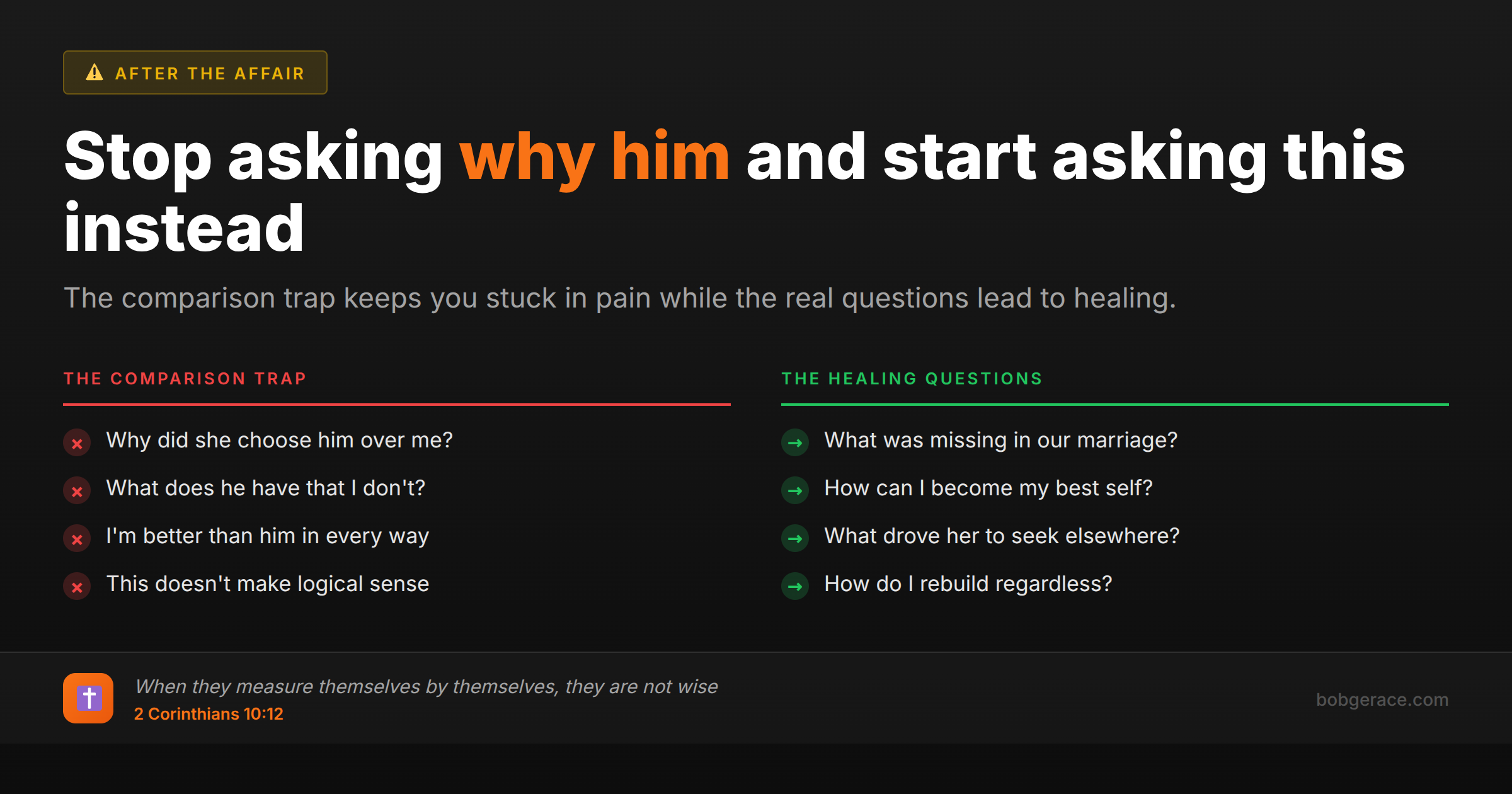
This question hits every betrayed husband like a freight train, and it's completely natural to ask it. You're measuring him against yourself using your own scorecard — career success, looks, character, provider ability — and you're winning. But here's the hard truth: she didn't choose him because he's "better" than you. Affairs aren't logical decisions based on objective comparisons. They're emotional responses to unmet needs, escape mechanisms, or reactions to problems in the marriage that may have been building for years. He represents something she felt was missing — attention, excitement, feeling desired, or simply being somewhere else than in the pain of your relationship. Stop trying to solve this puzzle by comparing resumes. Start understanding what drove her to seek that elsewhere.
The Full Picture
Let me be blunt with you — you're asking the wrong question. When you focus on comparing yourself to him, you're missing the entire point of what happened in your marriage.
It's Not About Him Being Better
I've worked with hundreds of men in your situation, and 95% of the time, the "other man" isn't objectively better. He might be less successful, less attractive, less stable, or less of everything you pride yourself on. That's not an accident — it's actually quite common.
Your wife didn't run a cost-benefit analysis and decide to trade up. She made an emotional decision based on how she felt in specific moments. Maybe he made her laugh when she'd been feeling heavy. Maybe he listened without trying to fix her problems. Maybe he represented freedom from responsibilities and difficulties.
What He Actually Represented
- Escape: He was a door out of whatever pain or dissatisfaction she was feeling - Novelty: New attention feels intoxicating compared to familiar patterns - Simplicity: No shared bills, parenting stress, or real-world complications - Validation: Someone new finding her attractive and interesting - Fantasy: The relationship with him existed outside of real life
The Comparison Trap
When you keep asking "why him?", you're actually avoiding the harder but more important questions: What was missing in our marriage? What was she trying to find or escape from? How did we get to a place where this felt like her best option?
Those questions hurt more because they require looking at yourself and your marriage honestly. But they're the only questions that lead to real answers and potential healing. Comparing yourself to him is just a distraction that keeps you stuck in anger and confusion instead of moving toward understanding and rebuilding.
What's Really Happening
From a clinical perspective, the "why him?" question reveals a fundamental misunderstanding of how affairs typically develop. Research consistently shows that affair partners are rarely objectively superior to spouses in measurable ways.
Affairs usually fill specific emotional or psychological needs that have gone unmet in the primary relationship. The other person doesn't need to be "better" overall — they just need to provide whatever was missing or perceived as missing. This might be attention, emotional connection, excitement, or simply the feeling of being truly seen and desired.
The affair partner often benefits from what therapists call the "grass is greener" effect and the "comparison advantage." They get to interact with your wife when she's escaping normal life stresses. They don't see her exhausted from parenting, worried about finances, or dealing with //blog.bobgerace.com/marriage-balance-account-christian-daily-deposits/:daily responsibilities. Meanwhile, you're associated with all the real-world pressures and challenges.
Neurologically, affairs trigger powerful reward chemicals — dopamine, norepinephrine, and phenylethylamine — that create an almost addictive high. This neurochemical cocktail makes people feel alive, excited, and validated in ways that long-term relationships, with their stable but less intense chemical patterns, simply cannot match.
The key insight here is that affairs are typically about the unfaithful spouse's internal emotional state and unmet needs, not about the objective qualities of the affair partner. Understanding this shifts the focus from "what does he have that I don't?" to "what was she seeking that she felt she couldn't find in our marriage?" That's where real healing and rebuilding can begin.
What Scripture Says
Scripture gives us wisdom about comparison, understanding human nature, and responding to betrayal with both truth and grace.
The Danger of Comparison
*"We do not dare to classify or compare ourselves with some who commend themselves. When they measure themselves by themselves and compare themselves with themselves, they are not wise."* - 2 Corinthians 10:12
God warns us against the trap of comparison because it distorts our perspective and leads us away from truth. When you measure yourself against the other man, you're playing a game that has no winners and no real answers.
Understanding the Human Heart
*"The heart is deceitful above all things and beyond cure. Who can understand it?"* - Jeremiah 17:9
Scripture acknowledges that human motivations are complex and often contradictory. Your wife's choice may not make logical sense because it came from a place of emotional confusion, unmet needs, or spiritual emptiness.
Seeking Wisdom Over Answers
*"If any of you lacks wisdom, you should ask God, who gives generously to all without finding fault, and it will be given to you."* - James 1:5
Instead of demanding to understand "why him," ask God for wisdom to understand what really matters — how to respond with character, how to address the real issues in your marriage, and how to move forward.
The Call to Examine Yourself First
*"Why do you look at the speck of sawdust in your brother's eye and pay no attention to the plank in your own eye?"* - Matthew 7:3
While your wife's choices are her responsibility, Christ calls us to examine our own hearts and actions first. What can you learn about yourself and your marriage from this situation?
Responding with Character
*"Above all else, guard your heart, for everything you do flows from it."* - Proverbs 4:23
*"In your anger do not sin."* - Ephesians 4:26
Your response to this betrayal will define who you are and who you become. Choose character over comparison, wisdom over wounded pride.
What To Do Right Now
-
1
Stop researching him — block his social media, stop asking mutual friends about him, and redirect that energy toward your own healing and growth.
-
2
Write down what you think was missing in your marriage from her perspective, even if it's painful to consider — this takes courage but provides real insight.
-
3
Focus on becoming the best version of yourself regardless of what happens with your marriage — work out, pursue counseling, develop your character and skills.
-
4
Have an honest conversation with a trusted friend or counselor about what you might have missed or neglected in your relationship.
-
5
Pray specifically for wisdom to understand the real issues rather than demanding answers to questions that won't actually help you heal or rebuild.
-
6
If you're working toward reconciliation, ask her directly what she was seeking or missing rather than making it about him — this shows maturity and genuine desire to understand.
Related Questions
- Should I confront the other man?
- Why does she prefer him to me?
- She says he 'gets' her — what does that mean?
- What is 'affair partner idealization' and why is it happening?
- Why does she see him as perfect and me as flawed?
- What does the other man represent that I don't?
- Why do I compare myself to him obsessively?
- Was I not enough for her?
- How do I become a man worth choosing without competing?
Also find Bob on
Subscribe for weekly videos on Christian marriage.
Your marriage isn't a generic case study
A coach who knows your actual story can help you stop spinning on this question and start working on what actually rebuilds trust in your specific situation.
Talk to Bob →