How do I lead without being positional?
6 min read
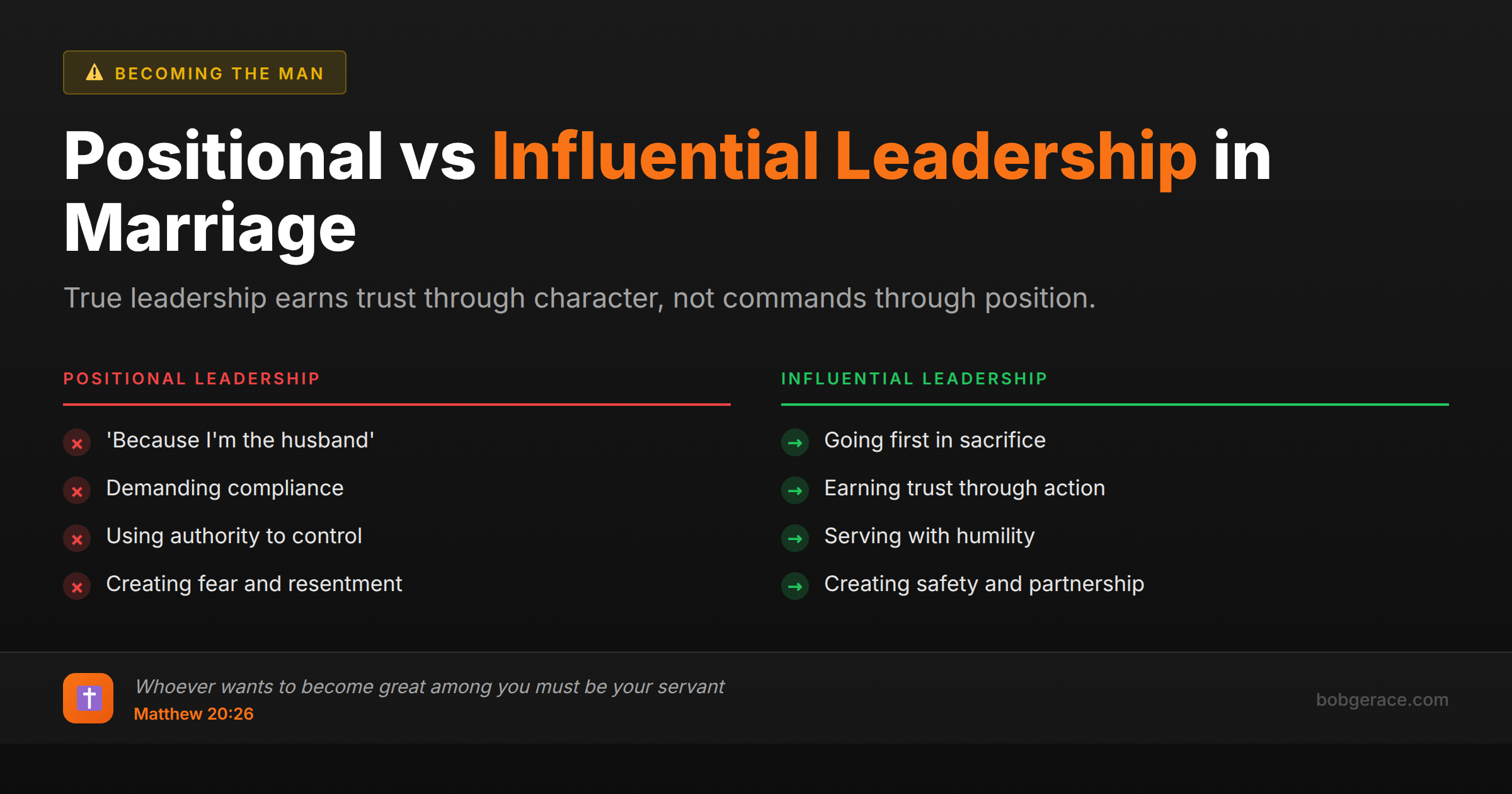
Leading without being positional means you influence through character, service, and example rather than demanding compliance through your role as 'husband.' It's the difference between saying 'because I'm the man' and earning your wife's trust through consistent, loving action. True leadership in marriage isn't about pulling rank—it's about going first in sacrifice, humility, and love. This kind of leadership creates safety and trust instead of resentment and resistance. When you lead through influence, your wife follows because she wants to, not because she has to. It transforms your marriage from a power struggle into a partnership where both of you thrive.
The Full Picture
Most men completely misunderstand what biblical leadership looks like in marriage. They think it means making executive decisions, having the final say, or getting their way because they're the 'head of the household.' That's not leadership—that's dictatorship, and it destroys marriages.
Real leadership is influence, not authority. It's earning the right to be followed through your character, not demanding it through your position. When you lead positionally, you're essentially saying, 'Do this because I outrank you.' When you lead through influence, you're saying, 'Follow me because you trust where I'm going.'
Here's what changes everything: leadership is about going first, not being in charge. You go first in apologizing. You go first in serving. You go first in sacrifice. You go first in vulnerability. You go first in seeking God. Your wife doesn't follow your words—she follows your footsteps.
Positional leadership creates compliance at best, rebellion at worst. Influential leadership creates partnership. When your wife sees you consistently choosing her good over your comfort, leading by example rather than by edict, something shifts. She starts to trust your judgment because she's watched you make good decisions. She respects your guidance because she's seen you guide yourself well first.
The irony is this: the moment you stop demanding to be followed is often when people most want to follow you. When you release the need to control and focus on earning influence through character, you actually become more effective as a leader, not less.
What's Really Happening
From a psychological perspective, positional leadership triggers what we call 'reactance'—the natural human tendency to resist when we feel our autonomy is threatened. When a husband says 'because I said so' or 'because I'm the man,' he's essentially telling his wife that her thoughts, feelings, and input don't matter. This creates psychological distance and erodes intimacy.
Influential leadership, on the other hand, activates trust and connection. When we see someone consistently act with integrity, put our needs first, and demonstrate wisdom through their choices, our brains naturally begin to defer to their judgment. It's not submission through force—it's voluntary followership based on proven competence and care.
Women especially respond to leadership that feels safe and collaborative. Research shows that women are more likely to follow leaders who demonstrate emotional intelligence, consider multiple perspectives, and create space for input. When a husband leads through influence rather than position, he's speaking his wife's emotional language.
The neuroscience is fascinating here: positional leadership activates the threat-detection centers of the brain, while influential leadership activates areas associated with safety and bonding. One creates chronic stress in the relationship; the other creates security. Men who learn to lead through influence literally change their wife's brain chemistry from defensive to receptive.
This doesn't mean men become passive or abdicate responsibility. It means they earn the right to lead through consistent, caring action rather than demanding it through cultural or biblical arguments.
What Scripture Says
Scripture is crystal clear about what godly leadership looks like, and it's nothing like the authoritarian model many men default to.
Jesus defined leadership: *'You know that the rulers of the Gentiles lord it over them, and their high officials exercise authority over them. Not so with you. Instead, whoever wants to become great among you must be your servant, and whoever wants to be first must be your slave—just as the Son of Man did not come to be served, but to serve and to give his life as a ransom for many.'* (Matthew 20:25-28)
Notice what Jesus said: worldly leaders 'lord it over' people and 'exercise authority.' But kingdom leadership is different—it serves first. Husbands, Christ loves the church and gave himself up for her (Ephesians 5:25). He didn't demand the church's submission; He earned it through sacrifice.
Leadership through example: *'Be shepherds of God's flock that is under your care, watching over them—not because you must, but because you are willing, as God wants you to be; not pursuing dishonest gain, but eager to serve; not lording it over those entrusted to you, but being examples to the flock.'* (1 Peter 5:2-3)
Even in church leadership, the command is clear: don't 'lord it over' people. Lead by example. Your character is your authority.
The ultimate model: *'In your relationships with one another, have the same mindset as Christ Jesus: Who, being in very nature God, did not consider equality with God something to be used to his own advantage; rather, he made himself nothing by taking the very nature of a servant.'* (Philippians 2:5-7)
Jesus had all the positional authority in the universe, yet He chose to lead through service and sacrifice. That's your blueprint.
What To Do Right Now
-
1
Stop using 'because I'm the husband' or 'because the Bible says' as reasons for your decisions. Start explaining your thinking and asking for your wife's input.
-
2
Identify one area where you can 'go first'—apologizing for a recent conflict, serving without being asked, or admitting where you've been wrong.
-
3
Ask your wife: 'What would make you feel more comfortable following my lead?' Then listen without defending.
-
4
Make decisions based on what's best for your family, not what's easiest for you. Let your actions demonstrate wisdom before you ask for trust.
-
5
When you disagree with your wife, seek to understand her perspective fully before trying to convince her of yours.
-
6
Look for opportunities to publicly honor your wife's wisdom and input, especially in front of your children or others.
Related Questions
- What does masculine leadership look like?
- How do I lead without controlling?
- What's the difference between leading and dominating?
- What is 'earned authority'?
- How do I lead when I've lost credibility?
- What does humble leadership look like?
- What is biblical headship?
- What's the difference between authority and authoritarianism?
- How do I lead without demanding submission?
Also find Bob on
Subscribe for weekly videos on Christian marriage.
Leading in Your Marriage, Not Theory
You know the concept. But applying it to your wife, your history, your specific dynamic—that's where most men stall. A coach helps you see what you can't see alone.
Talk to Bob →