What is the role of the church in accountability?
6 min read
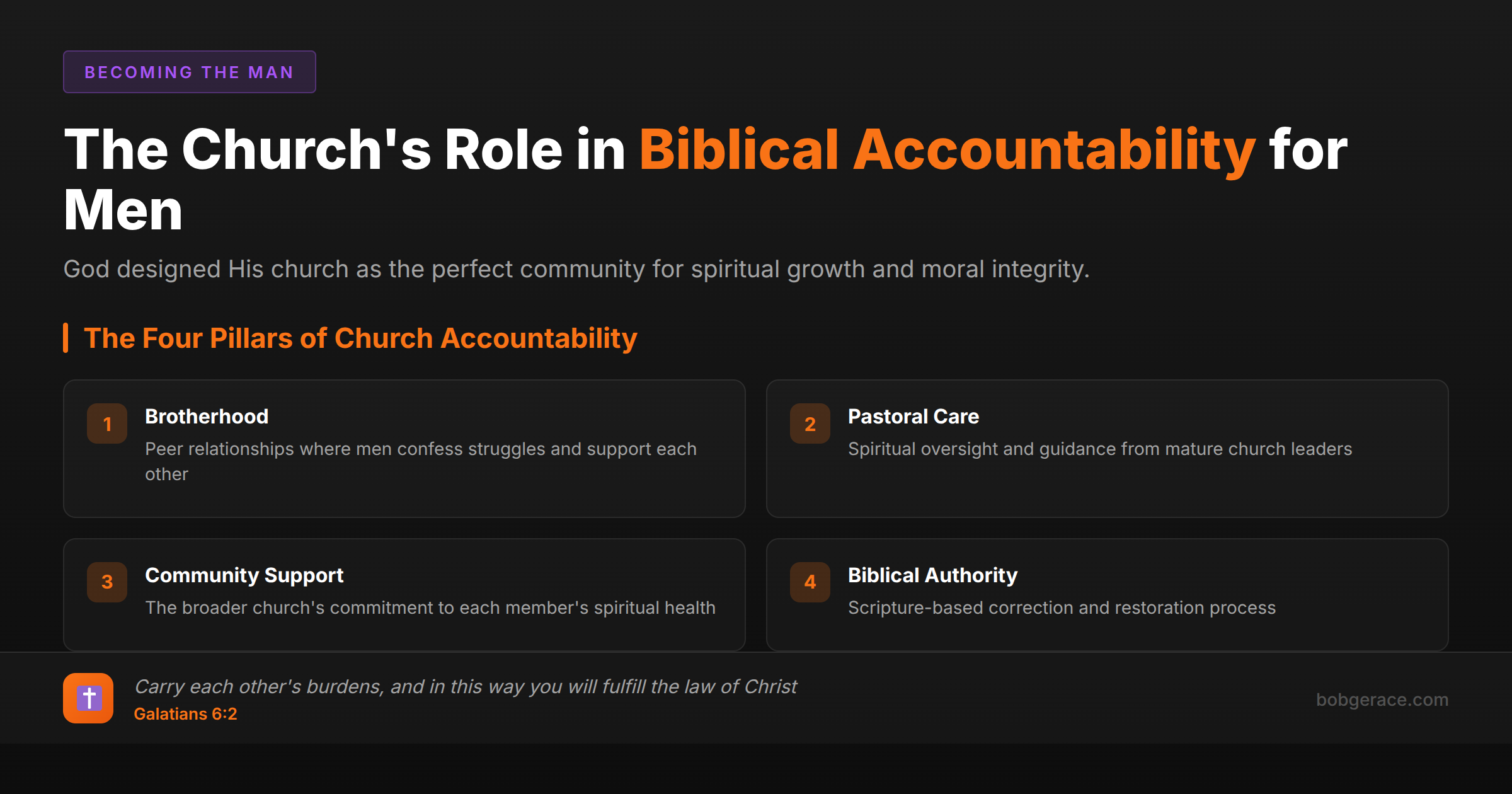
The church serves as God's appointed community for accountability, providing the structure and relationships necessary for spiritual growth and moral integrity. Through biblical community, the church creates an environment where men can confess struggles, receive correction, and experience restoration. This isn't about judgment or condemnation—it's about love expressed through truth-telling and support. Accountability in the church operates on multiple levels: peer-to-peer relationships among brothers, pastoral oversight and guidance, and the broader community's commitment to each member's spiritual health. The church provides both the relational framework and biblical authority needed for genuine transformation, especially in areas like marriage, integrity, and spiritual maturity.
The Full Picture
The church's role in accountability goes far beyond casual friendship or social connection—it's a divinely ordained system for spiritual formation and moral integrity. God designed the church as a community where believers don't walk alone but are surrounded by brothers and sisters committed to their spiritual health and growth.
Biblical accountability through the church operates on several interconnected levels. First, there's peer-to-peer accountability among Christian brothers who know your struggles, celebrate your victories, and aren't afraid to speak truth into your life. These relationships require vulnerability and mutual submission to God's Word.
Second, pastoral oversight provides wisdom, guidance, and sometimes necessary correction. Church leaders carry the responsibility to shepherd the flock, which includes addressing sin and providing direction for spiritual growth. This isn't authoritarian control—it's loving leadership exercised with humility and biblical authority.
The church also provides corporate accountability through teaching, worship, and community life. Regular exposure to God's Word, participation in the sacraments, and involvement in church life creates multiple touchpoints for spiritual formation and correction.
Most importantly, church accountability operates within a framework of grace and restoration, not shame and rejection. The goal is always repentance, healing, and spiritual maturity. When done biblically, church accountability creates safety for confession, support for change, and celebration of transformation. This kind of community is essential for men who want to grow in their faith, strengthen their marriages, and live with integrity.
What's Really Happening
From a therapeutic perspective, healthy church accountability provides what psychologists call 'social scaffolding'—external structure that supports internal change. Research consistently shows that accountability relationships increase the likelihood of sustained behavioral change by over 65% when regular check-ins occur.
The church community addresses several critical psychological needs simultaneously. It provides belonging and identity, reducing the isolation that often fuels destructive behaviors. It offers external validation and reality-testing, helping individuals see blind spots and patterns they might miss alone. Most importantly, it creates positive social pressure and support for growth.
However, accountability systems can become unhealthy when they operate from shame rather than love, focus on external compliance rather than heart change, or lack proper boundaries and training. Healthy church accountability mirrors good therapeutic alliance—it's collaborative, non-judgmental, focused on growth, and respects individual autonomy while providing structure.
The neurological impact is significant. Regular accountability relationships actually rewire the brain's reward systems, making healthy choices more automatic and reducing the appeal of destructive behaviors. The combination of spiritual community, practical support, and consistent encouragement creates an optimal environment for lasting personal transformation.
What Scripture Says
Scripture consistently presents the church as God's chosen instrument for accountability and spiritual formation. Galatians 6:1-2 provides the foundational approach: 'Brothers and sisters, if someone is caught in a sin, you who live by the Spirit should restore that person gently. But watch yourselves, or you also may be tempted. Carry each other's burdens, and in this way you will fulfill the law of Christ.'
The process of church accountability is outlined in Matthew 18:15-17: 'If your brother or sister sins, go and point out their fault, just between the two of you. If they listen to you, you have won them over. But if they will not listen, take one or two others along... If they still refuse to listen, tell it to the church.'
Hebrews 10:24-25 emphasizes the communal aspect: 'And let us consider how we may spur one another on toward love and good deeds, not giving up meeting together, as some are in the habit of doing, but encouraging one another.' This isn't optional—it's essential for spiritual health.
James 5:16 connects accountability to healing: 'Therefore confess your sins to each other and pray for each other so that you may be healed.' Notice the communal nature—confession happens within community, and healing comes through community prayer and support.
1 Thessalonians 5:14 gives specific instructions: 'Warn those who are idle and disruptive, encourage the disheartened, help the weak, be patient with everyone.' The church's accountability role includes correction, encouragement, and patient support.
Proverbs 27:17 reminds us that 'As iron sharpens iron, so one person sharpens another'—growth happens through relationship and sometimes friction, but always with the goal of mutual sharpening and spiritual maturity.
What To Do Right Now
-
1
Join a men's small group or Bible study in your local church where authentic relationships and accountability can develop naturally
-
2
Identify 2-3 Christian men in your church who demonstrate spiritual maturity and ask one to meet regularly for accountability and prayer
-
3
Schedule a conversation with your pastor or a church elder about areas where you need accountability and spiritual guidance
-
4
Participate actively in corporate worship and church life, allowing the community's influence to shape your spiritual formation
-
5
Practice biblical confession by sharing specific struggles with trusted brothers in your church, following James 5:16
-
6
Commit to both giving and receiving accountability by investing in other men's spiritual growth while remaining open to correction yourself
Related Questions
- What does Scripture say about brotherhood?
- What is 'iron sharpening iron'?
- What does 'confess your sins to one another' mean?
- What is 'bearing one another's burdens'?
- What is the theology of community?
- Why did God say 'it's not good for man to be alone'?
- Is church discipline appropriate here?
- What does 'godly sorrow' look like in practice?
- What role does wise counsel play?
- What scriptures guide divorced Christian parenting?
Also find Bob on
Subscribe for weekly videos on Christian marriage.
Your Marriage Needs More Than Theory
You know what the church should provide. A coach helps you figure out what's actually happening in your specific marriage—and what to do next week.
Talk to Bob →