Should I talk to his coach?
6 min read
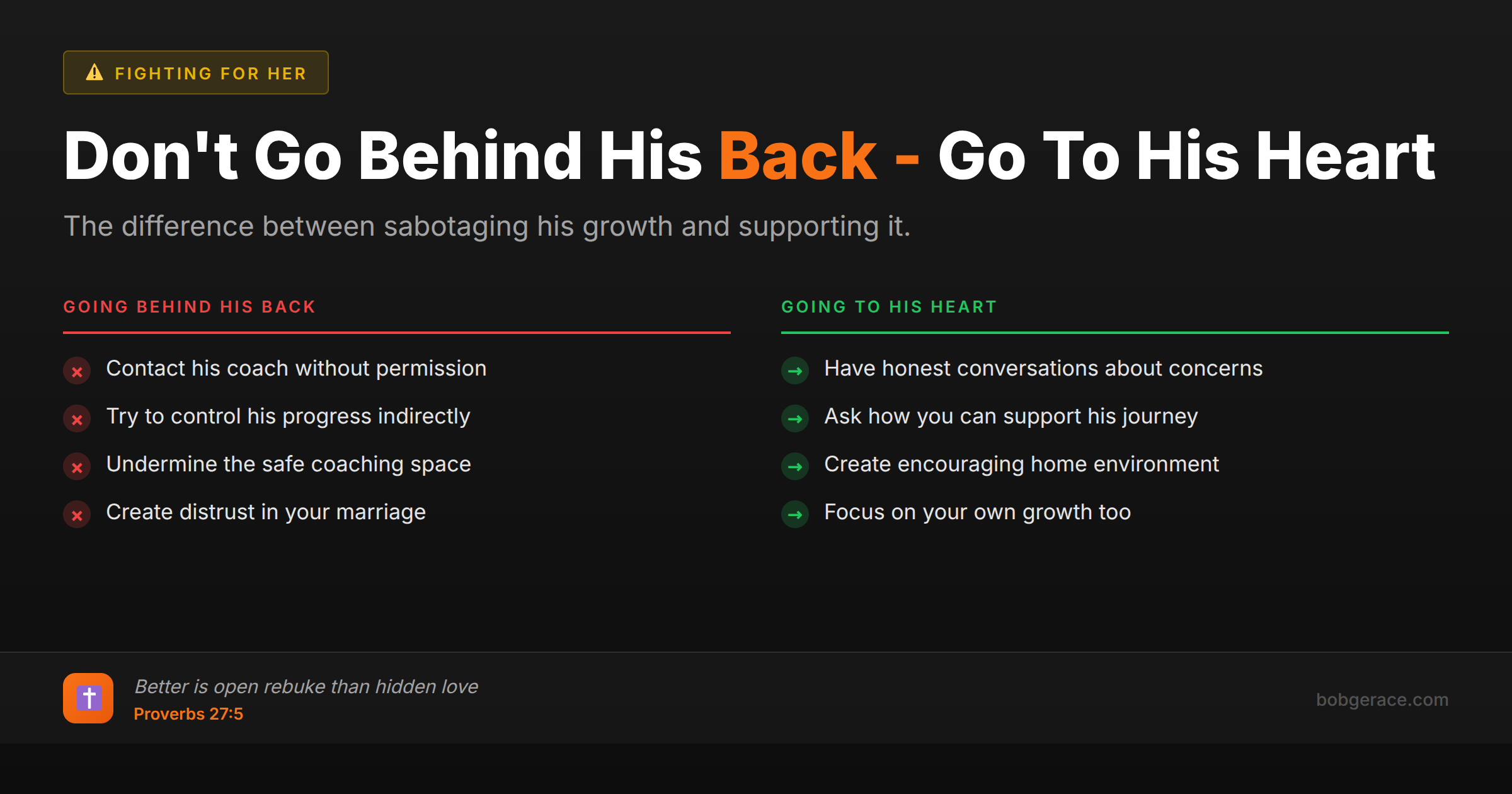
Generally speaking, no - you shouldn't reach out to your husband's coach without his knowledge and consent. His coaching relationship needs to be a safe space where he can be vulnerable and work through issues without worrying about outside interference. However, there are exceptions to this rule. If your husband has invited you to participate or if there are safety concerns, communication with his coach may be appropriate. The key is transparency and respect for boundaries. Your husband should be the primary driver of his own growth journey, and maintaining the integrity of that coaching relationship is crucial for his development. Instead of going around him, focus on supporting him directly and creating an environment where he feels motivated to engage fully with his coach.
The Full Picture
The question of whether to contact your husband's coach touches on some of the deepest dynamics in marriage: trust, boundaries, and the delicate balance between support and control. I get this question more often than you might think, and it usually comes from a place of genuine love and concern.
Here's what's really going on: You see your husband struggling, maybe not fully engaging with his coaching, or perhaps you feel like you have insights that could help his coach understand him better. Your heart is in the right place - you want to see him succeed and grow. But there's a fine line between being supportive and being intrusive.
The coaching relationship is built on trust and confidentiality. When a man enters coaching, he needs to know that space is sacred - that he can share his deepest fears, admit his failures, and work through his issues without worrying about judgment or interference from others, even his wife. This isn't about excluding you; it's about creating the psychological safety necessary for real transformation.
That said, there are legitimate situations where communication with a coach might be appropriate. If your husband has specifically asked you to reach out, if he's invited you to participate in sessions, or if there are genuine safety concerns, then the conversation changes entirely. The key principle is transparency - your husband should always know about any communication between you and his coach.
Remember, your role as his wife is incredibly important, but it's different from his coach's role. You can support his journey without needing to direct it.
What's Really Happening
From a therapeutic standpoint, the urge to contact a spouse's coach often stems from what we call 'anxious helping' - a well-intentioned but potentially counterproductive response to watching someone you love struggle. This behavior typically emerges when wives feel helpless or frustrated with the pace of their husband's progress.
The coaching relationship operates on principles similar to therapy: confidentiality, autonomy, and self-determination are foundational elements. When these boundaries are crossed, even with good intentions, it can undermine the client's sense of agency and trust in the process. Men, in particular, often struggle with feeling controlled or managed, and unauthorized contact between spouse and coach can trigger these sensitivities.
However, we also see the opposite extreme - complete disconnection between the coaching process and the marriage relationship. The healthiest approach involves what we call 'parallel process awareness' - where the wife understands her husband is in coaching, supports that journey, but maintains appropriate boundaries while working on her own growth simultaneously.
When wives feel compelled to contact the coach, it often indicates they're carrying too much responsibility for their husband's growth and not enough focus on their own development. The most successful coaching outcomes occur when both partners are engaged in their individual growth journeys while supporting each other's process from an appropriate distance.
What Scripture Says
Scripture provides clear guidance on respecting boundaries and the importance of direct communication in relationships. Proverbs 27:5-6 reminds us that "Better is open rebuke than hidden love. Wounds from a friend can be trusted, but an enemy multiplies kisses." This suggests that honest, direct communication with your husband about your concerns is more valuable than indirect approaches.
Matthew 18:15 gives us the principle of going directly to someone when we have concerns: "If your brother or sister sins, go and point out their fault, just between the two of you." While coaching isn't about sin, the principle of direct communication rather than triangulation applies here. If you have concerns about your husband's engagement with coaching, address them with him first.
1 Corinthians 13:7 tells us that love "always protects, always trusts, always hopes, always perseveres." Sometimes protecting your husband's growth process means respecting the boundaries of his coaching relationship, even when your instinct is to help more directly. Trust is an active choice - trusting that God is working in his life through the coaching process.
Ephesians 4:15 calls us to "speak the truth in love," which means having honest conversations with your husband about your observations and concerns rather than going around him. Galatians 6:2 reminds us to "carry each other's burdens," but verse 5 adds that "each one should carry their own load." There's a balance between support and enabling, between helping and taking over someone else's responsibility for growth.
What To Do Right Now
-
1
Have an honest conversation with your husband about your concerns regarding his coaching progress, but avoid ultimatums or demands
-
2
Ask your husband if there are specific ways you can support his coaching journey without interfering in the process
-
3
Focus on creating a supportive home environment that encourages his growth rather than trying to manage his coaching relationship
-
4
Consider getting your own coach or counselor to work through your feelings about his progress and your role in supporting him
-
5
Respect the boundaries of his coaching relationship unless he specifically invites your input or participation
-
6
If safety concerns exist, address them directly with your husband first, and only contact his coach with his knowledge or in genuine emergency situations
Related Questions
- What is he doing with his coach?
- Is his program legitimate?
- What should he be learning?
- How involved should I be in his process?
- What can I expect from this process?
- How do I evaluate his program quality?
- How do I know if he's really changing?
- Is he manipulating me or actually different?
- What are the markers of genuine behavior change?
- What does real transformation look like?
Also find Bob on
Subscribe for weekly videos on Christian marriage.
Stuck Between Supporting Him and Protecting Yourself?
A coach who knows your specific marriage can help you calibrate what support looks like when you're still hurting. You don't have to figure this out alone.
Talk to Bob →