What should he be learning?
6 min read
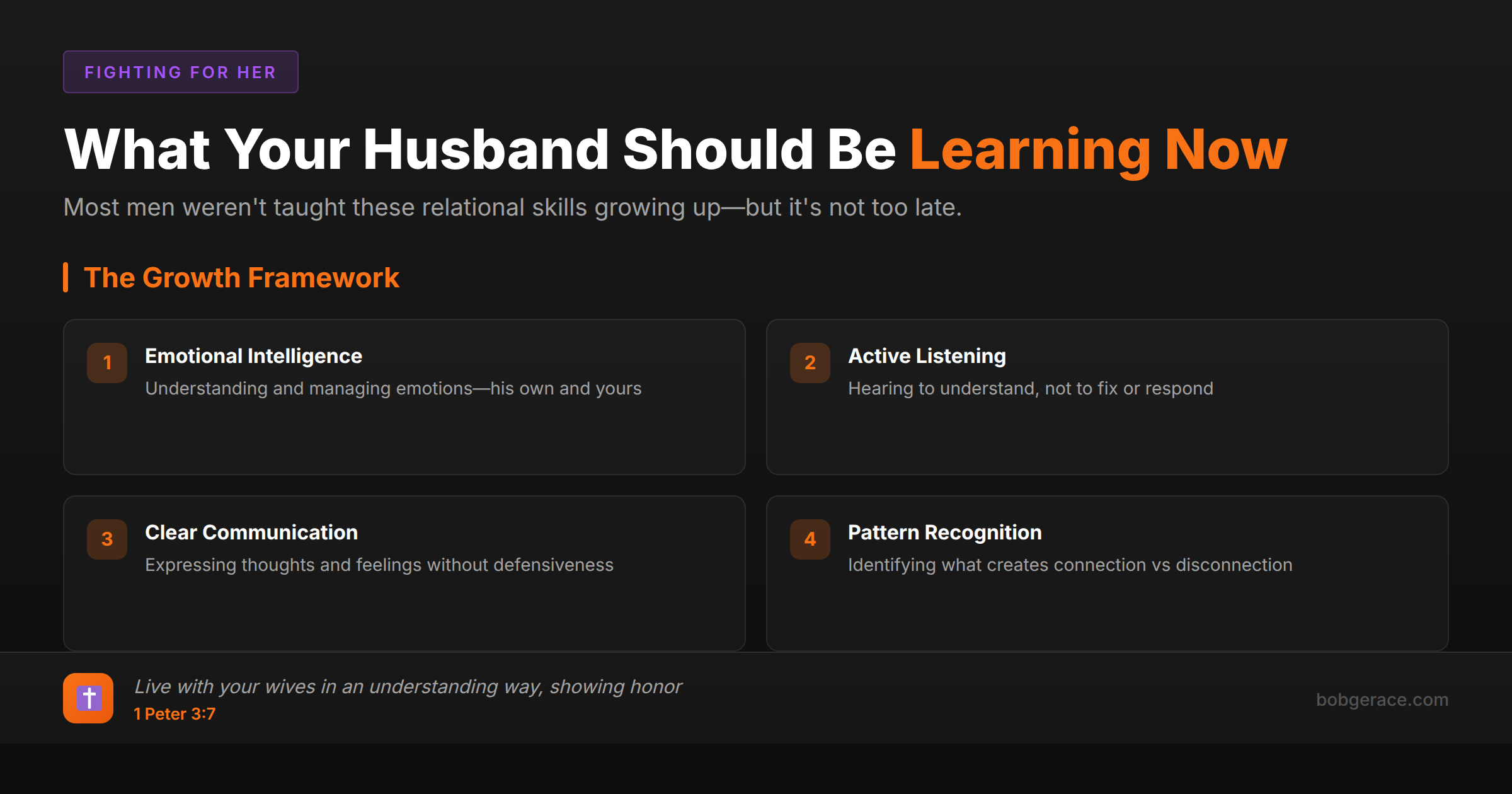
Your husband should be learning emotional intelligence, effective communication, and how to truly listen without immediately trying to fix everything. He needs to understand your emotional world and develop the skills to connect with you on a deeper level. Most men weren't taught these relational skills growing up, so this is new territory. He should be learning how to validate your feelings, express his own emotions clearly, and recognize the patterns that create disconnection in your marriage. This isn't about changing who he is—it's about developing the tools to love you better.
The Full Picture
Let's be honest—most men enter marriage equipped with career skills, maybe some practical abilities, but completely unprepared for the emotional complexity of intimate relationship. Society doesn't teach boys how to navigate feelings, communicate vulnerably, or understand the intricate dynamics that make marriages thrive.
Your husband should be learning:
Emotional Intelligence - This means recognizing his own emotions, understanding what triggers them, and developing healthy ways to express them. It also means learning to read your emotional cues and respond appropriately instead of shutting down or getting defensive.
Communication Beyond Problem-Solving - Men naturally want to fix things, but you often need him to simply listen and validate your experience first. He should learn the difference between when you want solutions versus when you want connection.
The Power of Presence - Being fully present means putting down the phone, making eye contact, and giving you his complete attention. This skill alone can transform your daily interactions.
Conflict Resolution - Instead of avoiding difficult conversations or bulldozing through them, he should learn how to navigate disagreements in ways that actually bring you closer together.
Your Unique Love Language - Understanding specifically how you receive love and making consistent efforts to speak that language, even when it doesn't come naturally to him.
The key insight here is that these aren't innate abilities for most men—they're learnable skills that require intentional practice and often some humility to admit he doesn't have it all figured out.
What's Really Happening
From a therapeutic perspective, we're seeing men who genuinely want to be good husbands but are operating with an incomplete toolkit. Many grew up in homes where emotional expression was discouraged or modeled poorly, creating significant gaps in their relational abilities.
The most critical area for male development is what we call 'emotional attunement'—the ability to sense, understand, and respond appropriately to their partner's emotional state. Research shows that marriages thrive when both partners feel emotionally understood, but men often struggle with this due to neurological and cultural factors.
I frequently work with husbands who interpret their wife's emotional sharing as criticism or demands for immediate action. Learning to sit with emotions—both theirs and yours—without immediately moving to solutions is a fundamental skill that requires rewiring decades of conditioning.
Another crucial area is developing distress tolerance. Many men shut down or become defensive when emotional intensity rises because they haven't learned healthy ways to manage that discomfort. Teaching them to stay present during difficult conversations, even when every instinct tells them to withdraw or fight, is transformative for marriages.
The good news is that men are typically very motivated learners when they understand the specific skills needed and see how these changes positively impact their relationship.
What Scripture Says
Scripture provides clear direction for what men should be learning and developing as husbands and leaders in their homes.
Ephesians 5:25 instructs husbands to "love your wives as Christ loved the church and gave himself up for her." This means learning sacrificial love—putting your needs above his own comfort and convenience.
1 Peter 3:7 commands husbands to "live with your wives in an understanding way, showing honor to the woman as the weaker vessel, since they are heirs with you of the grace of life." The word "understanding" here implies deep knowledge and consideration—he should be a student of you.
Ephesians 4:29 teaches that our words should "give grace to those who hear." Your husband should be learning to speak words that build you up, encourage you, and demonstrate love rather than tearing down or being careless with his communication.
James 1:19 provides practical wisdom: "Be quick to hear, slow to speak, slow to anger." This is foundational for healthy communication—learning to truly listen before responding and managing his emotional reactions.
Philippians 2:3-4 calls for humility and considering others' interests above our own. Your husband should be learning to approach your marriage with genuine humility, recognizing that loving you well requires ongoing growth and learning.
God's design for marriage involves continuous growth and sanctification. Your husband's willingness to learn and develop these skills isn't just about marital success—it's about becoming the man God calls him to be.
What To Do Right Now
-
1
Have an honest conversation about what specific areas you'd most like him to focus on developing
-
2
Suggest he read one marriage book per month and discuss it together
-
3
Encourage him to find a mentor or join a men's group focused on marriage and personal growth
-
4
Practice daily 15-minute check-ins where he focuses solely on listening to understand, not respond
-
5
Ask him to identify his emotional triggers and develop healthy coping strategies
-
6
Set up regular date nights dedicated to deeper conversation beyond logistics and daily tasks
Related Questions
- What does 'the work' actually mean?
- What is he doing with his coach?
- Is his program legitimate?
- What are the stages of change work?
- What does integration mean vs. just learning?
- How do I evaluate his program quality?
- What does real transformation look like?
- How do I change from the inside out?
- What's the difference between first-order and second-order change?
- What makes change sustainable vs. temporary?
Also find Bob on
Subscribe for weekly videos on Christian marriage.
Not sure what he needs to hear?
A coach who knows your marriage can help you figure out what to say, when to say it, and how to navigate his resistance without becoming his mother.
Talk to Bob →