How involved should I be in his process?
6 min read
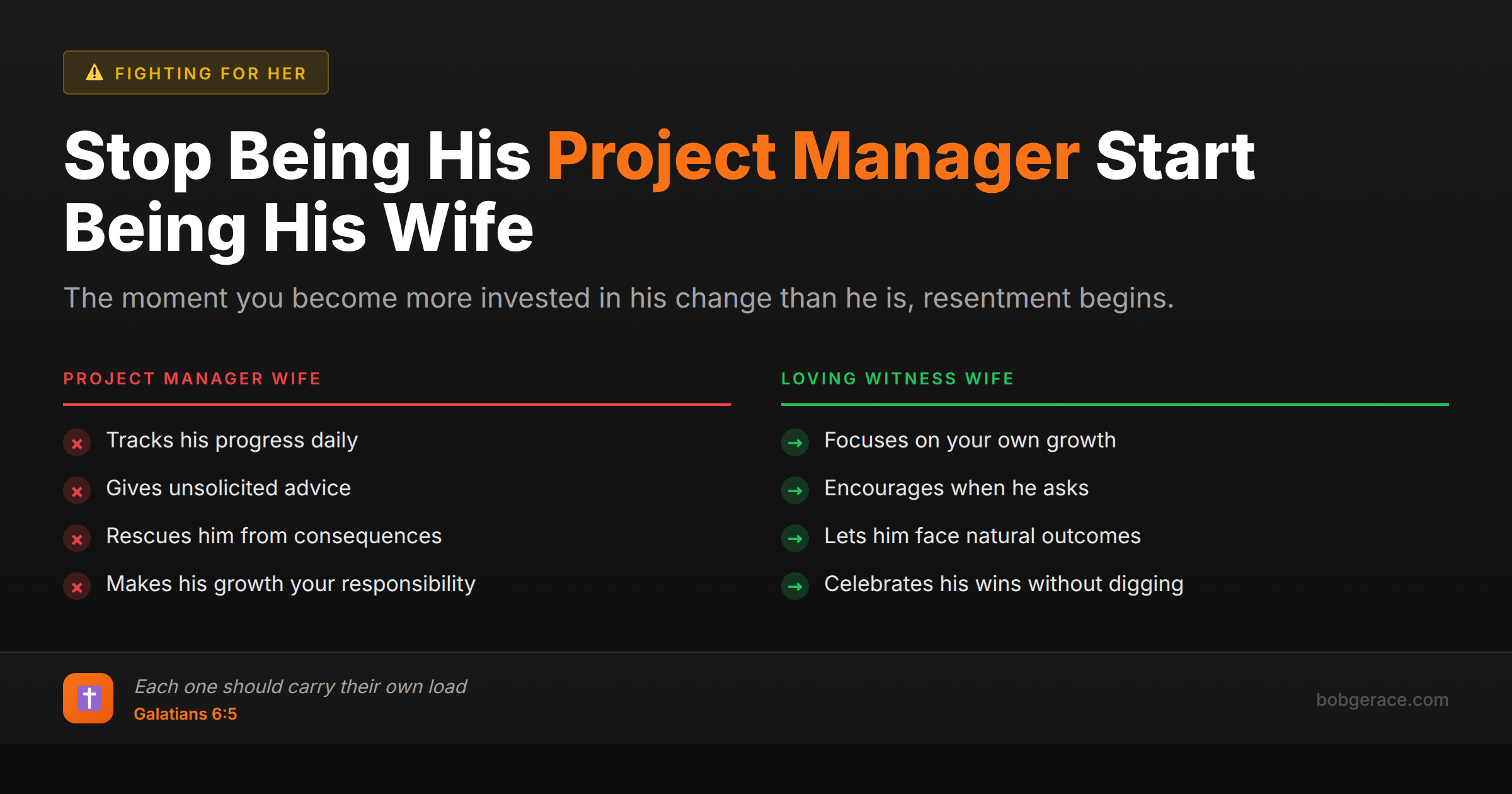
Your involvement in his process should be like a loving witness, not a project manager. You can encourage, pray for him, and celebrate progress, but you cannot do the work for him. The moment you become more invested in his change than he is, you've crossed into unhealthy territory that will breed resentment on both sides. Healthy involvement means being available when he asks for input, maintaining your own growth journey, and refusing to rescue him from the natural consequences of his choices. You're his wife, not his mother or his coach. Your job is to love him, not fix him.
The Full Picture
Here's what I see happening in most marriages: the wife becomes so focused on her husband's need to change that she essentially becomes his unpaid life coach, accountability partner, and progress tracker all rolled into one. This never works.
When you over-function in his process, several destructive things happen. First, you rob him of the opportunity to own his growth. Second, you set yourself up for constant disappointment when he doesn't meet your timeline or expectations. Third, you create a parent-child dynamic that kills intimacy and breeds resentment.
The healthy approach looks different. You stay focused primarily on your own growth while creating space for his. You respond to his efforts with appreciation rather than managing them. You refuse to chase him or cajole him into change.
This doesn't mean you become passive or uninvolved. It means you're involved in the right ways. You pray for him consistently. You notice and affirm positive changes. You maintain your standards and boundaries without trying to control his response to them.
The key distinction is this: Are you supporting his process, or are you trying to drive it? Supporting means you're there when he needs you but you're not pushing, reminding, or managing. Driving means you've made his change your responsibility, which is both exhausting for you and emasculating for him.
Remember, lasting change happens from the inside out, not from external pressure. Your husband needs to want to change more than you want him to change. Your role is to create an environment where change is welcomed and celebrated, not demanded and micromanaged.
What's Really Happening
From a psychological perspective, over-involvement in a spouse's change process often stems from anxiety and a desire for control. When wives become hyper-focused on their husband's transformation, they're usually trying to manage their own emotional dysregulation through his behavior modification.
This creates what we call a 'pursuer-distancer' dynamic. The more she pursues his change, the more he distances himself from the process. It becomes about her agenda rather than his authentic growth, which triggers natural resistance.
Healthy involvement requires emotional differentiation - the ability to stay connected to your spouse while maintaining your own emotional equilibrium. This means you can care about his growth without making it the center of your emotional world.
The most effective support happens when wives maintain what I call 'engaged detachment.' You're emotionally available and encouraging, but you're not emotionally dependent on his progress. This paradoxically creates more safety for him to be vulnerable about his struggles and more motivation for genuine change.
Research consistently shows that intrinsic motivation - change that comes from within - is far more sustainable than extrinsic pressure. When wives step back from managing the process, they often see their husbands step up to own it.
What Scripture Says
Scripture gives us clear guidance about our role in others' transformation. Romans 14:12 reminds us, "So then, each of us will give an account of ourselves to God." Your husband will answer to God for his choices, not to you.
Galatians 6:5 states, "Each one should carry their own load." While we're called to help with burdens (verse 2), we're not called to carry what others should carry themselves. There's a difference between supporting someone and enabling them.
1 Peter 3:1-2 offers powerful insight for wives: "Wives, in the same way submit yourselves to your own husbands so that, if any of them do not believe the word, they may be won over without words by the behavior of their wives, when they see the purity and reverence of your lives." Notice it says "without words" - not through nagging, coaching, or managing.
Philippians 2:12-13 shows us that change is both human effort and divine work: "Work out your salvation with fear and trembling, for it is God who works in you to will and to act in order to fulfill his good purpose." You can't do God's part, and you can't do your husband's part.
Matthew 7:3-5 warns against focusing on others' specks while ignoring our own logs. The healthiest thing you can do for your marriage is often to focus on your own growth and trust God with your husband's.
Proverbs 27:14 even warns that well-intentioned but overwhelming encouragement can backfire: "Whoever blesses their neighbor with a loud voice in the morning will be counted as cursing." Sometimes our 'help' feels like pressure.
What To Do Right Now
-
1
Stop tracking his progress - remove yourself as his accountability partner and let him manage his own commitments
-
2
Focus 80% of your change energy on your own growth and only 20% on encouraging his
-
3
Pray for him daily but resist the urge to share every insight or suggestion that comes to mind
-
4
Celebrate progress when he shares it, but don't go digging for updates or evidence of change
-
5
Maintain your boundaries and standards without lecturing about why they exist or what he should do about them
-
6
Ask yourself daily: 'Am I being his wife or his mother?' and adjust accordingly
Related Questions
- What does 'the work' actually mean?
- What is he doing with his coach?
- Is his program legitimate?
- What should he be learning?
- Should I talk to his coach?
- What can I expect from this process?
- How do I know if he's really changing?
- Is he manipulating me or actually different?
- What are the markers of genuine behavior change?
- What does real transformation look like?
Also find Bob on
Subscribe for weekly videos on Christian marriage.
Not Sure Where Your Line Is?
Every marriage has different dynamics. A coach who knows your specific situation can help you calibrate support without slipping into control.
Talk to Bob →