How should a Christian husband confess porn without self-protection?
5 min read
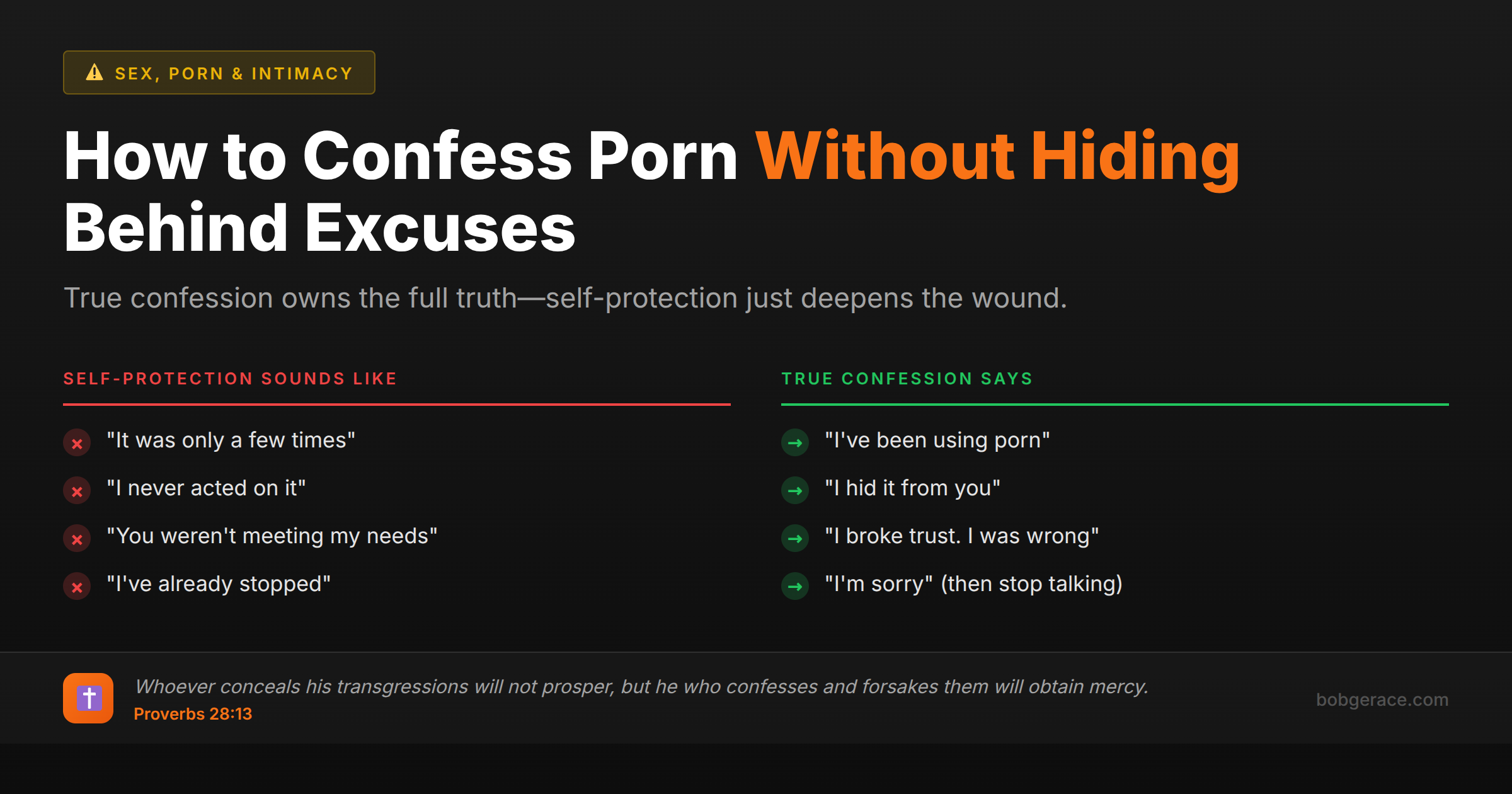
You confess by owning the full truth without minimizing, blaming stress or her, or managing her reaction. Say what you did, how long, and that you were wrong—then stop talking. Don't explain why she shouldn't be as hurt as she is. Don't promise it'll never happen again in the same breath. Let her feel what she feels without rushing her to forgiveness or trying to control the fallout. Self-protection sounds like "it was only a few times," "I never acted on it," "you weren't meeting my needs," or "I've already stopped." True confession sounds like: "I've been using porn. I hid it from you. I broke trust. I was wrong. I'm sorry." Then you sit in the weight of it with her.
Why Self-Protection Kills the Confession
Most Christian men confess porn the way they'd report a minor traffic violation—technically honest but stripped of weight. You admit enough to feel like you came clean, but you frame it to minimize damage. You say "I struggled with some stuff online" instead of "I've been looking at porn." You add "but I've been working on it" before she even processes the betrayal. You explain how hard work has been, how long it's been since you were intimate, how you were trying to stop on your own. Every word after the confession is damage control.
Your wife doesn't just hear the porn. She hears that you hid it. That you lied by omission every day. That you touched her body while secretly feeding your mind on other women. That you led family devotions, prayed over meals, and sat in church while living a double life. The issue isn't just the sin—it's the fracture in reality. She doesn't know what was real anymore.
Self-protection extends the betrayal. When you minimize, you're saying her pain is an overreaction. When you blame circumstances, you're saying you're the victim. When you manage her response, you're still controlling the narrative instead of letting truth land. She needs to see you own it without flinching. That's the first step back toward trust.
The Nervous System of Confession
When you confess, your nervous system wants to escape the shame. It will flood you with the urge to explain, justify, or soften the blow. That's a dorsal vagal shutdown response—your system trying to minimize threat by collapsing the truth into something smaller. You're not lying; you're compressing reality to survive the moment.
Her nervous system, meanwhile, is entering hyperarousal. She's scanning for the full threat. Every hedge you offer, every "but" or "however," signals that you're still hiding something. Her system won't settle until she believes she has the whole picture. If you drip-truth her over weeks, you re-traumatize her each time. One full confession is painful. Ten partial ones are torture.
Self-protection also keeps you in shame instead of moving you toward repentance. Shame says "I am bad." Repentance says "I did wrong and I'm turning." When you confess with spin, you're trying to stay good in her eyes and your own. You're negotiating your identity instead of accepting the truth. But freedom comes when you let the worst thing be said out loud and discover you're still a man who can choose differently tomorrow.
Your wife can't trust you until she sees you trust God enough to tell the truth without a safety net.
Confession Without Fig Leaves
Adam's first move after sin was to hide and then blame. "The woman you gave me—she gave me the fruit." He confessed while pointing everywhere but at himself. God didn't accept it. He required an honest accounting. Confession in Scripture is never self-managed. David said, "I have sinned against the Lord" with no qualifiers (2 Samuel 12:13). The prodigal son said, "I have sinned against heaven and before you; I am no longer worthy" (Luke 15:21). No spin. No context. Just truth.
Proverbs 28:13 says, "Whoever conceals his transgressions will not prosper, but he who confesses and forsakes them will obtain mercy." Notice the order: confess fully, then forsake. Not "I've already forsaken it, so this confession should be easier for you." You don't get to control the mercy timeline.
James 5:16 calls us to "confess your sins to one another." Not your struggles. Not your tendencies. Your sins. To another person. In the body of Christ, we don't get to self-absolve. Your wife is the person you sinned against most directly. She deserves the truth without your editorial commentary. Trust that God is big enough to hold you both in this moment. He doesn't need you to manage the fallout. He needs you to walk in the light.
Action Steps
-
1
Write out the full truth before you speak it—what you did, how long, how often—so you're not figuring it out in real time while she's reacting.
-
2
Confess without clauses: no 'but,' 'however,' 'only,' or 'I think.' Say what happened and stop talking.
-
3
Do not explain why she shouldn't feel devastated. Let her cry, rage, or go silent without trying to fix her emotional response.
-
4
Answer her questions with specifics, even if they're humiliating. Vague answers extend her trauma and make her imagine worse.
-
5
Get a Christian accountability partner or counselor the same week—not to manage her reaction, but to own your own discipleship and repentance process outside the marriage.
Related Questions
Also find Bob on
Subscribe for weekly videos on Christian marriage.
You Don't Have to Navigate This Alone
Confessing porn is the beginning, not the end. Most men need help walking the road from confession to real change and rebuilt trust. I work with Christian husbands every week who are learning to lead with integrity after betrayal.
Talk to Bob →