How do I fight without pushing her away?
5 min read
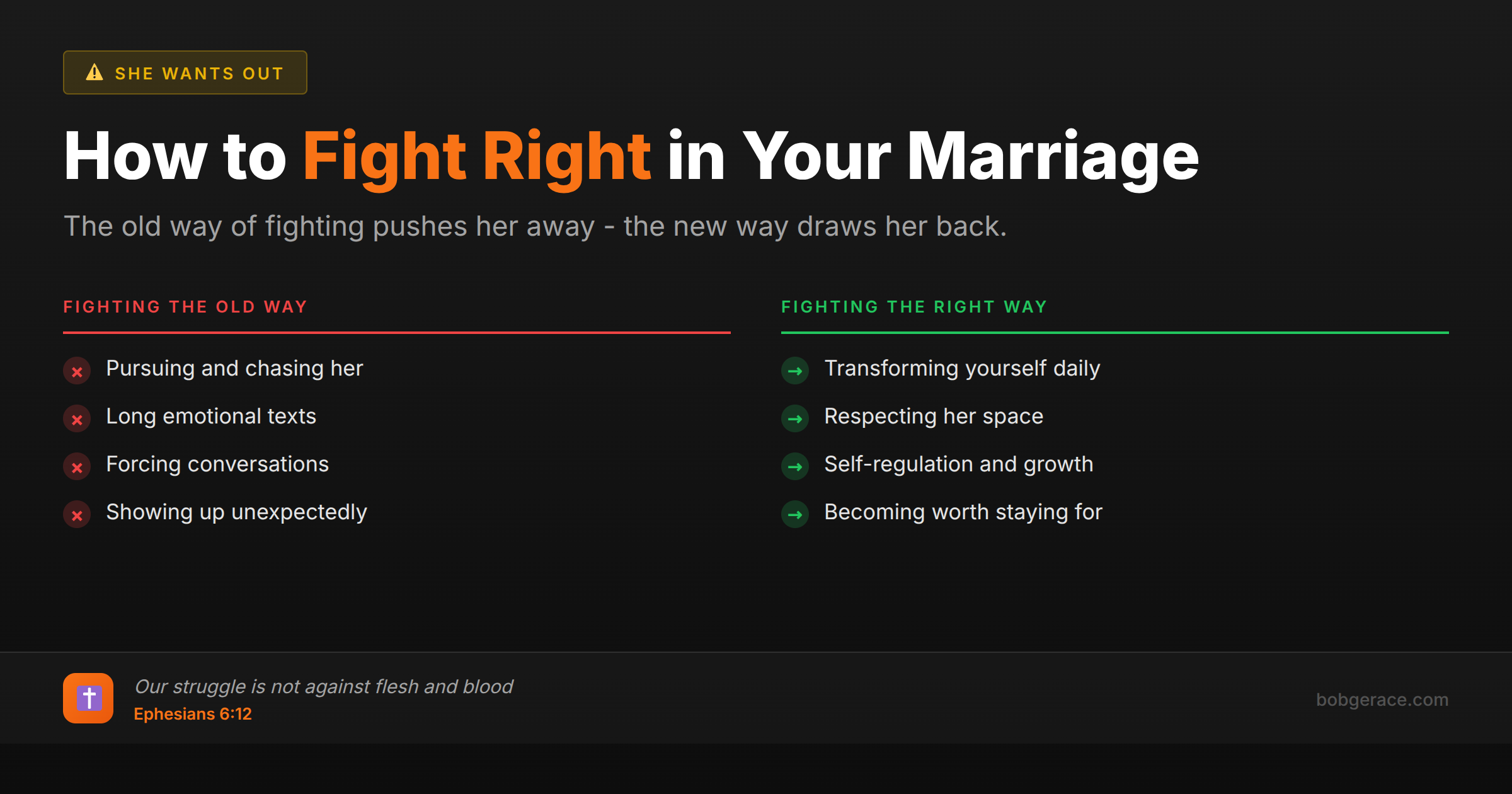
The secret to fighting without pushing her away isn't avoiding conflict—it's changing how you show up in it. Most men make the mistake of trying to win the argument or force immediate resolution, which triggers her flight response. Instead, you need to fight for the relationship, not against her position. Start by lowering your intensity. When she feels attacked or overwhelmed, she'll create distance to protect herself. Focus on understanding her perspective before defending yours. Use phrases like "Help me understand..." instead of "You always..." This shifts you from adversaries to allies working on a problem together. Remember: the goal isn't to be right, it's to stay connected while working through real issues.
The Full Picture
When wives start pulling away, every disagreement feels like a threat to the marriage. You're walking on eggshells, afraid that one wrong move will send her packing. But here's what most men don't realize: avoiding conflict altogether is just as damaging as fighting poorly.
Your wife isn't asking you to become a doormat. She's asking you to become a better fighter. The issue isn't that you disagree—it's how you disagree. Most men approach conflict like a courtroom battle: present evidence, attack weak points, demand a verdict. This might work in business, but it's relationship poison.
Common mistakes that push her away: • Raising your voice to make your point • Bringing up past grievances • Using absolute language ("always," "never") • Trying to solve everything in one conversation • Making it about being right instead of being connected
When she feels cornered or attacked, her nervous system goes into fight-or-flight mode. Since she can't physically overpower you, flight becomes her default response. She shuts down, walks away, or emotionally checks out. This isn't manipulation—it's biology.
Healthy conflict actually builds intimacy when done right. It shows her you can handle her real thoughts and feelings without falling apart or becoming aggressive. It proves you're emotionally mature enough to work through problems together instead of avoiding them or bulldozing through them.
What's Really Happening
From a neurobiological perspective, what you're dealing with is the difference between perceived threat and perceived safety. When conflict feels threatening, the amygdala hijacks rational thinking and activates survival responses.
Research by Dr. John Gottman shows that during heated arguments, partners' heart rates can spike above 100 beats per minute, flooding their systems with stress hormones. At this point, productive communication becomes neurologically impossible. Women, on average, have a stronger startle response and take longer to recover from physiological arousal, which explains why she might need space after an argument.
The Polyvagal Theory helps us understand her withdrawal response. When feeling overwhelmed, her nervous system shifts into a dorsal vagal state—essentially going offline to protect itself. This isn't conscious rejection; it's an autonomic nervous system response to perceived threat.
Secure attachment patterns in conflict involve what we call "repair attempts"—small gestures that de-escalate tension and maintain connection. This might be softening your tone, acknowledging her perspective, or taking a strategic pause. Partners in healthy relationships fight about issues, not about each other's character.
The goal is creating what researchers call "psychological safety"—an environment where both partners can express disagreement without fear of relationship-ending consequences. This requires emotional regulation, empathetic responding, and the ability to separate the problem from the person.
What Scripture Says
Scripture provides clear guidance on navigating conflict while preserving relationship. Proverbs 15:1 tells us, "A gentle answer turns away wrath, but a harsh word stirs up anger." Your tone and approach often matter more than your actual words.
James 1:19 instructs us to be "quick to listen, slow to speak and slow to become angry." This isn't about suppressing legitimate concerns—it's about approaching conflict with wisdom and self-control. When you lead with curiosity instead of defensiveness, you create space for understanding.
Ephesians 4:26-27 says, "In your anger do not sin: Do not let the sun go down while you are still angry, and do not give the devil a foothold." Notice it doesn't say don't be angry—it says don't sin in your anger. There's a difference between righteous frustration about real issues and sinful anger that attacks character.
Matthew 7:3-5 challenges us to examine our own hearts first: "Why do you look at the speck of sawdust in your brother's eye and pay no attention to the plank in your own eye?" Before pointing out her faults, honestly assess your contribution to the problem.
Colossians 3:13 reminds us to "bear with each other and forgive one another if any of you has a grievance against someone." This doesn't mean avoiding difficult conversations, but approaching them with grace and a willingness to extend mercy.
As the spiritual leader of your home, you're called to create an atmosphere where truth can be spoken in love (Ephesians 4:15), not where conflict becomes a battle for dominance.
What To Do Right Now
-
1
Lower your voice and slow your speech when tension rises—she needs to feel emotionally safe to engage
-
2
Start with validation before presenting your perspective—'I can see why you'd feel that way' builds connection
-
3
Use 'I' statements instead of 'you' accusations—focus on your experience rather than her behavior
-
4
Take strategic breaks when emotions escalate—agree on a time to reconvene rather than storming off
-
5
Ask curious questions instead of making statements—'What would help you feel heard?' opens dialogue
-
6
Focus on one issue at a time—resist the urge to bring up everything that's been bothering you
Related Questions
- Should I give her space or fight for her?
- What's the difference between pursuing and chasing?
- What does healthy pursuit look like vs. desperate pursuit?
- How do I show love without activating her withdrawal?
- What's the difference between presence and pressure?
- How do I hold tension without collapsing or attacking?
- What is anxious attachment and am I doing it right now?
- How do I pursue without pressuring?
- What does 'protest behavior' look like and am I doing it?
- How do I not pursue while also not abandoning?
Also find Bob on
Subscribe for weekly videos on Christian marriage.
You Don't Have to Figure This Out Alone
A coach who knows your marriage can help you see what's actually happening in your fights—and what to do differently next time one starts.
Talk to Bob →