What does 'space' actually mean to her?
5 min read
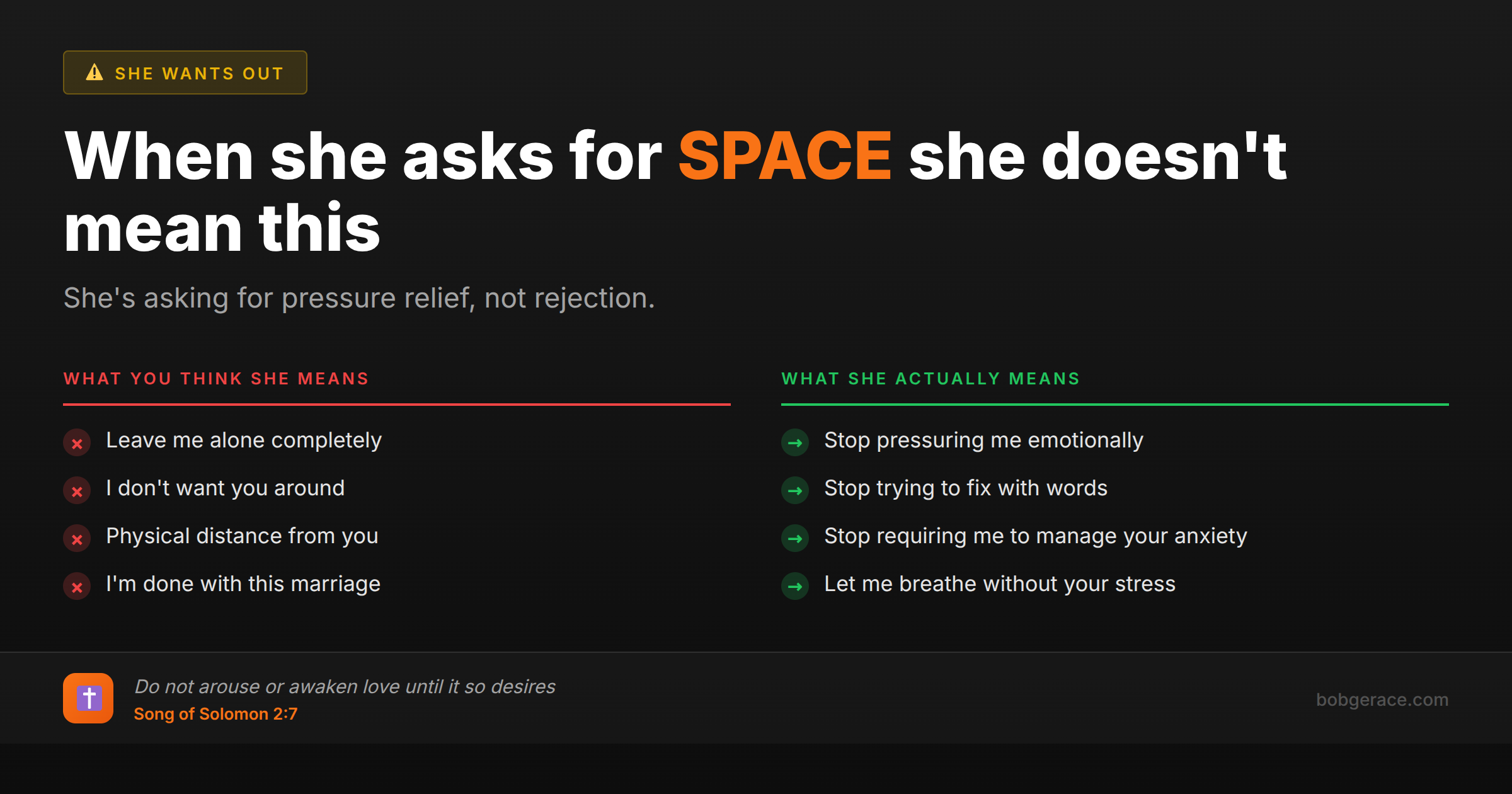
When your wife says she needs 'space,' she's not speaking in code - she's asking for emotional and psychological distance to process her feelings without the pressure of your presence, your questions, or your attempts to fix things. This isn't necessarily about physical separation, though it might include that. She needs room to breathe emotionally, to think clearly without feeling overwhelmed by your intensity or desperation. Space means she wants to stop feeling suffocated by constant relationship conversations, your emotional neediness, or the weight of your expectations. It's her way of saying 'I need to figure out what I'm feeling without you watching my every move or trying to influence the outcome.' The mistake most men make is thinking space means abandonment - it doesn't. It means she's trying to find herself again.
The Full Picture
Space is about emotional regulation, not rejection. Your wife is likely overwhelmed by the emotional intensity of your relationship dynamic right now. When she asks for space, she's essentially saying her nervous system needs to calm down so she can think clearly about what she wants and feels.
Here's what space typically includes: • No constant check-ins or 'how are we doing' conversations • Reduced physical affection or intimacy demands • Time to pursue her own interests without reporting back to you • Freedom from your emotional reactions to her moods or decisions • Room to miss you instead of feeling crowded by your presence
What space is NOT: • Permission for you to shut down completely • An invitation to pursue other women • A guarantee that she's coming back • A test to see how much you'll fight for her
Most men panic when they hear 'space' because they interpret it as the beginning of the end. But often, space is actually her attempt to save the marriage by getting enough emotional distance to remember why she fell in love with you in the first place. When you're constantly in 'fix it' mode, pursuing her, analyzing the relationship, or walking on eggshells, you create an emotionally suffocating environment.
The hard truth: If she's asking for space, you've probably been too intense, too needy, or too focused on the relationship. She needs to experience you as a separate, whole person again - not as someone whose entire emotional state depends on her responses to you.
What's Really Happening
From a psychological perspective, the request for space typically indicates emotional overwhelm and a need for autonomy restoration. Research in attachment theory shows that when one partner becomes overly focused on the relationship, the other often experiences what we call 'engulfment anxiety' - a feeling that their individual identity is being consumed by the partnership.
The space request is actually a healthy self-preservation mechanism. Your wife's nervous system is likely in a state of chronic activation from relationship stress, and space allows her parasympathetic nervous system to engage - the 'rest and digest' response that enables clear thinking and emotional regulation.
Studies on relationship dynamics show that pursuit-distance cycles often develop when one partner's anxiety increases their need for connection while simultaneously pushing the other partner toward withdrawal. The more intensely you pursue emotional connection when she's overwhelmed, the more space she'll need.
Neurologically, when someone feels emotionally suffocated, their brain's threat detection system (amygdala) becomes hyperactive, making it difficult to access the prefrontal cortex where love, appreciation, and positive memories are processed. Space literally allows her brain to shift out of survival mode.
The key clinical insight here is that honoring her need for space, rather than fighting it, often leads to faster relationship repair. When the pursuing partner steps back and focuses on their own emotional regulation, it creates the psychological safety the withdrawing partner needs to reconnect. This isn't manipulation - it's understanding how human attachment systems actually work under stress.
What Scripture Says
Scripture speaks directly to the need for emotional and physical space in relationships. Ecclesiastes 3:1 reminds us that 'To every thing there is a season, and a time to every purpose under the heaven.' This includes seasons of closeness and seasons of individual growth within marriage.
1 Corinthians 7:5 acknowledges that even married couples may need temporary separation for spiritual purposes: 'Defraud ye not one the other, except it be with consent for a time, that ye may give yourselves to fasting and prayer; and come together again.' While this specifically addresses physical intimacy, the principle applies to emotional space as well.
Philippians 2:3-4 calls us to 'Let nothing be done through strife or vainglory; but in lowliness of mind let each esteem other better than themselves. Look not every man on his own things, but every man also on the things of others.' When your wife asks for space, honoring that request demonstrates you esteem her needs above your own comfort.
Proverbs 27:14 warns that 'He that blesseth his friend with a loud voice, rising early in the morning, it shall be counted a curse to him.' Even good intentions can become overwhelming when poorly timed or excessive. Your attempts to love and reconnect may feel like a curse if she's not in a place to receive them.
1 Peter 3:7 instructs husbands to dwell with their wives 'according to knowledge, giving honour unto the wife.' True biblical love requires understanding what your wife actually needs right now, not what you think she should need. Giving her space when she asks for it is an act of biblical submission to God's design for sacrificial love.
What To Do Right Now
-
1
Stop asking her how she's feeling about the relationship or when she'll know what she wants
-
2
Give her actual physical and emotional space - no hovering, checking in, or analyzing her behavior
-
3
Focus on your own emotional regulation and personal growth instead of monitoring her responses
-
4
Maintain normal household responsibilities and pleasant interactions without being needy
-
5
Use this time to address the behaviors and patterns that created her need for space
-
6
Trust that space is not abandonment and resist the urge to pursue or convince her of anything
Related Questions
- Should I give her space or fight for her?
- How much space is too much?
- If I give space, won't she think I don't care?
- When does giving space become abandonment?
- She asked for space — can I still text?
- Why does her nervous system need space from me?
- What is 'deactivation' and did I cause it?
- What does 'dorsal vagal shutdown' look like in marriage?
- How do I pursue without pressuring?
- What boundaries should I set?
Also find Bob on
Subscribe for weekly videos on Christian marriage.
You Don't Have to Navigate This Alone
A coach who knows your marriage can help you read what she actually needs right now—and what moves keep the door open versus pushing her further away.
Talk to Bob →