How do I protect myself without escalating?
6 min read
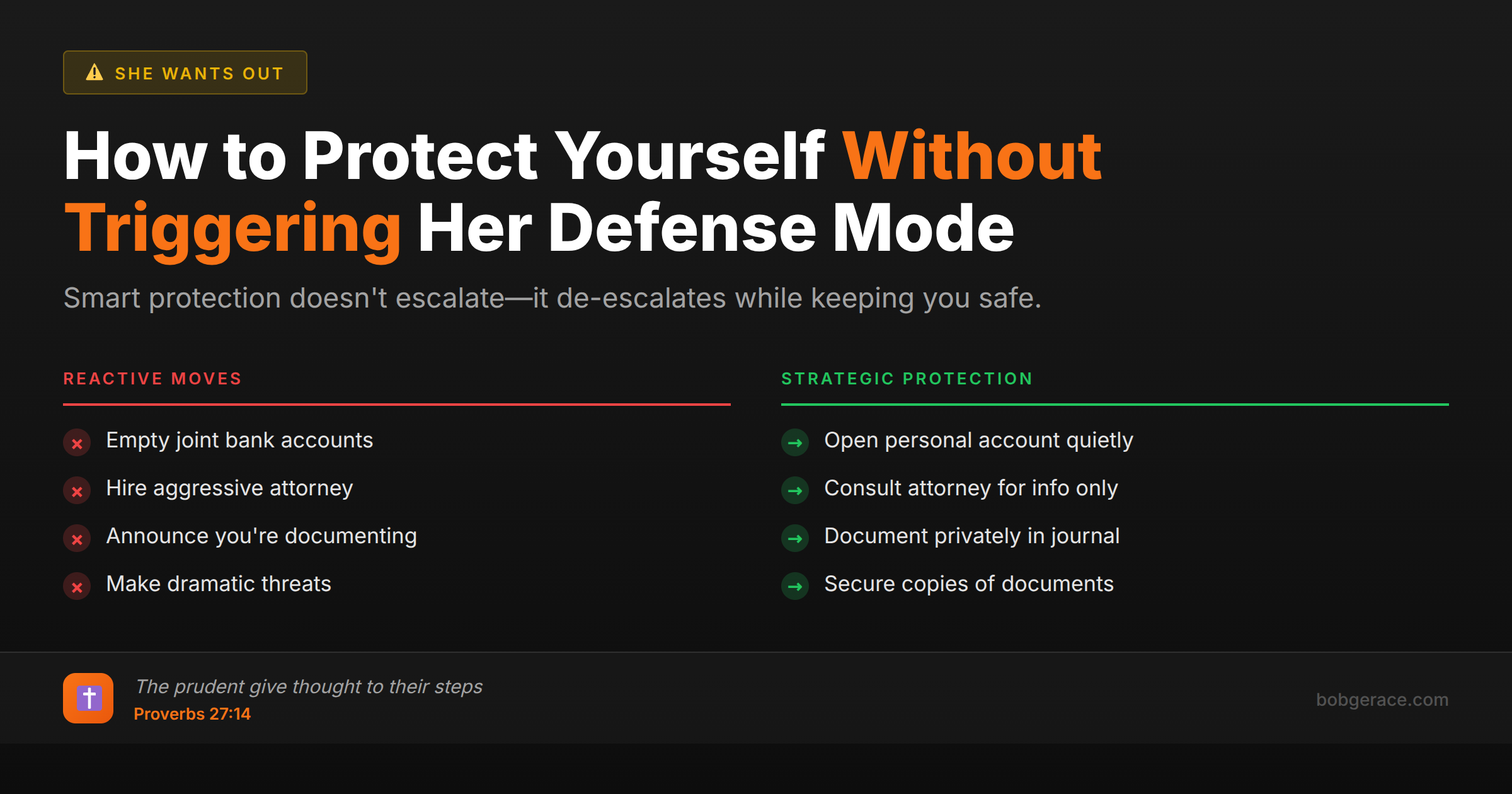
The key to protecting yourself without escalating is to take quiet, strategic action rather than reactive moves that signal threat to your wife. Start by documenting everything - conversations, incidents, financial changes - but don't announce it. Secure copies of important documents and open your own bank account, but avoid dramatic gestures like emptying joint accounts or hiring an aggressive attorney. Think of this like defusing a bomb rather than preparing for war. Every protective step you take should be invisible to your wife or, if visible, framed as responsible planning rather than adversarial positioning. The moment she feels you're "lawyering up" or preparing to fight, her own defenses go up and reconciliation becomes much harder. Protection and de-escalation aren't opposites - they're two sides of wise stewardship during crisis.
The Full Picture
Most men facing separation make the critical error of choosing between two extremes: complete passivity (hoping everything will work out) or aggressive protection (preparing for battle). Both approaches backfire spectacularly.
The passive approach leaves you vulnerable to sudden legal actions, financial moves, or custody issues you never saw coming. I've watched too many good men wake up to find joint accounts emptied, credit cards maxed out, or restraining orders filed based on twisted versions of arguments.
The aggressive approach is equally destructive. When you hire the most combative attorney in town, start moving money around, or begin building a case against your wife, you're essentially declaring war. She'll respond by fortifying her own position, and any chance of reconciliation dies in the crossfire.
The third way is strategic protection - taking necessary steps to safeguard your interests while maintaining the emotional and relational space needed for potential healing. This means:
• Documentation without investigation - Keep records of important conversations and events, but don't hire private investigators or start building a dossier against your wife • Financial awareness without financial warfare - Monitor accounts and protect credit, but avoid dramatic moves that signal distrust • Legal consultation without legal escalation - Understand your rights and options without immediately exercising them • Boundary setting without ultimatums - Protect your emotional and physical wellbeing without issuing threats
Remember, every action you take sends a message about your intentions. Are you signaling that you want to work things out, or that you're preparing for the inevitable end? The way you protect yourself can either preserve hope or destroy it entirely.
What's Really Happening
From a therapeutic standpoint, the challenge here lies in managing what psychologists call the security dilemma - the same actions taken to increase your own security can inadvertently threaten your partner's sense of safety, leading to an escalating cycle of defensive behaviors.
Research in conflict resolution shows that during marital crisis, partners often interpret protective behaviors through the lens of negative attribution bias - assuming the worst possible motives behind their spouse's actions. When a wife is already considering separation, she's hypervigilant for signs that confirm her decision is correct. Overtly protective or defensive moves can be interpreted as evidence of hidden aggression, financial deception, or emotional manipulation.
The neurobiological reality is that both partners are likely operating from activated threat detection systems. The amygdala is heightened, rational thinking is compromised, and everything gets filtered through a survival lens. In this state, even reasonable protective measures can trigger fight-or-flight responses.
Effective de-escalation requires what I call "transparent protection" - taking necessary steps while maintaining open communication about your intentions. This might sound like: "I'm opening a separate account so I can manage my business expenses more easily" rather than simply moving money without explanation.
The key insight is that security doesn't come from secrecy or superior positioning - it comes from predictability and clear communication. When your partner can understand and even validate your protective measures, they're less likely to interpret them as threats. This requires tremendous emotional regulation and the ability to think strategically rather than reactively during intense stress.
What Scripture Says
Scripture provides a framework for wise protection that doesn't compromise our call to love and reconciliation. Proverbs 27:14 reminds us that "The simple believe anything, but the prudent give thought to their steps." Being prudent isn't unfaithful - it's wise stewardship.
Luke 14:28-30 teaches about counting the cost before building: "Suppose one of you wants to build a tower. Won't you first sit down and estimate the cost to see if you have enough money to complete it?" This applies to protecting yourself during marital crisis - wise planning is biblical responsibility.
However, this must be balanced with 1 Corinthians 13:5, which tells us that love "does not dishonor others, it is not self-seeking, it is not easily angered, it keeps no record of wrongs." Your protective measures should reflect love's character - not seeking to harm or gain unfair advantage.
Matthew 10:16 gives us the perfect framework: "Be as shrewd as snakes and as innocent as doves." Shrewdness means understanding the realities you face and taking appropriate precautions. Innocence means your heart remains pure - you're protecting yourself for restoration, not for retaliation.
Proverbs 15:1 reminds us that "A gentle answer turns away wrath, but a harsh word stirs up anger." Even your protective actions should carry a gentle spirit. When your wife asks about a document you've copied or an account you've opened, your response can either escalate or de-escalate the situation.
Finally, Romans 12:18 calls us to "If it is possible, as far as it depends on you, live at peace with everyone." Your protection should serve peace, not war. Every step you take should be one that you could explain to Jesus without shame - motivated by wisdom and love, not fear and revenge.
What To Do Right Now
-
1
Document important conversations and incidents in a private journal, focusing on facts rather than interpretations
-
2
Secure copies of financial documents, tax returns, and important papers without removing originals
-
3
Consult with an attorney to understand your rights, but explicitly state you're seeking information, not immediate action
-
4
Open a personal checking account for your income while maintaining joint accounts for shared expenses
-
5
Install credit monitoring to protect against unexpected financial changes or identity issues
-
6
Create a support network of trusted friends who can provide counsel and accountability for your decisions
Related Questions
- What should I know before agreeing to anything?
- How does moving out affect my legal position?
- What do I document?
- Should I get a lawyer now or wait?
- What financial protections should I put in place?
- How do I protect assets without being aggressive?
- What boundaries should I set?
- What's the difference between boundary and ultimatum?
- What evidence should I secure?
- How do I not lose my mind right now?
Also find Bob on
Subscribe for weekly videos on Christian marriage.
You Don't Have to Guess Alone
A coach who knows your marriage can help you protect yourself without triggering her defenses. Bob's worked with hundreds of men in this exact position.
Talk to Bob →