What should I know before agreeing to anything?
6 min read
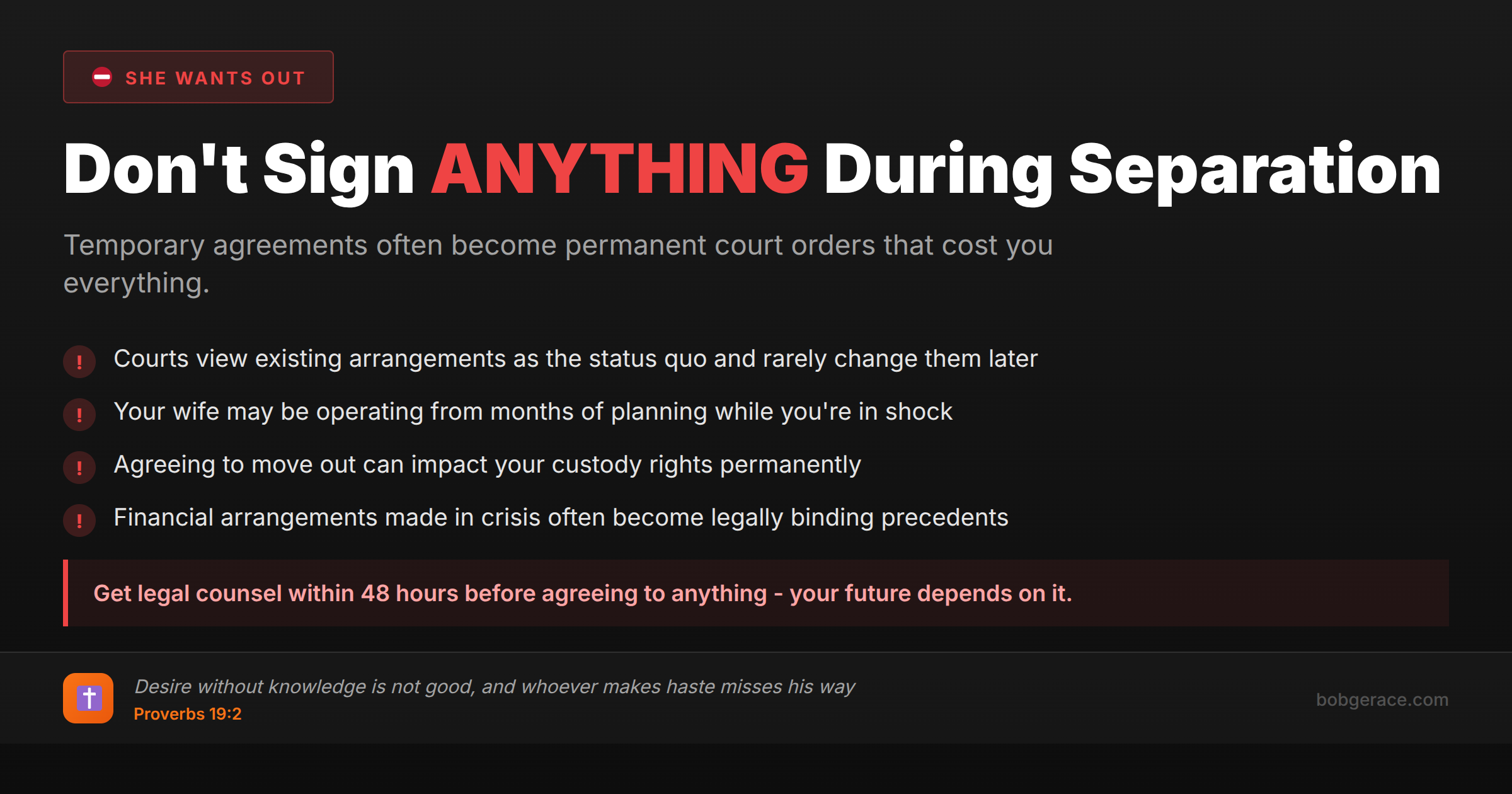
Stop. Before you sign anything or agree to any terms, you need to understand that decisions made during separation often become permanent in divorce proceedings. Your wife may be operating from a place of clarity and planning, while you're likely in shock and willing to agree to anything to save your marriage. This imbalance can cost you your home, your children, and your financial future. The harsh reality is that many men agree to temporary arrangements that feel reasonable in the moment but become legally binding precedents. Courts often view existing arrangements as the status quo, making them difficult to change later. You need time, information, and wise counsel before making any commitments.
The Full Picture
The Danger of Reactive Decisions
When your wife announces she wants a separation, your instinct is to agree to anything that might prevent her from leaving permanently. This is exactly when you're most vulnerable to making agreements that will haunt you for years. Legal separation agreements often address custody, support, property division, and living arrangements – decisions with profound long-term consequences.
What Courts Actually Consider
Judges pay close attention to established patterns. If you agree to see your children every other weekend during separation, the court may view this as evidence that such an arrangement works. If you move out and continue paying all household expenses while covering your own living costs, this becomes the financial baseline. These "temporary" arrangements have a way of becoming permanent.
The Information Imbalance
Often, the spouse initiating separation has been thinking, planning, and possibly consulting attorneys for months. Meanwhile, you're hearing about separation for the first time and expected to make immediate decisions. This is like being asked to negotiate a business deal when the other party has done months of research and you haven't seen the contract.
Your Rights vs. Your Desire to Reconcile
The tension here is real – asserting your legal rights might feel like giving up on your marriage. But protecting yourself legally doesn't mean abandoning hope for reconciliation. It means ensuring that if reconciliation doesn't happen, you haven't sacrificed your ability to be a present father or maintain financial stability.
What's Really Happening
From a psychological standpoint, the spouse requesting separation typically experiences what we call "emotional divorce" long before the legal process begins. Research by Dr. John Gottman shows that women, in particular, often mentally and emotionally disengage from the relationship months or even years before expressing their desire to separate. This creates a significant psychological imbalance during initial negotiations.
The pursuing spouse – usually the husband in these situations – operates from what attachment theory identifies as "protest behaviors." You're likely experiencing panic, desperation, and a willingness to sacrifice almost anything to prevent abandonment. This psychological state makes objective decision-making nearly impossible. Your nervous system is in survival mode, prioritizing immediate relief over long-term consequences.
Neurobiologically, acute stress floods your system with cortisol, which impairs executive function and rational thinking. The prefrontal cortex, responsible for planning and weighing consequences, literally goes offline during high-stress situations. This is why decisions made during crisis often feel foreign to us later – we weren't operating from our full cognitive capacity.
Therapeutic research also shows that power imbalances during separation negotiations can perpetuate unhealthy relationship dynamics. If you consistently accommodate and sacrifice during marriage, you're likely to continue this pattern during separation unless you consciously intervene. Taking time to make informed decisions isn't selfish – it's necessary for your psychological health and models healthy boundaries for your children.
What Scripture Says
Scripture consistently emphasizes the importance of wisdom and counsel in decision-making. Proverbs 19:2 tells us, "Desire without knowledge is not good, and whoever makes haste with his feet misses his way." Rushing into agreements without understanding their implications violates this principle of patient, informed decision-making.
Proverbs 27:14 reminds us, "Plans fail for lack of counsel, but with many advisers they succeed." God designed us to need community and wise counsel, especially during life's most difficult decisions. Isolating yourself or making unilateral decisions during separation goes against this biblical model.
The concept of stewardship also applies here. 1 Corinthians 4:2 states, "It is required of stewards that they be found faithful." You are a steward of your children's need for their father, your own calling and gifts, and the resources God has entrusted to you. Agreements that unnecessarily compromise your ability to fulfill these stewardships may not align with faithful stewardship.
Luke 14:28 asks, "For which of you, desiring to build a tower, does not first sit down and count the cost, whether he has enough to complete it?" Jesus advocates for careful consideration of consequences before making commitments. This principle applies to separation agreements – you need to count the cost before agreeing to terms.
Finally, Matthew 10:16 instructs us to be "wise as serpents and innocent as doves." Wisdom includes understanding legal realities and protecting your ability to love and provide for your family. Being loving doesn't mean being naive about legal consequences.
What To Do Right Now
-
1
Refuse to sign anything immediately – tell your wife you need time to process and understand any proposed agreements
-
2
Consult with a family law attorney within 48 hours to understand your rights and local laws regarding separation
-
3
Document your current involvement with your children, including daily routines, school activities, and care responsibilities
-
4
Gather all financial documents including bank statements, tax returns, investment accounts, and debt information
-
5
Create a temporary budget showing what you can realistically afford for support while maintaining your own living situation
-
6
Identify at least two trusted friends or family members who can provide objective counsel during this process
Related Questions
- She wants separation — should I agree?
- Should I move out if she asks?
- How does moving out affect my legal position?
- What do I document?
- Should I get a lawyer now or wait?
- What financial protections should I put in place?
- What boundaries should I set?
- What's the difference between boundary and ultimatum?
- What evidence should I secure?
- What do I do about finances immediately?
Also find Bob on
Subscribe for weekly videos on Christian marriage.
Don't Sign Anything Without a Coach
You're in shock. She's been planning. Bob's worked hundreds of separations—he'll tell you what you're actually agreeing to before it's permanent.
Talk to Bob →