What's the difference between separation and divorce legally?
5 min read
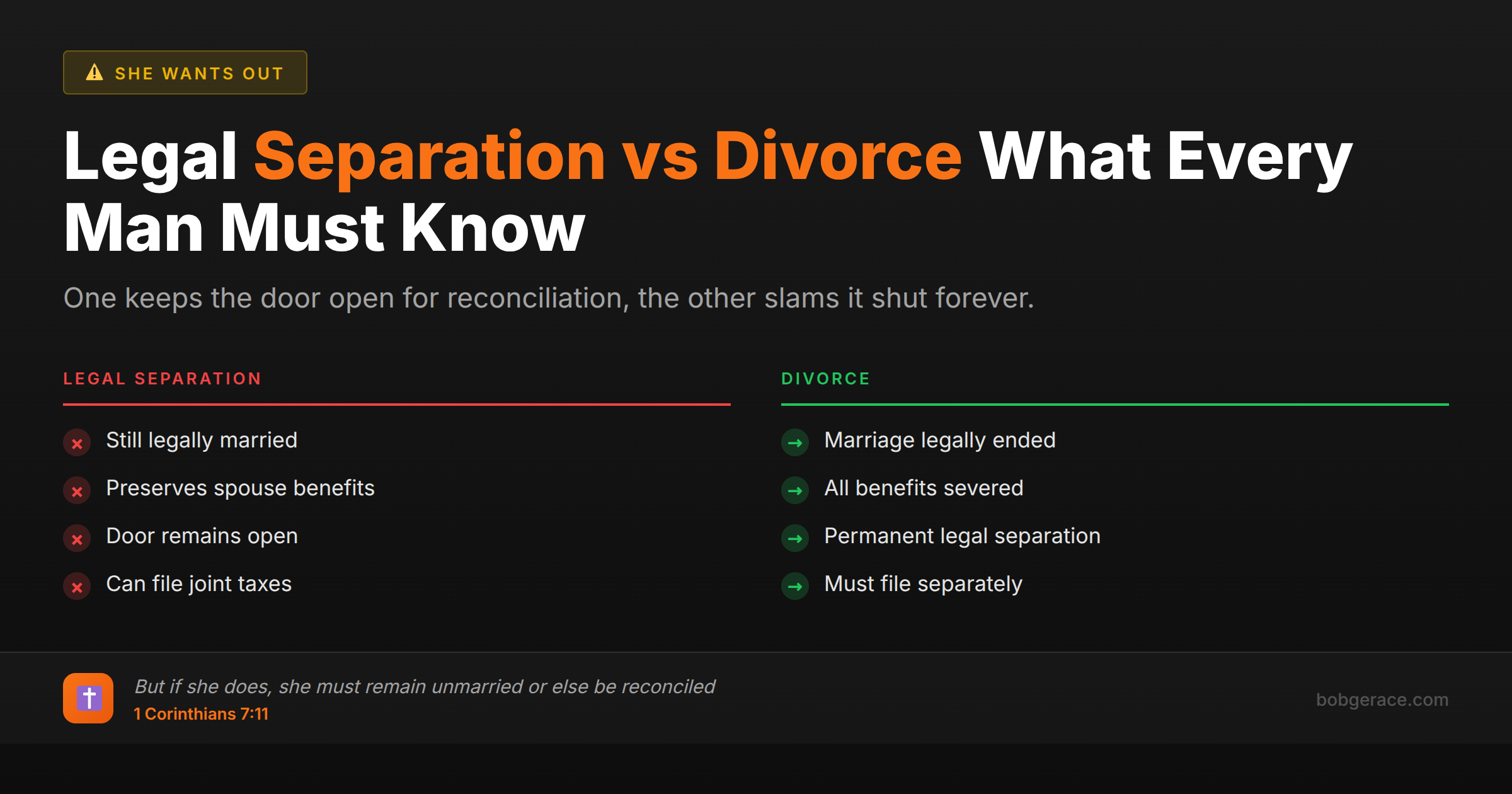
Legal separation means you're still married but living apart with court-approved arrangements for finances, custody, and property. Divorce legally ends your marriage entirely. Here's what matters most: separation preserves your legal status as spouses while establishing boundaries, while divorce severs that bond permanently. The biggest difference? Separation leaves the door open. You're still legally married, which affects everything from taxes to medical decisions to inheritance rights. With divorce, those legal ties are cut. Many men don't realize that separation can actually protect both spouses financially while creating space to work on the marriage. It's not giving up - it's buying time with legal structure.
The Full Picture
Legal separation is a formal court process that allows married couples to live apart while remaining legally married. Think of it as structured space with legal protections. The court establishes rules for child custody, spousal support, property division, and debt responsibility - but you're still married in the eyes of the law.
Divorce, on the other hand, legally terminates the marriage entirely. Once finalized, you're single again with no legal obligations to each other beyond court-ordered support or custody arrangements.
Key Legal Differences:
• Remarriage Rights: You cannot remarry during separation, but you can after divorce • Tax Filing: Separated couples can still file jointly; divorced couples cannot • Medical Decisions: Separated spouses retain medical decision-making rights • Social Security/Benefits: Separation preserves spousal benefit eligibility • Insurance Coverage: Many policies continue to cover separated spouses • Inheritance Rights: Separated spouses can still inherit; divorced spouses typically cannot
Common mistake: Many men think separation is just "practice divorce." Wrong. Separation can be a strategic tool for marriage restoration. It creates safety and structure while preserving the legal marriage bond. Some couples use separation to work through issues without the pressure of impending divorce.
The financial reality: Separation often costs less initially than divorce, but maintaining two households is expensive either way. However, separation preserves certain financial benefits that divorce eliminates permanently.
What's Really Happening
From a psychological standpoint, the decision between separation and divorce often reflects the emotional state of the marriage rather than purely practical considerations. Research shows that couples who choose legal separation first have a 20-30% reconciliation rate, compared to those who file directly for divorce.
Separation provides what we call 'therapeutic space.' It removes the daily friction that escalates conflict while maintaining the psychological safety net of still being married. This can reduce anxiety for both spouses and allow healing to begin. Many women who demand divorce are actually asking for relief from chaos - separation can provide that relief.
However, separation without intentional work toward reconciliation often becomes a prolonged path to divorce. The couple gets comfortable with the arrangement and gradually detaches emotionally. The key factor is whether both spouses view separation as an opportunity for restoration or simply a gentler way to transition out of marriage.
Neurobiologically, the stress of marital conflict creates a hypervigilant state in both partners. Separation can allow the nervous system to regulate, making rational decision-making possible again. This is why many couples report clarity during separation periods.
For men specifically, separation often provides the wake-up call needed to address behaviors that contributed to marital breakdown. The reality of potential permanent loss can motivate change in ways that years of conflict couldn't accomplish. Research indicates that men who use separation time for genuine self-improvement and therapeutic work have higher rates of successful reconciliation.
What Scripture Says
Scripture addresses separation and divorce with both grace and gravity. 1 Corinthians 7:10-11 provides clear guidance: *"To the married I give this command (not I, but the Lord): A wife must not separate from her husband. But if she does, she must remain unmarried or else be reconciled to her husband. And a husband must not divorce his wife."* This passage acknowledges that separation happens while emphasizing reconciliation as the goal.
Malachi 3:16 reminds us of God's heart: *"'I hate divorce,' says the Lord God of Israel."* This doesn't mean God hates divorced people - it means He grieves the breaking of covenant relationships because He knows the pain it causes.
Matthew 19:3-9 shows Jesus addressing divorce, emphasizing that *"what God has joined together, let no one separate."* However, He also acknowledges that some situations become untenable due to hardness of heart.
The biblical principle is clear: marriage is a covenant meant to reflect Christ's relationship with the church (Ephesians 5:25-33). Separation can be a tool for covenant restoration rather than covenant breaking. 1 Peter 3:7 calls husbands to live with wives "in an understanding way," which sometimes means creating space for healing.
Practically, this means: If separation is necessary, approach it as covenant protection rather than covenant abandonment. Use the time for genuine repentance, growth, and restoration. Hosea's pursuit of Gomer (Hosea 1-3) demonstrates that even when separation occurs due to unfaithfulness, love continues to pursue reconciliation.
What To Do Right Now
-
1
Consult with a family law attorney to understand your state's specific separation laws and requirements
-
2
Document all assets, debts, and income sources before any legal proceedings begin
-
3
Research whether your state recognizes legal separation or only informal separation agreements
-
4
Calculate the costs of maintaining two households versus pursuing divorce proceedings
-
5
Determine if separation allows you to retain important benefits like health insurance or tax advantages
-
6
Establish clear goals for what you hope to accomplish during a separation period
Related Questions
- She wants separation — should I agree?
- Should I move out if she asks?
- How does moving out affect my legal position?
- What should I know before agreeing to anything?
- Is trial separation ever a good idea?
- What are the rules of separation?
- What does Scripture say about divorce?
- Does the Bible address separation specifically?
- What boundaries should I set?
- How do I protect myself legally without being adversarial?
Also find Bob on
Subscribe for weekly videos on Christian marriage.
Your Marriage Isn't a Legal Question
You know the legal difference now. What you need is someone who knows your specific situation—what led here, what you actually want, whether separation buys you time or just delays the inevitable.
Talk to Bob →