How do I remain married in my heart when we live apart?
5 min read
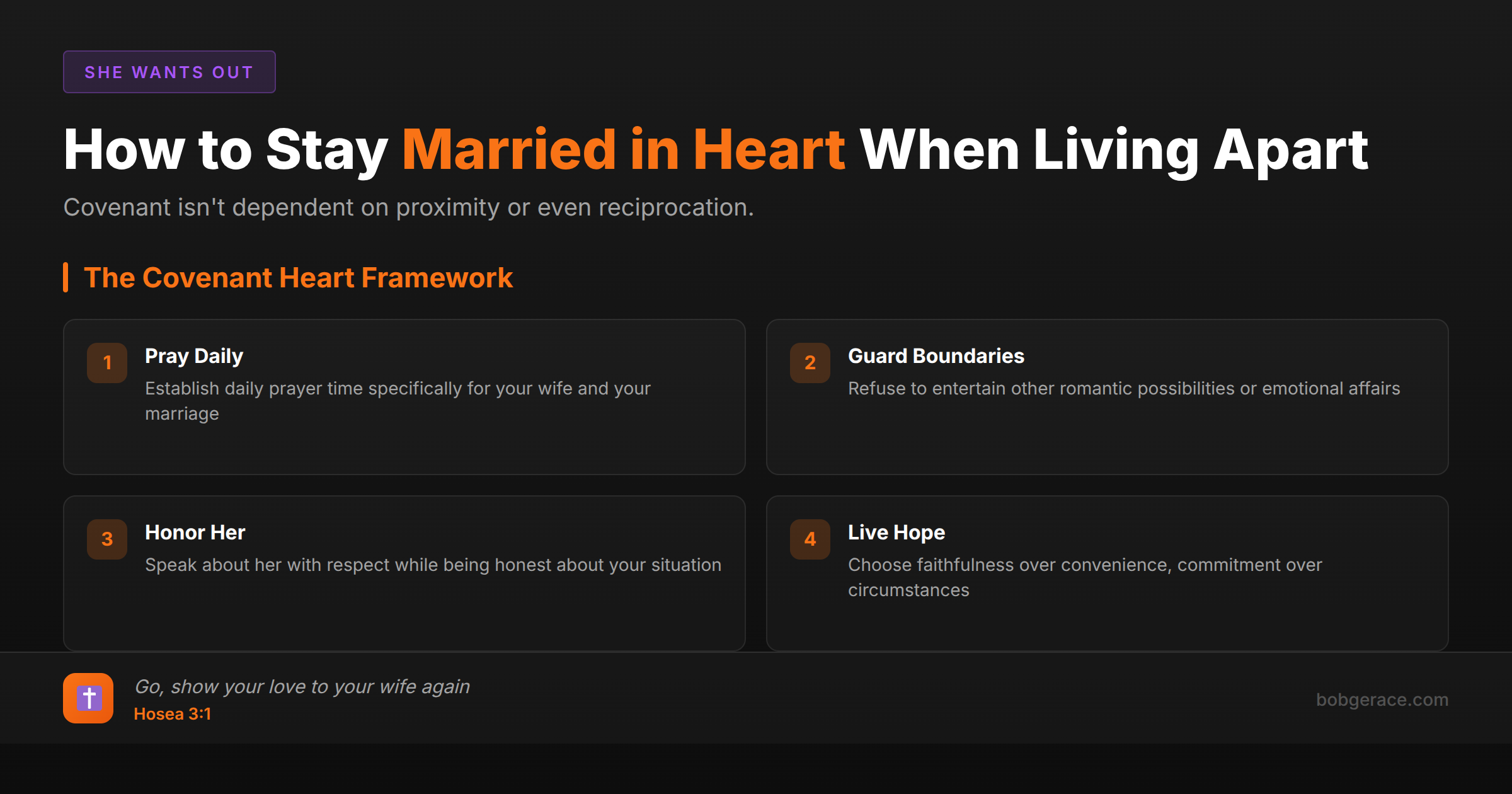
Remaining married in your heart during separation means honoring your covenant daily through intentional choices, not just feelings. This isn't about pretending everything's fine or living in denial. It's about maintaining the spiritual and emotional posture of a married man even when your wife isn't under the same roof. The key is understanding that covenant isn't dependent on proximity or even reciprocation. You remain married in your heart by continuing to pray for her, by refusing to entertain other romantic possibilities, by speaking about her with respect, and by living as though reconciliation is your goal. This doesn't mean being a doormat or ignoring reality—it means choosing faithfulness over convenience, hope over bitterness, and commitment over circumstances.
The Full Picture
Physical separation creates a unique challenge that most men aren't prepared for. You're still legally married, but emotionally you're in limbo. This tension can either destroy your sense of commitment or deepen it in ways you never imagined.
The mistake most men make is thinking that remaining married in their heart means:
• Pretending the separation isn't real or minimizing its impact • Waiting passively for her to come back while doing nothing to change • Living in constant emotional turmoil because they can't "turn off" their feelings • Isolating themselves from friends and family out of shame
The reality is more nuanced. Remaining married in your heart is an active choice that requires daily discipline. It means maintaining the posture of a husband without the daily interactions of marriage. You're choosing to honor a covenant that feels one-sided right now.
This involves practical decisions: How do you talk about your wife to others? Do you still wear your ring? How do you handle holidays and social events? Do you date? These aren't just practical questions—they're covenant questions that reveal what you truly believe about marriage.
The goal isn't to live in denial but to live in hope grounded in commitment. You acknowledge the reality of separation while refusing to let that reality change your fundamental identity as a married man. This position actually gives you strength and clarity during an incredibly confusing time.
What's Really Happening
From a psychological perspective, separation creates what we call ambiguous loss—you're grieving someone who is still alive but no longer present in your daily life. This type of loss is particularly difficult because there's no clear closure or defined grieving process.
Attachment theory helps us understand what's happening in your heart. When the primary attachment bond is disrupted through separation, your nervous system goes into a state of chronic activation. You're literally wired to seek reconnection, which explains why separation feels so physically and emotionally painful.
The concept of remaining married in your heart engages what psychologists call cognitive consistency—aligning your behaviors and thoughts with your stated values. When you consciously choose to maintain your identity as a married man, you're creating psychological coherence that actually reduces anxiety and depression.
Research on commitment shows that people who maintain their commitments during difficult periods experience better mental health outcomes than those who abandon them. However, this only works when the commitment is freely chosen rather than imposed by guilt or external pressure.
The key is developing what we call differentiation—the ability to maintain your sense of self and your values regardless of your wife's choices or presence. This isn't emotional detachment; it's emotional maturity. You can love her, miss her, and want reconciliation while still maintaining your own psychological stability and sense of purpose.
What Scripture Says
Scripture provides a clear framework for covenant commitment that transcends circumstances. Malachi 2:16 reminds us that God hates divorce, not because He wants people to suffer, but because He understands the sacred nature of covenant.
Hosea's relationship with Gomer provides the most powerful biblical example of remaining married in heart during separation. Hosea 3:1 says, "Go, show your love to your wife again, though she is loved by another man and is an adulteress. Love her as the Lord loves the Israelites." Hosea maintained his covenant commitment even when Gomer was physically and emotionally unfaithful.
1 Corinthians 7:10-11 addresses separation directly: "To the married I give this command (not I, but the Lord): A wife must not separate from her husband. But if she does, she must remain unmarried or else be reconciled to her husband. And a husband must not divorce his wife." This passage acknowledges that separation happens while maintaining the covenant framework.
Romans 12:18 offers wisdom for the practical aspects: "If it is possible, as far as it depends on you, live at peace with everyone." You control your part of the equation—your attitudes, actions, and commitment to the covenant.
Ephesians 5:25 calls husbands to "love your wives, just as Christ also loved the church and gave Himself for her." Christ's love wasn't conditional on the church's response or proximity—it was a covenant commitment that endured separation, rejection, and even betrayal.
These passages don't promise easy solutions, but they provide a foundation for maintaining covenant commitment regardless of circumstances.
What To Do Right Now
-
1
Establish daily prayer time specifically for your wife and your marriage, asking God for her heart and your own transformation
-
2
Create boundaries around dating, romantic relationships, or emotional affairs—make a clear decision and communicate it to trusted friends
-
3
Develop a consistent way to speak about your wife that honors your covenant while being honest about your situation
-
4
Schedule regular times to evaluate your own growth and changes rather than focusing solely on what she needs to do
-
5
Connect with other men who can support your commitment while holding you accountable for your own behavior
-
6
Write out your covenant commitment in practical terms and review it weekly to stay anchored to your values
Related Questions
- Should I give her space or fight for her?
- What does faithfulness look like when we're apart?
- She wants separation — should I agree?
- How do I honor her request while honoring my vows?
- Am I enabling divorce by agreeing to separation?
- Is agreeing to separation the same as agreeing to divorce?
- What does biblical forgiveness require of me?
- How do I pray when I'm angry at God?
- What does surrendered prayer look like?
- How do I love my enemy when he's sleeping with my wife?
Also find Bob on
Subscribe for weekly videos on Christian marriage.
Separation Needs a Coach Who Knows Your Story
Living apart changes everything about how you stay faithful. A coach who knows your specific situation can help you hold covenant without losing yourself.
Talk to Bob →