How do I know if my wife is emotionally checked out?
6 min read
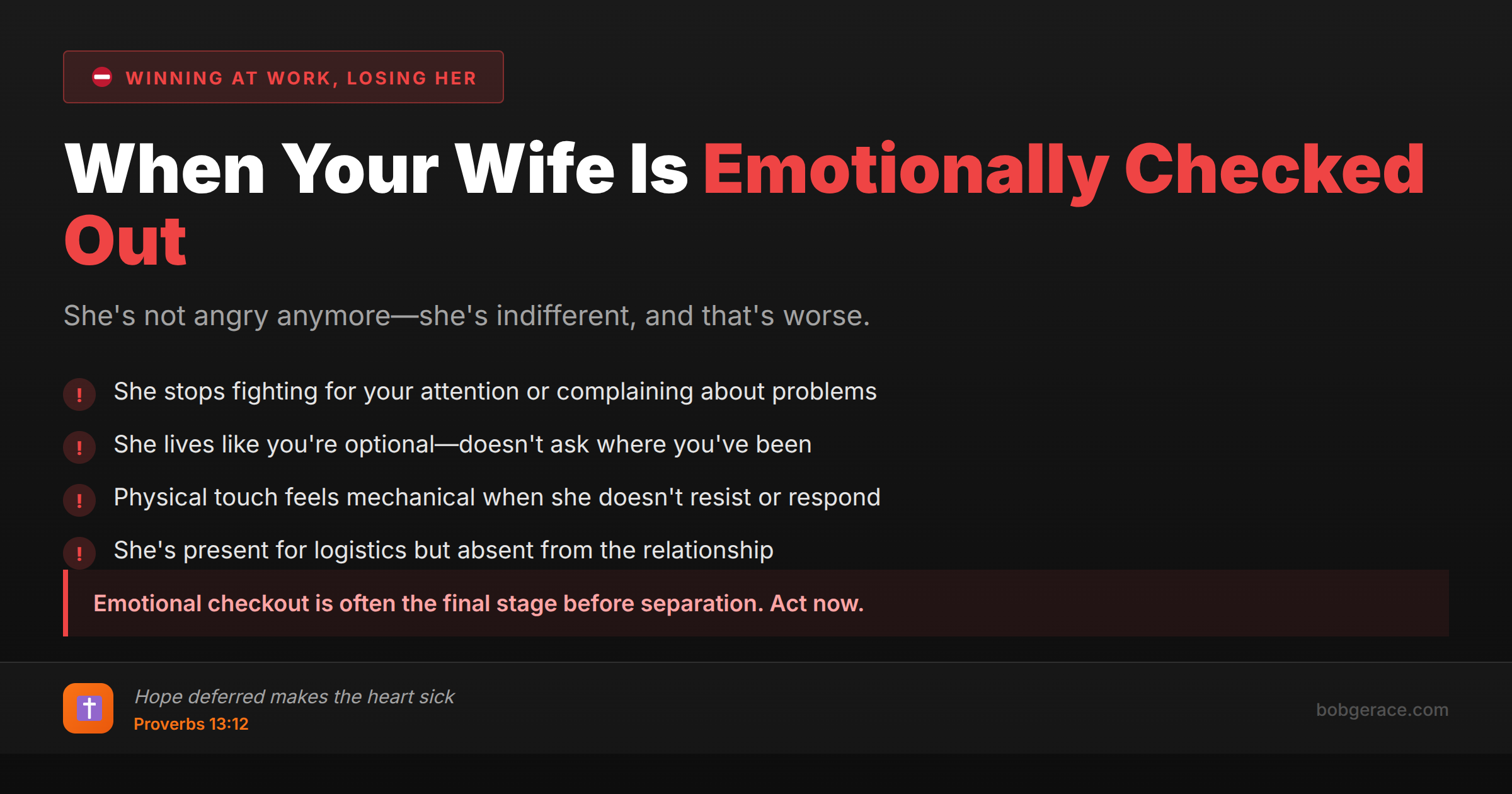
You know your wife is emotionally checked out when she stops fighting for your attention, stops complaining about what's wrong, and starts living like you're optional. She's not angry. She's not sad. She's just... indifferent. She doesn't ask where you've been. She doesn't care if you come to bed. She doesn't reach for you, and when you reach for her, it feels mechanical. She's present in the logistics of life but absent in the relationship. This is different from a rough season or a temporary disconnect. This is sustained emotional withdrawal. She's not waiting for you to change anymore. She's not hoping you'll notice. She's protecting herself by not expecting anything from you. And if you're seeing this, you're likely closer to the end than you think. Emotional checkout is often the final stage before she either asks for separation or quietly starts planning her exit.
The Anatomy of Emotional Checkout
Emotional checkout doesn't happen overnight. It's the result of a thousand small moments where she reached and you didn't respond. It's the accumulation of unmet needs, unheard complaints, and unrepaired hurts. She didn't wake up one day and decide to stop caring. She got tired of caring alone.
Here's what emotional checkout looks like in real time: She doesn't initiate conversation. She doesn't ask about your day. She doesn't share hers. She's polite but distant. She doesn't get upset when you work late or miss dinner—she seems relieved. She doesn't invite you into her world anymore. She makes plans without you. She talks to her friends, her mom, her therapist, but not to you. She's not withholding to punish you. She's withholding because she's given up hope that you'll engage.
Physically, she's there. She's managing the house, the kids, the calendar. But emotionally, she's gone. There's no affection unless you initiate, and even then it feels obligatory. She doesn't flirt. She doesn't laugh at your jokes. She doesn't light up when you walk in the room. She's not cold, exactly. She's just... flat. And that flatness is the sound of a woman who's already grieving the marriage while still living in it.
You might also notice that she's stopped complaining. That sounds like a good thing, but it's not. Complaint is a form of hope. It means she still believes you might change. When she stops complaining, it means she's stopped believing. She's not trying to fix the marriage anymore. She's just trying to survive it. And if you don't intervene now, the next step is her telling you she wants out.
Detachment as Self-Protection: The Neuroscience of Giving Up
What you're witnessing is a nervous system in full detachment mode. Attachment theory describes this as the final stage of protest-despair-detachment. First, she protested—she told you what she needed, asked for more time, more attention, more emotional presence. You didn't respond, or you responded defensively, or you promised to change but didn't follow through. So she moved into despair—sadness, withdrawal, maybe depression. You might have noticed her seeming down, but you didn't connect it to the marriage. Now she's in detachment. She's not protesting anymore. She's not despairing. She's just... done.
From a neurobiological perspective, her brain has recategorized you. You're no longer a source of safety or connection. You're a source of disappointment, and her nervous system is protecting her by shutting down the attachment circuitry. This is dorsal vagal shutdown—a state where the body conserves energy by numbing out, disconnecting, and going through the motions without emotional investment. She's not avoiding you out of spite. She's avoiding you because her nervous system has learned that reaching for you is painful.
The other dynamic at play is resentment. Resentment is what happens when love meets repeated disappointment. It's not hate. It's the slow erosion of respect, affection, and goodwill. And resentment is one of the strongest predictors of divorce, because it makes repair feel impossible. When she's emotionally checked out, resentment is usually the fuel. She's not just distant. She's bitter. And bitterness doesn't heal on its own. It requires you to see it, own your part, and pursue repair with urgency and humility.
The Hardened Heart and the Call to Pursue
Scripture speaks often about the danger of a hardened heart. Hebrews 3:13 warns, "Encourage one another daily, as long as it is called 'Today,' so that none of you may be hardened by sin's deceitfulness." When you ignore your wife's heart long enough, it hardens. Not because she's sinful, but because she's human. Hearts that are neglected, dismissed, or taken for granted eventually close.
Proverbs 13:12 says, "Hope deferred makes the heart sick, but a longing fulfilled is a tree of life." Your wife's heart is sick because her hope has been deferred again and again. She longed for you to see her, to prioritize her, to be emotionally present. And when that longing went unmet, her heart got sick. Now she's protecting it by shutting you out.
But here's the good news: God is a God of resurrection. He specializes in bringing dead things back to life. Ezekiel 36:26 says, "I will give you a new heart and put a new spirit in you; I will remove from you your heart of stone and give you a heart of flesh." That's a promise for both of you. But it requires you to move. You can't wait for her to soften. You have to pursue her the way Christ pursues the church—with humility, consistency, and sacrificial love. You have to own your part, repent, and show her through your actions that you're a different man. Words won't do it. Only sustained, humble, consistent presence will.
Action Steps
-
1
Sit down with her this week and say, 'I think I've lost you, and I don't want to lose you. Will you tell me what I've missed?' Don't defend. Just listen.
-
2
Write down three specific ways you've been emotionally unavailable in the last six months. Confess them to her without excuse or explanation.
-
3
Ask her: 'If you could have one thing from me that you don't have now, what would it be?' Then do it, even if it feels awkward or uncomfortable.
-
4
Stop waiting for her to initiate. Start pursuing her—not sexually, but emotionally. Ask her questions. Notice her. Be curious about her inner world.
-
5
If she won't talk or says it's too late, get help immediately. Call a coach, a pastor, or a therapist. Don't assume time will fix this. Time without intervention makes it worse.
Related Questions
- What does roommate marriage mean?
- Why does she light up for everyone but me?
- What are the six-month warning signs before she leaves?
- How do I become her husband again, not her roommate?
- Why does my wife not admire me the way other people do?
- Why does she need presence when I already provide security?
Also find Bob on
Subscribe for weekly videos on Christian marriage.
She's Not Gone Yet. But She's Close.
If your wife is emotionally checked out, you don't have time to figure this out on your own. I work with men in this exact situation every week, and there's a path forward—but it requires you to move now.
Talk to Bob →