How do I stop making her carry the emotional load?
5 min read
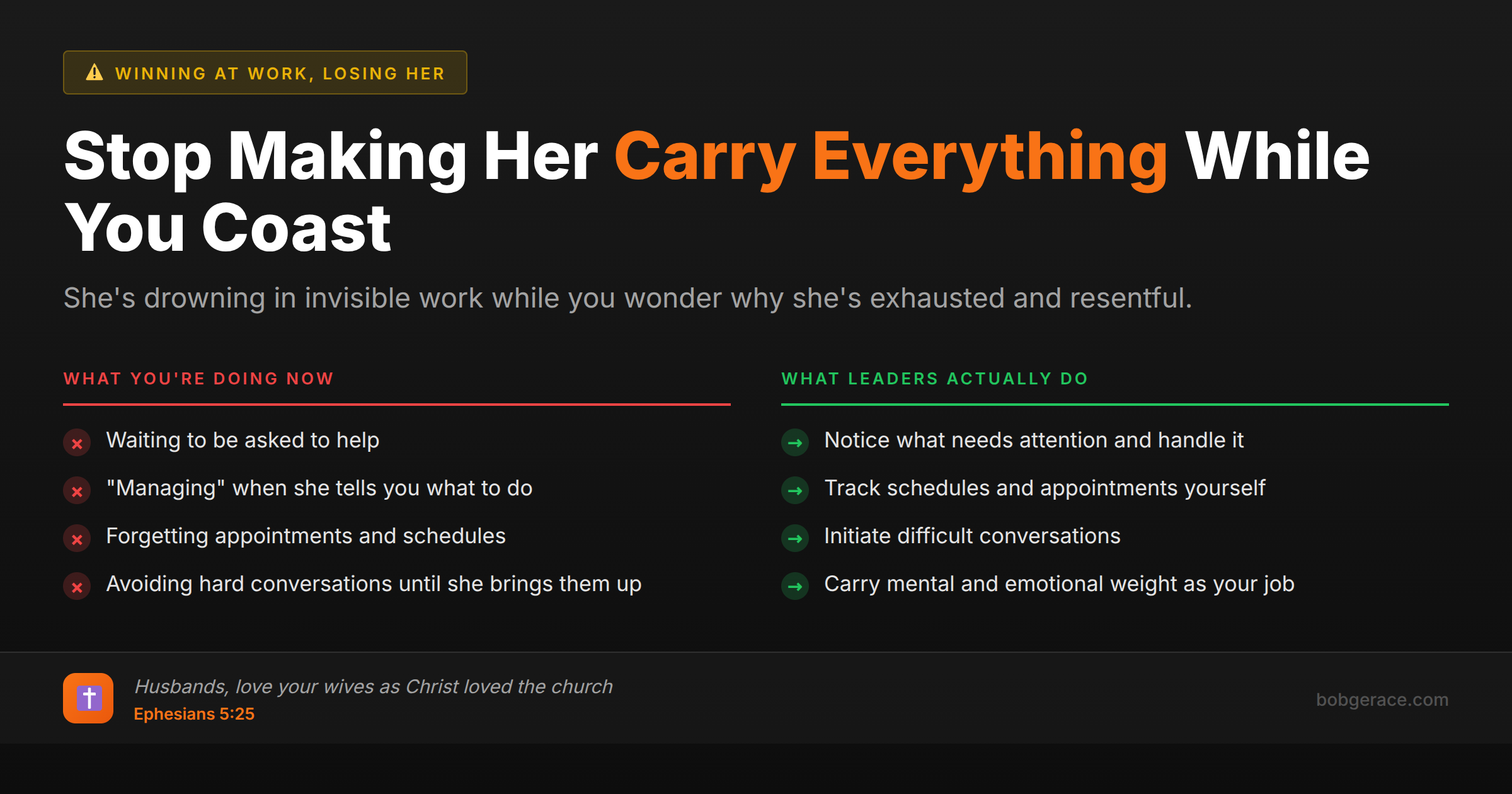
You stop making her carry the emotional load by taking ownership of the invisible work she has been doing alone—tracking schedules, managing relationships, anticipating needs, initiating hard conversations, and holding the emotional temperature of your home. This is not about helping her. It is about becoming a co-leader in your marriage instead of a dependent she has to manage. Start by noticing what she does that you do not see. Then take responsibility for those things without being asked. Remember your kids' doctor appointments. Reach out to your parents. Notice when the house needs attention. Initiate conversations about your marriage. Carry the mental and emotional weight of your family, not as a favor to her, but as your job.
The Invisible Weight She Carries Alone
Your wife is tired. Not just physically, though she may be that too. She is tired of being the only one who remembers, anticipates, plans, and manages the emotional life of your family. She tracks everyone's schedules. She knows when the kids need new shoes, when your mother's birthday is, when the dog is due for shots. She initiates the hard conversations about your marriage, your sex life, your future. She manages your social calendar, remembers thank-you notes, notices when someone is struggling.
You may think you help. You do the dishes when asked. You play with the kids. You handle the finances. But helping is not the same as carrying. Helping means she is still the project manager, and you are the assistant who waits for instructions. She has to think of it, remember it, ask you to do it, and often follow up to make sure it gets done. That is exhausting.
Meanwhile, you may be genuinely unaware of how much she is doing. You do not see the mental load because it is invisible. You do not realize she is tracking a dozen things at once while you focus on one. You think she is naturally better at this stuff, or that it does not bother her. But it does. She feels alone in the labor of keeping your family running. And she resents you for it.
This is not about her being controlling or you being incompetent. It is about a pattern where she has become the emotional and relational leader by default, and you have become passive. She did not choose this. You did not choose this. But it is killing your marriage.
Why Emotional Labor Becomes One-Sided
Emotional labor is the work of managing feelings, relationships, and the invisible needs of a household. Research shows that women disproportionately carry this load, even in dual-income marriages. This is not because women are naturally better at it. It is because they are socialized to notice and respond to emotional needs, while men are often socialized to focus on tasks and outcomes.
For high-performing men, this pattern is amplified. You are trained to compartmentalize, to focus on one thing at a time, to solve problems efficiently. Emotional labor requires the opposite: diffuse attention, relational awareness, and ongoing maintenance with no clear endpoint. It does not fit your operating system. So you default to what you are good at—work, finances, logistics—and leave the emotional labor to her.
Over time, this creates a parent-child dynamic. She becomes the manager. You become the person she has to remind, direct, and chase. She loses respect for you. You feel nagged and controlled. Both of you are miserable, but neither of you knows how to break the cycle.
The solution is not for her to lower her standards or stop caring. The solution is for you to develop the capacity to notice, anticipate, and carry emotional and relational weight. This requires you to expand your awareness, slow down, and engage with the invisible work that keeps your family functioning. It is learnable. But it requires intention.
Leadership Means Carrying the Load
Ephesians 5 calls husbands to lead their wives as Christ leads the church. But Christ's leadership is not passive or positional. He does not wait to be asked. He does not need to be reminded. He sees, He anticipates, He carries. He washes feet. He enters into the mess. He takes responsibility for the well-being of His people.
You are called to the same. To lead is to carry weight, not to delegate it. To notice what needs attention and take care of it. To initiate the hard conversations, not wait for her to bring them up. To manage your own emotional life so she does not have to manage it for you.
Proverbs 27:23 says, 'Know well the condition of your flocks, and give attention to your herds.' This is not just about livestock. It is about stewardship. About paying attention to what is under your care. Your wife, your kids, your home, your relationships—these are your responsibility. Not hers to manage while you focus elsewhere.
Galatians 6:2 tells us to bear one another's burdens. For years, she has been bearing yours. She has carried the emotional load of your marriage, your family, your life—while you focused on work. It is time to carry your share. Not as a favor. As obedience.
Action Steps
-
1
Ask your wife, 'What are three things you track or manage that I do not?' Listen without defending. Write them down. Take ownership of those things starting today.
-
2
Stop waiting to be asked. Notice what needs to happen—schedule the oil change, plan the date night, reach out to your parents—and do it without her prompting.
-
3
Track your own calendar and your kids' schedules. Know what is happening this week without asking her. Be the one who remembers and prepares.
-
4
Initiate one hard conversation this week. About your marriage, your sex life, your future, your conflict patterns. Do not wait for her to bring it up. Lead.
-
5
When you feel the urge to say 'just tell me what you need,' stop. That is asking her to manage you. Instead, pay attention, anticipate, and act. Show her you are carrying weight, not waiting for instructions.
Related Questions
Also find Bob on
Subscribe for weekly videos on Christian marriage.
Learn to Lead by Carrying Weight
Stopping the pattern of emotional labor imbalance requires more than good intentions. It requires new skills, new awareness, and accountability. I help men learn to notice, anticipate, and carry their share so their wife can finally stop managing them. Let's talk.
Talk to Bob →