Is roommate marriage a phase or a warning?
5 min read
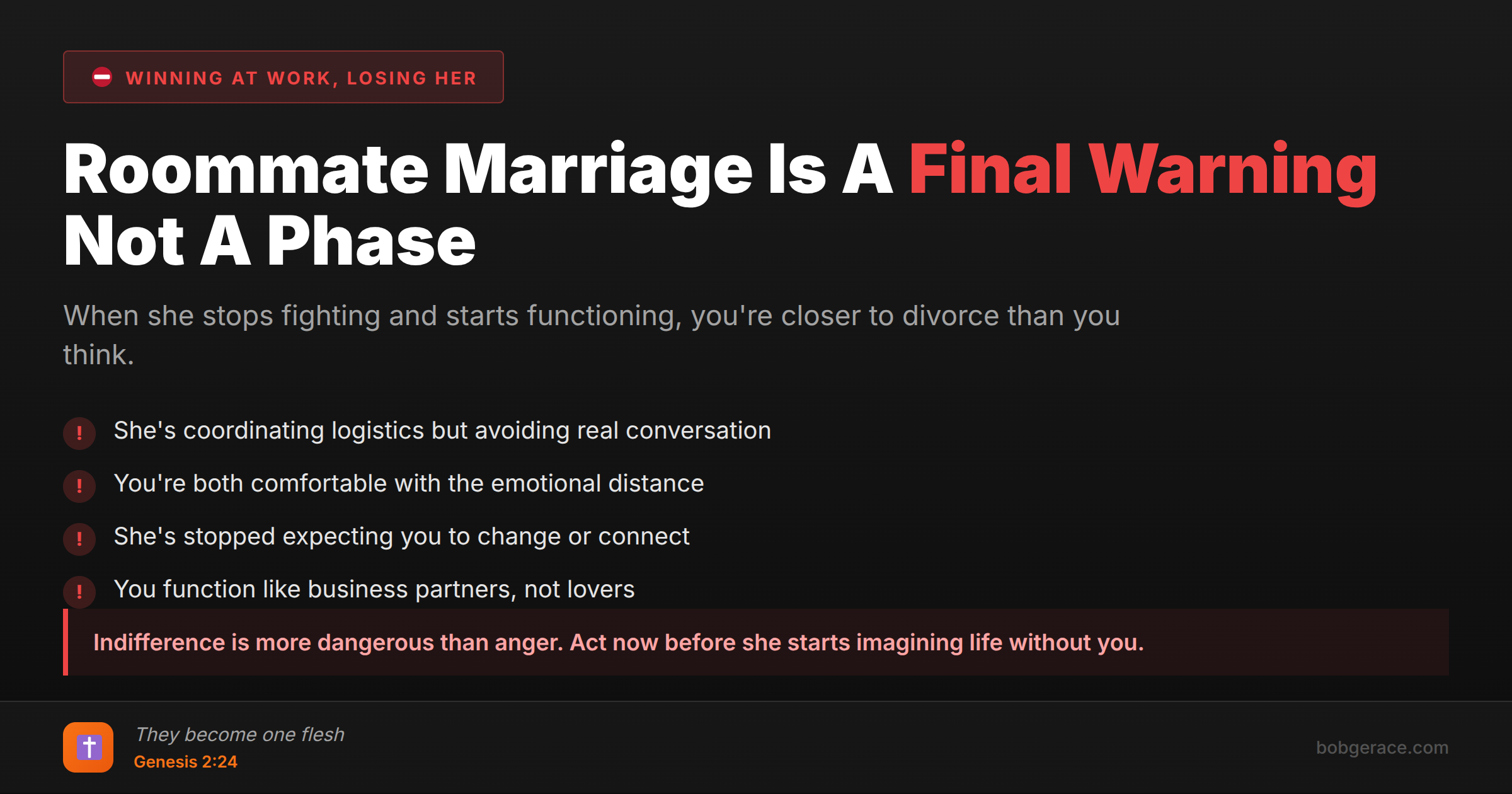
Roommate marriage is a warning, not a phase. It's what happens when emotional connection collapses and both of you adapt to the distance instead of fighting for closeness. Phases pass on their own. Warnings require action. If you're living like roommates—coordinating logistics, avoiding conflict, functioning without intimacy—you're not in a rough patch. You're in relational decay. This is the stage before she starts imagining life without you. She's not angry anymore. She's indifferent. That's more dangerous than fighting. Indifference means she's stopped expecting you to change. If you don't act now, the next stage is separation, affair, or divorce. This is your wake-up call.
What Roommate Marriage Really Signals
Roommate marriage is not about busy seasons or life stress. It's about emotional abandonment that's been normalized. You're both going through the motions—managing kids, bills, schedules—but there's no relational fuel. No pursuit. No curiosity. No emotional risk. You've become business partners in the enterprise of family life, not covenant partners in a one-flesh union.
This usually happens slowly. You got busy with work. She got busy with kids. You stopped talking about anything real. Conflict felt too hard, so you avoided it. Sex became rare or transactional. Affection disappeared. You started living parallel lives under the same roof. At first it felt like survival. Then it felt normal. Now it feels permanent.
But here's the thing: she didn't choose this. She adapted to it. Early on, she probably asked for more—more time, more attention, more emotional presence. You were too busy, too tired, or too checked out to respond. So she stopped asking. She built a life that doesn't require your participation. She has her friends, her routines, her ways of coping. You have your work, your hobbies, your distractions. You're coexisting, not connecting.
Most men don't realize how serious this is until she says she wants out. By then, she's been emotionally gone for months or years. Roommate marriage is the warning. The question is whether you'll hear it and act, or ignore it until it's too late.
The Neurobiology of Relational Shutdown
From a nervous system perspective, roommate marriage is mutual deactivation. Both of you have learned that emotional engagement is unsafe or unrewarding, so your systems have shut down the desire for connection. If she was anxiously attached early in the marriage, she used to protest—pursue you, ask for more, express frustration. When that didn't work, she moved into avoidant shutdown. Now she's not asking anymore. She's just done.
If you're avoidantly attached, you've been in shutdown mode for years. You mistake emotional distance for peace. You think things are fine because there's no conflict. But absence of conflict is not the same as presence of connection. Your nervous system is comfortable with distance. Hers has adapted to it. That's not health. That's relational death.
Resentment is the emotional residue of unmet bids for connection. Every time she tried to share her heart and you stayed surface-level. Every time she asked for help and you said you were busy. Every time she reached for you and you were unavailable. Those moments didn't just disappear. They accumulated. Resentment is what happens when hope dies slowly. She's not keeping score to punish you. She's protecting herself from more disappointment.
The danger of roommate marriage is that it feels stable. There's no drama. No big fights. But stability without intimacy is not a marriage—it's a business arrangement. And when she realizes she can have stability without you, she starts planning her exit. You're not in a phase. You're in the final warning stage before she's done.
God's Design Is Intimacy, Not Coexistence
Genesis 2:24 says a man leaves his father and mother and is united to his wife, and they become one flesh. One flesh is not just sexual union. It's emotional, spiritual, and relational intimacy. Roommate marriage is a violation of God's design. You're legally married but functionally separated. You're under the same roof but living in different worlds.
Ephesians 5:25 calls husbands to love their wives as Christ loved the church. Christ didn't just provide for the church. He pursued her. He knows her. He's present with her. He sacrificed for her. Roommate marriage is what happens when you reduce your role to provider and protector but abandon your role as pursuer and partner. You're doing half the job and wondering why the marriage is dying.
Matthew 19:6 says, "What God has joined together, let no one separate." But separation doesn't only happen through divorce. You can be separated emotionally while still living together. You can be married on paper and strangers in practice. God's design is covenant intimacy—knowing and being known, pursuing and being pursued, serving and being served. Roommate marriage is the slow death of that design.
Proverbs 5:18 says, "Rejoice in the wife of your youth." Not just stay married to her. Rejoice. Delight. Pursue. If you're not doing that, you're not living out biblical manhood. You're coasting on a covenant you're not honoring.
Action Steps
-
1
Sit down with your wife and acknowledge the distance without defending yourself—say 'I know we've been living like roommates, and I want that to change.'
-
2
Identify one specific way you've been emotionally absent and apologize for it without expecting immediate forgiveness or warmth in return.
-
3
Initiate one meaningful conversation per day where you ask about her inner world—her feelings, her thoughts, her experience—and listen without fixing.
-
4
Rebuild nonsexual physical connection by touching her daily with no agenda—hand on her back, kiss on the forehead, holding her hand.
-
5
Schedule a weekly check-in to talk about the state of your marriage, where you ask how she's feeling and commit to one thing you'll work on.
Related Questions
Also find Bob on
Subscribe for weekly videos on Christian marriage.
Don't Wait Until She's Done
Roommate marriage doesn't fix itself. It escalates into separation, affair, or divorce. If you're reading this, you already know something's wrong. The question is whether you'll act now or wait until it's too late.
Talk to Bob →