What does wife feels neglected actually mean?
5 min read
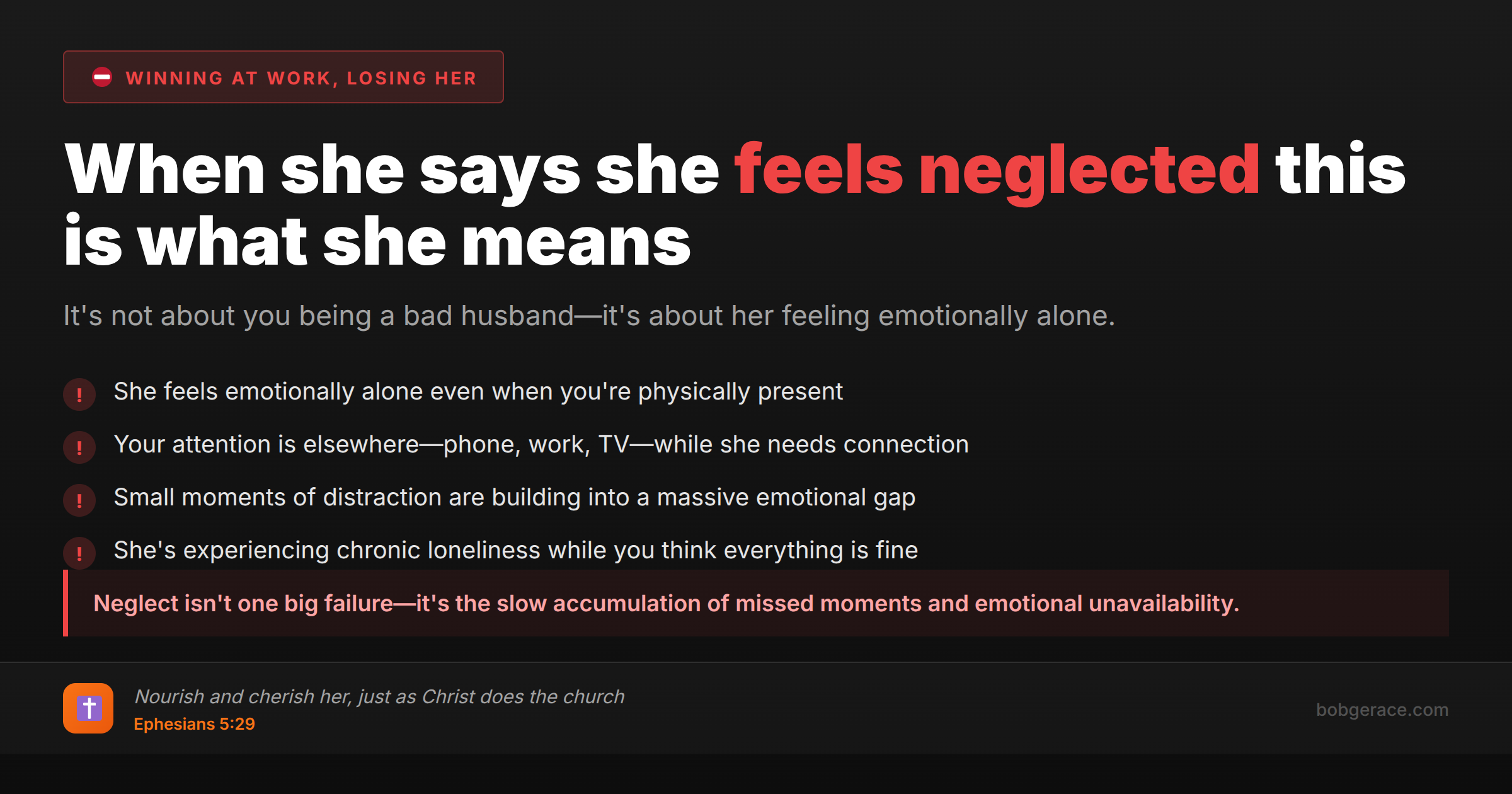
When your wife says she feels neglected, she is not saying you are a bad man or a bad provider. She is saying she feels emotionally alone in the marriage. She may be physically near you, but she does not feel seen, known, or prioritized. The connection she once felt has eroded, and she is living with a quiet, chronic ache of loneliness. Neglect in marriage is rarely dramatic. It is not one big failure. It is the slow accumulation of missed moments, distracted conversations, and emotional unavailability. You are working hard, providing well, handling responsibilities. But she is experiencing you as absent. Your body is there. Your attention is not. And over time, that gap becomes a chasm.
What Neglect Looks Like in Real Time
Neglect is not always visible. It does not look like yelling or cruelty. It looks like you scrolling your phone while she talks. It looks like her sharing something vulnerable and you offering a quick fix before moving on. It looks like weeks passing without a real conversation. It looks like her initiating connection and you being too tired, too busy, or too distracted to engage.
She may stop asking for your attention. She may stop sharing her struggles. She may become quieter, more withdrawn, or more irritable. These are not personality changes. They are adaptations to chronic emotional neglect. She has learned that reaching for you does not result in connection, so she stops reaching.
Many high-performing men do not see this happening. You believe you are present because you are home. You believe you are engaged because you are handling logistics. But presence is not proximity. Engagement is not task completion. Your wife is not asking for more help with the dishes. She is asking for more of you—your attention, your curiosity, your emotional availability.
Neglect also shows up in how you touch her. If the only time you initiate physical affection is when you want sex, she feels used, not loved. If you do not hold her hand, hug her without agenda, or kiss her just because, she feels like a service provider, not a wife. Over time, this creates deep resentment and a sense of being objectified in her own marriage.
The tragedy is that most men do not intend this. You are not trying to hurt her. You are trying to build a good life. But you are doing it in a way that leaves her feeling like a bystander in your world instead of a partner in a shared life.
The Physiology of Chronic Emotional Neglect
Emotional neglect activates the same neural pathways as physical pain. When your wife feels unseen or dismissed, her brain registers it as a threat. Her nervous system goes into a state of chronic activation. She may become hypervigilant—scanning for signs of rejection or disconnection. Or she may collapse into shutdown—numbing out, withdrawing, losing interest in the relationship.
This is not drama. It is neurobiology. Human beings are wired for connection. When that connection is absent, the nervous system interprets it as danger. Over time, chronic neglect can lead to anxiety, depression, and a deep sense of hopelessness about the marriage. She may start to believe that this is just how it is, that you will never change, that she will always feel alone.
Attachment theory helps explain why neglect is so damaging. Your wife is wired to turn to you for co-regulation, safety, and connection. When you are emotionally unavailable, her attachment system goes into protest mode. She may criticize, pursue, or demand. If that does not work, she moves into despair. She stops protesting. She stops expecting. She detaches. That is when you hear, 'I do not even care anymore.'
Many men misread this detachment as her being difficult, cold, or checked out. But it is not a character flaw. It is a survival response. She has been reaching for you and coming up empty for so long that her system has adapted by shutting down the longing. That is a dangerous place. It is often the stage right before she says she wants out.
The good news is that nervous systems can heal. Consistent attunement, presence, and repair can rebuild safety. But it requires you to change the pattern, not just apologize for it.
The Call to Nourish and Cherish
Ephesians 5:29 says no one ever hated his own flesh, but nourishes and cherishes it, just as Christ does the church. Nourish means to feed, sustain, and care for. Cherish means to hold dear, to treat as precious. Emotional neglect is the opposite of both. It is withholding the care and attention your wife needs to thrive.
Jesus did not lead from a distance. He was present. He noticed. He responded. He made people feel seen and valued. That is the model for husbands. Not distant authority. Not benevolent provision. Active, engaged, attentive love. When you neglect your wife emotionally, you are not loving her as Christ loved the church. You are managing her like a responsibility.
Proverbs 5:18-19 calls husbands to rejoice in the wife of their youth and be intoxicated always in her love. That is not passive. It is active delight. It is ongoing pursuit. It is the choice to prioritize her, to stay curious about her, to keep showing up emotionally even when life is demanding. Neglect happens when you stop choosing her.
First Peter 3:7 commands husbands to live with their wives in an understanding way, showing honor. Understanding requires presence. It requires attention. It requires the willingness to know her inner world and respond to it. Honor means treating her as valuable, not as an afterthought. Neglect is the failure to do both.
Action Steps
-
1
Ask your wife this week: 'When do you feel most neglected by me?' Then listen without defending or explaining. Just hear her.
-
2
Identify one pattern where you are consistently distracted or unavailable—phone, work, TV—and change it for two weeks. Show up differently.
-
3
Initiate non-sexual physical affection daily. Hold her hand. Hug her. Kiss her without it leading anywhere. Let her feel wanted, not used.
-
4
Set a weekly time to check in with her about her inner world. Ask how she is really doing, not just what is on the calendar.
-
5
If she has stopped reaching for you, own it. Say, 'I know I have been unavailable. I want to change that. Will you give me a chance to show up differently?'
Related Questions
Also find Bob on
Subscribe for weekly videos on Christian marriage.
Do Not Wait Until She Is Done
If your wife feels neglected, the clock is ticking. Emotional neglect does not stay static. It escalates into resentment, detachment, and eventually, divorce. Coaching helps you see the pattern and change it before it is too late.
Talk to Bob →