What if I am physically present but emotionally gone?
6 min read
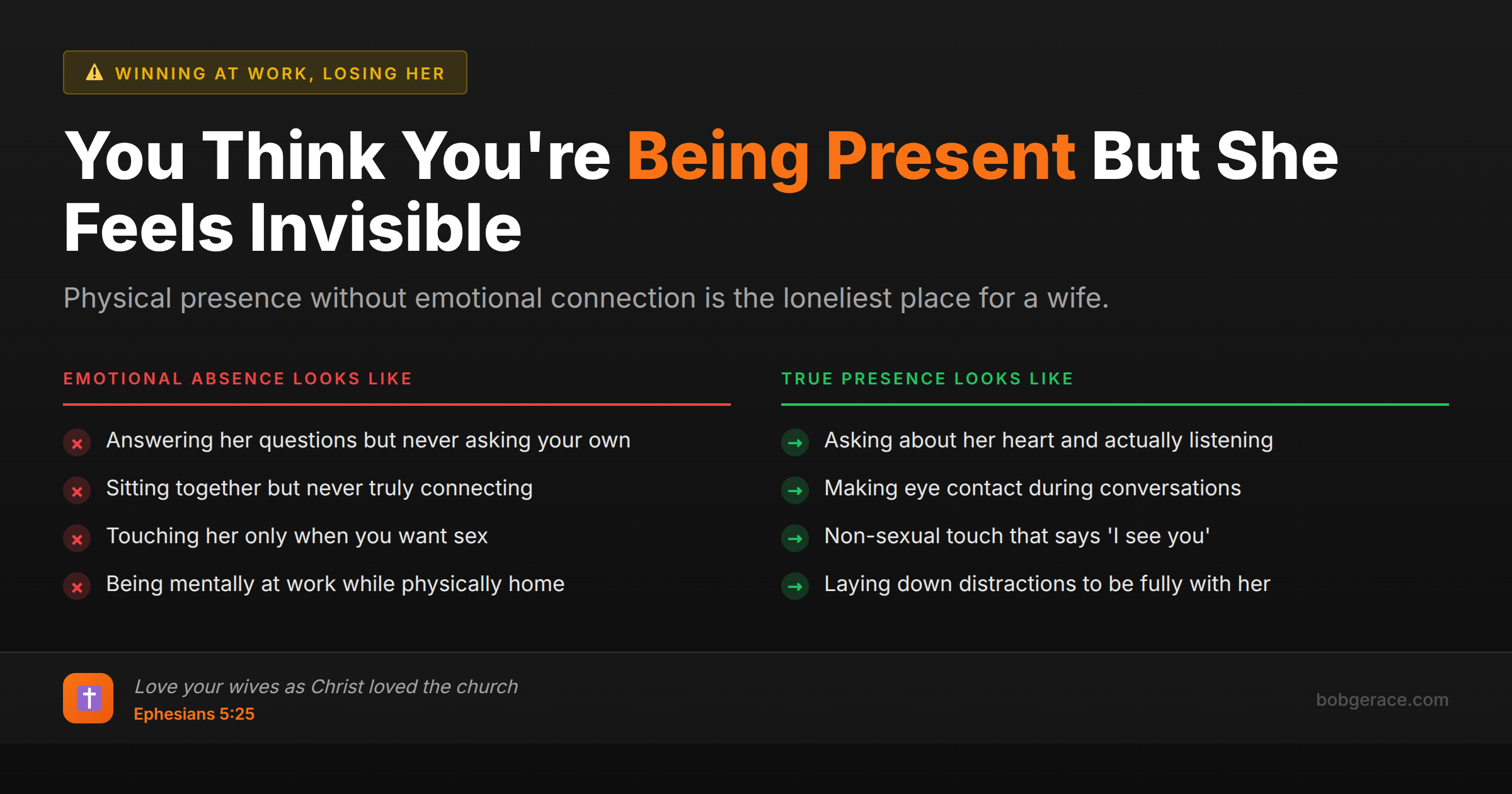
Your wife is telling you something critical: your body shows up, but you do not. You are in the room but defended, distracted, or shut down. She experiences you as unavailable even when you believe you are being responsible. This is not about one bad day. It is the accumulated pattern where she reaches for you emotionally and finds a wall, a screen, or a man who is mentally still at work. Emotional absence is not usually dramatic. It is the slow erosion where you answer her questions but never ask your own, where you sit together but never connect, where you touch her only when you want sex. She does not feel seen, known, or safe. And over time, that loneliness becomes the loudest voice in her head.
The Loneliness of Living with a Ghost
You work hard. You provide. You show up to dinner, help with logistics, handle the bills. From your perspective, you are doing what a man does. But your wife is describing a different reality. She says she feels alone in the marriage. She says you are not really there. And when you defend yourself by listing everything you do, it only confirms her point: you still do not see her.
Emotional presence is not the same as physical proximity. It is not about hours logged at home. It is about whether you are open, attuned, and responsive when she reaches for you. Do you ask how she is and actually wait for the real answer? Do you notice when she is struggling without her having to perform her pain? Do you initiate non-sexual touch, or does she only feel your hands when you want something?
Many successful men operate in a mode that works brilliantly at work but destroys intimacy at home. You solve, you optimize, you move to the next task. Emotions are inefficient. Vulnerability feels weak. So you stay in your head, stay in control, and stay disconnected. Your wife is not asking you to become soft. She is asking you to become present. She wants the man she married, not the professional mask you wear everywhere now.
This pattern does not announce itself. It builds slowly. You stop having real conversations. You stop being curious about her inner world. You stop sharing yours. The marriage becomes a logistics partnership. She feels it first, and she tries to tell you. But you are too busy, too defended, or too convinced that providing is enough. By the time you finally hear her, she may already be one foot out the door.
The Nervous System Cost of Chronic Unavailability
Emotional unavailability is often a nervous system defense, not a character flaw. Many high-performing men learned early that feelings are dangerous, that vulnerability invites harm, that shutting down is how you survive. You built a life by staying in your head, controlling your environment, and never letting anyone see you sweat. That strategy made you successful. It is also killing your marriage.
When you are emotionally unavailable, your wife's nervous system registers you as unsafe. Not because you are cruel, but because you are unpredictable in your presence. She never knows if she will get the real you or the defended version. She reaches for connection and gets a wall. She shares something vulnerable and you fix it, dismiss it, or change the subject. Over time, her system stops reaching. She goes into protective mode. She may become anxious, pursuing you for reassurance you never give. Or she may become avoidant herself, shutting down and planning her exit.
This is not about feelings for feelings' sake. It is about co-regulation. Your wife's nervous system is wired to find safety in your emotional presence. When you are consistently unavailable, her body stays in low-grade threat. She feels alone even when you are next to her. That chronic activation leads to resentment, contempt, and eventually detachment. She stops trying. She stops hoping. She starts imagining life without you.
The good news: this is not permanent wiring. You can learn to be present. You can learn to tolerate emotional discomfort without shutting down or fixing. You can learn to attune to her without losing yourself. But it requires you to see the pattern first, and to stop defending it as if your busyness or your provision excuses your absence.
Presence as the Foundation of Covenant Love
Scripture does not call you to be a distant provider. It calls you to love your wife as Christ loved the church—sacrificially, intimately, and with full presence. Ephesians 5 is not about control or authority. It is about laying down your life, which includes laying down your defenses, your distractions, and your emotional unavailability.
Jesus did not love from a distance. He was present. He saw people. He asked questions. He wept with those who wept. He did not fix everything immediately. He entered into the pain, the mess, the humanity of those He loved. That is the model. You are called to be emotionally present, not because it is efficient, but because covenant love requires it.
Proverbs 20:5 says, 'The purposes of a person's heart are deep waters, but one who has insight draws them out.' Your wife has deep waters. She has fears, dreams, wounds, and longings that she will only share if you are present enough to draw them out. If you are always distracted, defended, or in work mode, you will never know her. And she will spend her life feeling unknown.
God does not call you to be perfect. He calls you to be present. To show up not just physically, but emotionally and spiritually. To be a man who is strong enough to be soft, successful enough to be still, and secure enough to let your wife see you. That is the leadership your marriage needs.
Action Steps
-
1
Ask your wife this week: 'When do you feel most alone in our marriage?' Do not defend, explain, or fix. Just listen and write down what she says.
-
2
Identify your most common emotional escape hatch—phone, work, TV, gym—and set a boundary around it for one hour each evening to be fully present with her.
-
3
Practice non-sexual touch daily: a long hug when you get home, holding her hand during a conversation, a hand on her back while she cooks. Let her feel you without an agenda.
-
4
Share one thing you are struggling with this week that you would normally keep to yourself. Let her see you, not just your competence.
-
5
Schedule a weekly 30-minute check-in with no phones, no logistics, no problem-solving. Ask her how she is and what she needs from you emotionally.
Related Questions
- How can my wife feel neglected when I work so hard for her?
- How do I know if I am an emotionally unavailable husband?
- Why does my success not make her feel secure?
- What is emotional neglect in marriage?
- What if I have time for clients but not for my wife?
- What if my lifestyle is comfortable but my marriage is starving?
Also find Bob on
Subscribe for weekly videos on Christian marriage.
You Can Learn to Be Present
If your wife says you are emotionally gone, she is giving you a roadmap. Most men wait until she stops talking altogether. I help men learn to be present before it is too late.
Talk to Bob →