What if she says she feels invisible?
5 min read
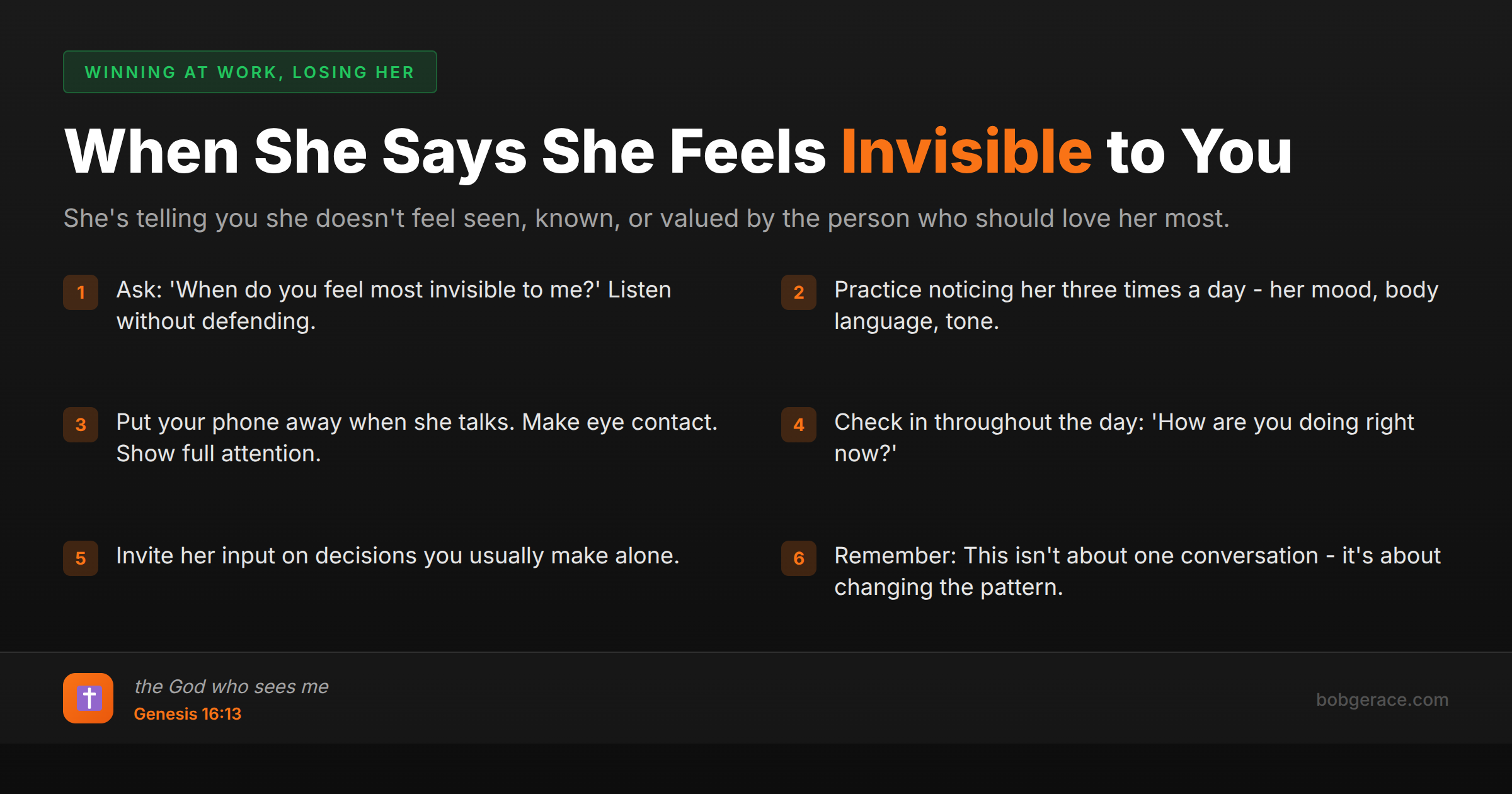
When your wife says she feels invisible, she is telling you that she does not feel seen, known, or valued. She is in the room, but she does not feel like she matters to you. You may be physically present, but emotionally, you are somewhere else. She has been trying to get your attention, your curiosity, your care—and she is coming up empty. This is not about one missed conversation. It is about a pattern. She feels like she could disappear and you would not notice. She feels like your phone, your work, your hobbies, or your stress get more attention than she does. And that feeling—being invisible to the person who is supposed to love you most—is one of the loneliest experiences in marriage.
The Daily Experience of Feeling Invisible
Feeling invisible does not mean you ignore her completely. It means you do not really see her. You hear her words, but you miss the emotion behind them. You notice her tasks, but you do not notice her. You respond to logistics, but you do not respond to her heart. She is functioning, managing, keeping things running—but she does not feel like you are tracking her inner world at all.
She may test this. She stops initiating conversation to see if you notice. She pulls back physically to see if you reach for her. She hints at struggles or needs to see if you pick up on them. When you do not, it confirms what she already fears: she is invisible to you. You are not doing this on purpose. But your lack of attention has the same effect as intentional neglect.
Many high-performing men are shocked when they hear this. You think, 'I am here. I provide. I show up. How can she feel invisible?' But presence is not the same as attention. You can be in the same room and completely miss her. You can share a bed and never really see her. She is not asking for grand gestures. She is asking for you to notice her—her mood, her needs, her heart.
Feeling invisible also shows up in how decisions get made. You plan your schedule without checking in. You make choices about money, time, or priorities without her input. You operate like a solo agent, and she feels like a supporting character in your life instead of a co-leader. Over time, this creates deep resentment. She stops feeling like a wife and starts feeling like staff.
The danger is that invisible wives eventually stop trying to be seen. They detach. They build a life that does not include you emotionally. They may stay for the kids, for finances, for faith—but the marriage becomes a shell. And by the time you notice, the damage is often severe.
The Attachment Wound of Invisibility
Feeling invisible is an attachment injury. Your wife's nervous system is wired to seek connection, safety, and attunement from you. When she does not get it, her system interprets it as rejection. She may move into anxious attachment—pursuing, criticizing, demanding your attention. Or she may move into avoidant attachment—withdrawing, shutting down, building walls. Both are adaptations to the pain of not being seen.
This is not manipulation. It is survival. Human beings cannot tolerate prolonged invisibility. It is a form of relational trauma. When someone you love consistently fails to see you, your brain starts to believe you do not matter. That belief seeps into everything. It affects her sense of self, her emotional regulation, her capacity for hope in the marriage.
Many men respond to this by getting defensive. 'I do see you. I am right here. You are being dramatic.' But defensiveness only deepens the wound. It confirms that you are more interested in protecting yourself than understanding her. What she needs is validation. 'I hear you. I have not been seeing you the way you need. That is on me. I want to change that.'
Neurologically, feeling seen activates the brain's reward centers. It releases oxytocin, the bonding hormone. It signals safety and connection. When your wife feels invisible, those systems go offline. She stops experiencing you as a source of comfort or joy. She may even start to feel activated or numb in your presence. That is not a character flaw. That is what happens when attunement is absent for too long.
The path forward is consistent, intentional attunement. You have to learn to track her—her emotions, her needs, her inner world. You have to practice noticing her and responding. Over time, that rebuilds the neural pathways of safety and connection. But it requires you to change, not just to acknowledge the problem.
Seeing as an Act of Love
In Scripture, being seen by God is a profound experience of love and care. Hagar, alone and desperate, encounters God and calls Him 'the God who sees me' (Genesis 16:13). That moment of being seen changes everything for her. It is not just acknowledgment. It is the experience of being known, valued, and cared for. That is what your wife is longing for from you.
Jesus saw people. He saw the widow giving her last coins. He saw Zacchaeus in the tree. He saw the woman caught in adultery, the leper on the road, the children the disciples tried to turn away. He did not just glance at them. He truly saw them—their pain, their hope, their humanity. That is the kind of seeing your wife needs from you.
Proverbs 31 describes a husband who praises his wife. But you cannot genuinely praise someone you do not see. Praise requires attention. It requires noticing her character, her efforts, her heart. When you fail to see your wife, you also fail to honor her. You reduce her to a role instead of relating to her as a person.
First Peter 3:7 calls you to live with your wife in an understanding way. Understanding is impossible without seeing. You cannot understand someone you do not pay attention to. This is not optional. It is a command. It is part of what it means to love your wife as Christ loved the church. Christ does not love from a distance. He is present, attentive, engaged. That is the standard.
Action Steps
-
1
Ask your wife: 'When do you feel most invisible to me?' Listen without defending. Let her answer shape how you show up this week.
-
2
Practice noticing her three times a day. Notice her mood, her body language, her tone. Then check in: 'How are you doing right now?'
-
3
Put your phone away when she is talking. Make eye contact. Reflect back what you hear. Show her that she has your full attention.
-
4
Identify one area where you operate solo—schedule, decisions, priorities—and invite her input. Let her know her voice matters.
-
5
Tell her one thing you see in her that you appreciate. Be specific. Not 'You are great.' But 'I see how patient you were with the kids today. That matters.'
Related Questions
- How can my wife feel neglected when I work so hard for her?
- How do I know if I am an emotionally unavailable husband?
- Why does my success not make her feel secure?
- What is emotional neglect in marriage?
- What daily habits make my wife feel unseen?
- What does emotional attunement look like for a husband?
Also find Bob on
Subscribe for weekly videos on Christian marriage.
She Is Telling You What She Needs
When your wife says she feels invisible, she is giving you critical information. Do not dismiss it. Do not defend. This is your chance to change the trajectory of your marriage before she stops trying. Coaching helps you learn to see her again.
Talk to Bob →