When should a successful man get marriage coaching?
6 min read
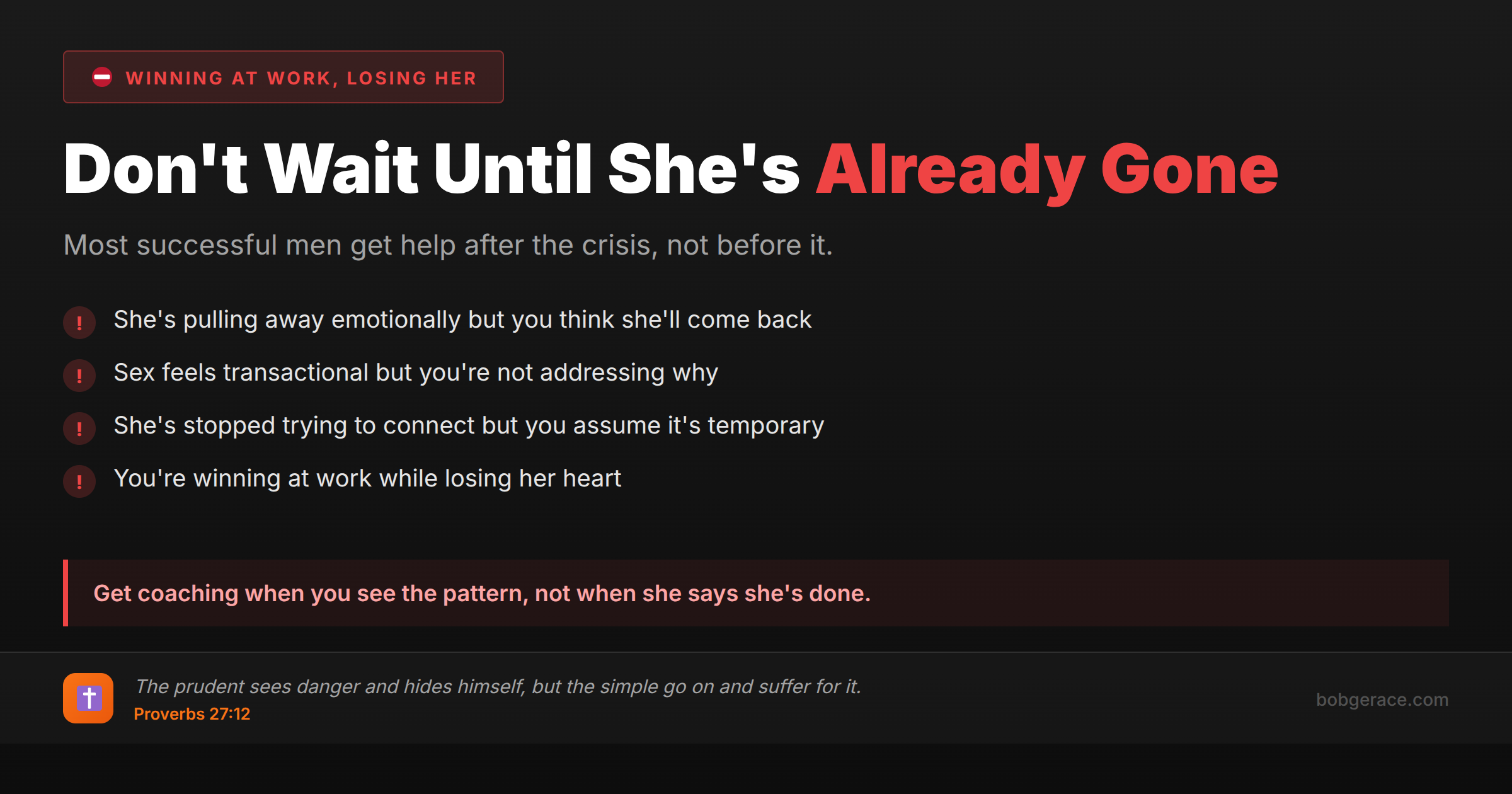
Get marriage coaching before the crisis, not after. Most successful men wait until their wife says she's done, until she's found someone else, or until divorce papers are filed. By then, you're not working on your marriage—you're trying to stop a collapse. The right time to get coaching is when you notice the pattern: she's pulling away, sex feels transactional, she's stopped trying to connect, or you realize you've been winning at work while losing her. You don't wait until your business is failing to hire a consultant. You don't wait until you're in the hospital to care about your health. Why would you wait until your marriage is in crisis to get help? The men who save their marriages are the ones who act when they see the early signs—when she's distant but not gone, when resentment is building but not hardened, when there's still time to become the man she needs before she stops believing you can.
Why Successful Men Wait Too Long
You're used to solving problems on your own. You've built a career, led teams, closed deals, and figured things out. You don't ask for help until you've exhausted every option. That works in business. It destroys marriages. By the time you realize you need help, your wife has already spent months or years trying to tell you something's wrong. She's exhausted. She's done managing your emotions. She's stopped fighting for your attention. And now you're panicking.
Successful men also struggle with the optics of needing help. You're the guy everyone else comes to for advice. You're the leader, the provider, the one who has it together. Admitting your marriage is struggling feels like failure. So you minimize it. You tell yourself she's overreacting, she'll get over it, or things will improve once work slows down. Meanwhile, she's planning her exit.
The other reason men wait is that they don't see the problem until it's a crisis. You're focused on work, on results, on the next goal. You don't notice that she's stopped reaching for you, that she's emotionally checked out, or that she flinches when you touch her. You think everything's fine because there's no screaming, no obvious affair, no separation. But she's been telling you in a hundred small ways that she's alone, unseen, and done. You just weren't paying attention.
The right time to get coaching is not when she's filing for divorce. It's when you notice the distance. When sex feels like a transaction. When she stops sharing her day. When she's more interested in her friends, her work, or her phone than in you. When you realize you've been emotionally unavailable, defensive, or only present when you want something. That's the moment. Not six months later when she's already emotionally gone.
The Cost of Waiting
Attachment research shows that relationship distress follows a predictable pattern: protest, despair, detachment. In the protest phase, your wife is fighting for your attention. She's asking you to listen, to be present, to care about her inner world. She's upset, but she's still engaged. If you dismiss her, defend yourself, or stay focused on work, she moves to despair. She stops fighting and starts grieving the marriage she thought she'd have.
By the time she reaches detachment, her nervous system has shifted from 'How do I get him to see me?' to 'How do I survive without him?' She's no longer trying to connect. She's protecting herself. This is the phase where most men finally wake up and want help. But by then, her brain has rewired. She's not just frustrated—she's done. Her hope is gone. And while it's not impossible to rebuild from detachment, it's exponentially harder than intervening during protest or early despair.
The clinical reality is that every month you wait, the gap widens. Resentment builds. Trust erodes. Her nervous system becomes more vigilant, more protective, more convinced that you're not safe. The longer the pattern continues—you prioritizing work, dismissing her concerns, being emotionally unavailable, using her for sex—the more evidence her brain collects that you won't change. By the time you're ready to do the work, she's already emotionally divorced.
This is why successful men need coaching before the crisis. Not because coaching is magic, but because it interrupts the pattern before it becomes irreversible. It gives you the tools to regulate your nervous system, to hear her without defending, to own your failures without collapsing, and to become emotionally available before she stops believing it's possible. The earlier you start, the more options you have.
Stewarding Your Marriage Before It's Broken
Proverbs 27:12 says, 'The prudent sees danger and hides himself, but the simple go on and suffer for it.' Waiting until your marriage is in crisis to get help isn't faith—it's foolishness. God calls you to steward your marriage, not to coast until it collapses and then beg Him to fix it. Stewardship means paying attention, doing the work, and getting help before the foundation cracks.
In Matthew 7, Jesus talks about the wise man who builds his house on the rock and the foolish man who builds on sand. The difference isn't the storm—both houses face storms. The difference is the foundation. If you're building your marriage on your career success, your ability to provide, or your assumption that she'll always be there, you're building on sand. When the storm comes—and it will—your marriage won't hold.
Getting coaching before the crisis is an act of wisdom and humility. It's saying, 'I don't have this figured out. I need help becoming the husband God has called me to be.' That's not weakness. That's strength. Proverbs 11:14 says, 'Where there is no guidance, a people falls, but in an abundance of counselors there is safety.' You wouldn't run your business without advisors. Why would you try to lead your marriage without them?
The biblical model is also preventative, not reactive. You don't wait until you're in sexual sin to guard your heart. You don't wait until you're bankrupt to steward your finances. You don't wait until your kids are lost to disciple them. The same is true for your marriage. Ephesians 5 calls you to love your wife as Christ loved the church—sacrificially, intentionally, consistently. That requires more than good intentions. It requires skill, insight, and accountability. That's what coaching provides.
Action Steps
-
1
Assess honestly: Is your wife pulling away, emotionally distant, or stopped trying to connect? If yes, don't wait.
-
2
Identify the pattern you're avoiding: workaholism, porn, emotional unavailability, defensiveness, sexual selfishness, or spiritual passivity.
-
3
Reach out to a marriage coach or therapist this week—not to fix her, but to work on yourself and your leadership.
-
4
Stop telling yourself things will get better on their own or that she's overreacting—those are the lies that cost men their marriages.
-
5
Commit to doing the work whether she notices or not, because the goal isn't to manipulate her response but to become the man God has called you to be.
Related Questions
- Can I rebuild trust before she makes a final decision?
- How do I become trustworthy after years of not showing up?
- What if my wife says she is done but has not filed?
- What if my wife says she loves me but is not in love?
- What should I change before my wife leaves?
- What should I do if my wife says she needs space?
Also find Bob on
Subscribe for weekly videos on Christian marriage.
Don't Wait Until She's Done
The men who save their marriages are the ones who get help before the crisis, not after. If you're noticing distance, resentment, or disconnection, now is the time to act—before she stops believing you can change.
Talk to Bob →