Why did my wife stop trying?
6 min read
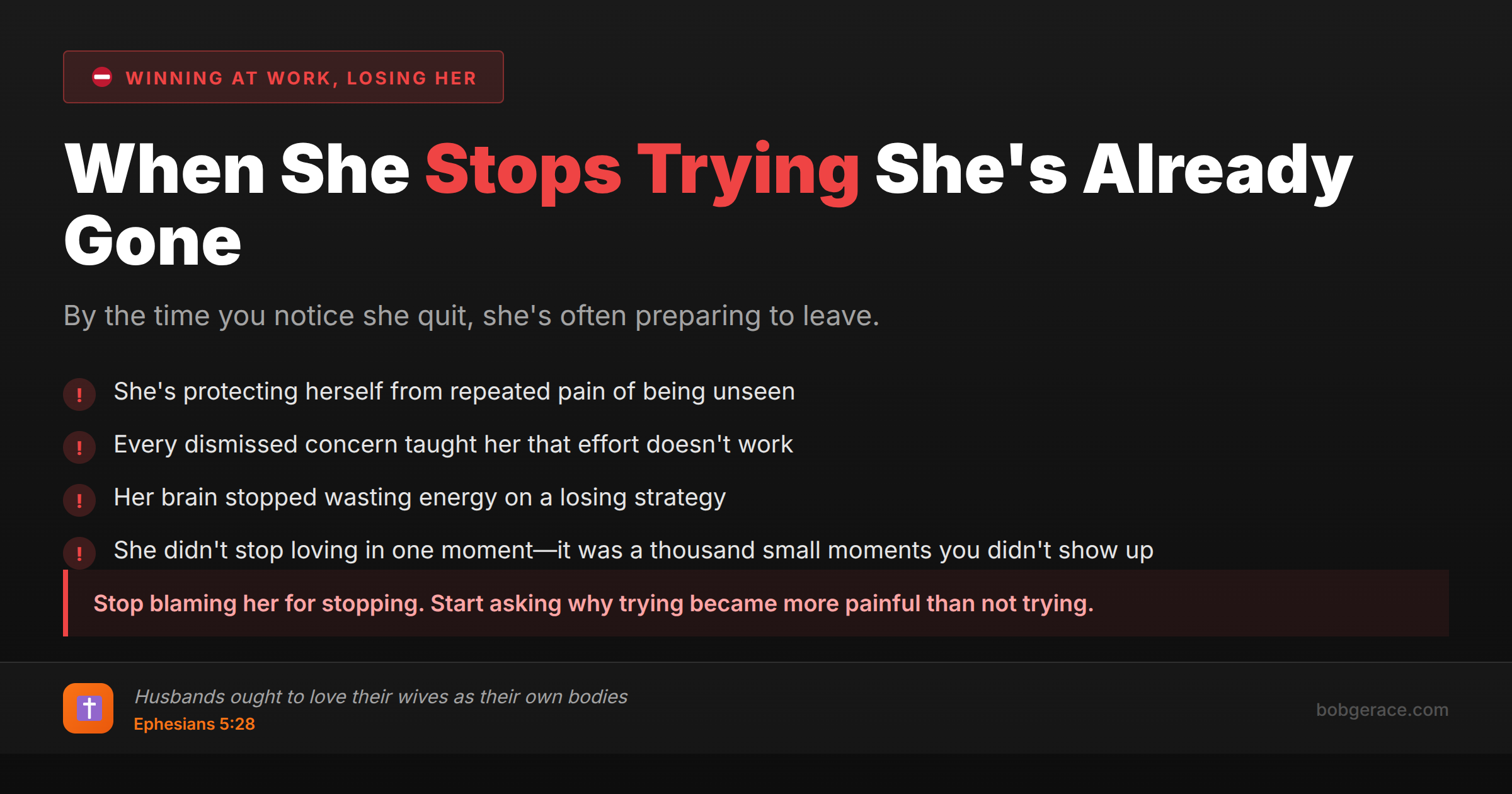
Your wife stopped trying because trying became more painful than not trying. She didn't wake up one day and decide to quit. She spent months—maybe years—reaching for you, asking for connection, expressing needs, and getting little or nothing in return. Every unmet bid for attention, every dismissed concern, every promise you didn't keep taught her nervous system that effort doesn't produce results. So her brain did what brains do when they're trying to survive: it stopped wasting energy on a losing strategy. She's not being stubborn or cold. She's protecting herself from the repeated pain of being unseen. This isn't about her character or her commitment. It's about what happens when someone loves hard, tries hard, and feels alone anyway. She didn't stop loving you in a single moment. She stopped trying in a thousand small moments when you didn't show up, didn't listen, didn't change, or didn't see her. And now you're noticing. The problem is, by the time you notice she stopped trying, she's often already emotionally preparing to leave.
The Slow Fade of Effort
She used to plan date nights. She used to initiate sex. She used to ask about your day, your stress, your heart. She used to bring up hard conversations because she believed you could work through them together. She used to cry when you fought because it mattered. She used to light up when you walked in the door. And then, slowly, she stopped. Not all at once. Not dramatically. Just... less. And then less. And then not at all.
You probably didn't notice the early signs. You were busy. Work was demanding. The kids needed things. Bills had to be paid. And when she brought up feeling disconnected, you thought, "We're fine. She's just stressed." Or maybe you got defensive: "I'm doing everything I can. What more does she want?" So she tried harder for a while. She read the marriage books. She suggested counseling. She asked you to put your phone down, to be present, to talk to her like you used to. And you said you would. But you didn't. Or you did for a week, then slipped back.
Eventually, she stopped asking. She stopped planning. She stopped initiating. She stopped expecting. Not because she's punishing you, but because hope became too expensive. Every time she tried and you didn't meet her, it hurt. So her brain learned: don't try. The trying is the problem. Now she's functional, polite, even kind—but distant. She's managing her own emotional world because she's learned she can't count on you to be part of it. You think the storm has passed. She knows the marriage is dying.
What Happens When Bids for Connection Fail
Researcher John Gottman found that healthy marriages are built on partners "turning toward" each other's bids for connection. A bid is any attempt to connect—asking a question, sharing a thought, requesting time, initiating affection. When bids are consistently ignored, dismissed, or met with irritation, the person making them eventually stops. It's not a choice. It's a survival adaptation. Your wife's brain has learned that reaching for you produces pain, so it stops reaching.
This is compounded by attachment injury. If your wife has an anxious attachment style, she likely pursued you harder at first, trying to close the distance. If you have an avoidant style—common in high-performing men—you likely pulled away, feeling smothered or criticized. The more she pursued, the more you withdrew. The more you withdrew, the more she pursued. Until one day, she didn't. She moved from anxious to avoidant herself, or worse, into what's called "detached attachment"—a state where she's still physically present but emotionally gone.
Her nervous system is now in self-protection mode. The ventral vagal system, which governs connection and social engagement, has gone offline. She's operating from a dorsal vagal state: shutdown, numbing, disconnection. She's not trying to hurt you. She's trying not to be hurt again. And the longer this goes on, the more her brain reinforces the belief that you are not safe, not responsive, not worth the emotional risk. You can't logic her out of this. You can't promise your way out. You have to become a different man—one whose actions prove, over time, that turning toward you is safe again.
The Cost of Neglect
Ephesians 5:28-29 tells husbands to love their wives as their own bodies, to nourish and cherish them. Nourish means to feed, to sustain, to provide what's needed for growth. Cherish means to hold tenderly, to value, to protect. When a wife stops trying, it's often because she hasn't been nourished or cherished—not because you're a monster, but because you've been absent, distracted, or emotionally unavailable. You fed the bank account. You protected the house. But you didn't feed her heart. And a heart that isn't fed will eventually stop reaching for food.
Jesus speaks often about the danger of neglect. In Matthew 25, the servant who buried his talent wasn't evil—he was passive. He didn't steward what he was given. And he lost it. Your wife's heart, her trust, her willingness to try—these were talents entrusted to you. Not to control, but to steward. And if you've been passive, distracted, or dismissive, you've buried them. She didn't stop trying because she's weak. She stopped because you didn't steward what was given.
The good news is that God is a God of restoration. But restoration requires repentance—real repentance, which means turning around and walking a different direction. It's not enough to feel bad. It's not enough to say, "I'll try harder." She's heard that. What she needs to see is a man who has genuinely changed, who has done his own work, who has learned to nourish and cherish not because she's nagging him, but because he's become the kind of man who does that naturally. That kind of change is possible. But it requires you to stop defending and start transforming.
Action Steps
-
1
Stop blaming her for stopping. She didn't quit because she's selfish or cold. She quit because trying hurt. Own that without defensiveness.
-
2
Make a list of the ways she used to try—things she initiated, asked for, or pursued. Notice how many of those you ignored, delayed, or dismissed.
-
3
Get help now. Not couples counseling where you perform for her. Individual coaching or therapy where you do the hard work of understanding why you've been emotionally unavailable, avoidant, or dismissive.
-
4
Start changing your behavior without asking her to notice or believe in it. If she used to ask for presence, be present. If she wanted emotional availability, start learning what that means. Do it for six months before you expect her to soften.
-
5
Prepare for the possibility that she's too far gone. If she's stopped trying, she may already be planning her exit. Your job isn't to manipulate her into staying. It's to become a man worth staying for—and if she leaves, to be that man for the next chapter of your life.
Related Questions
- What does roommate marriage mean?
- Why does she light up for everyone but me?
- What are the six-month warning signs before she leaves?
- How do I become her husband again, not her roommate?
- What does emotional exit look like before physical separation?
- What if she has built a life that no longer needs me?
Also find Bob on
Subscribe for weekly videos on Christian marriage.
Don't Wait Until She's Gone
When a wife stops trying, the clock is ticking. I help men understand what happened, why it happened, and what to do now—before it's too late. Let's talk about where you are and what's actually possible.
Talk to Bob →