Why do emotionally unavailable men often think they are calm?
5 min read
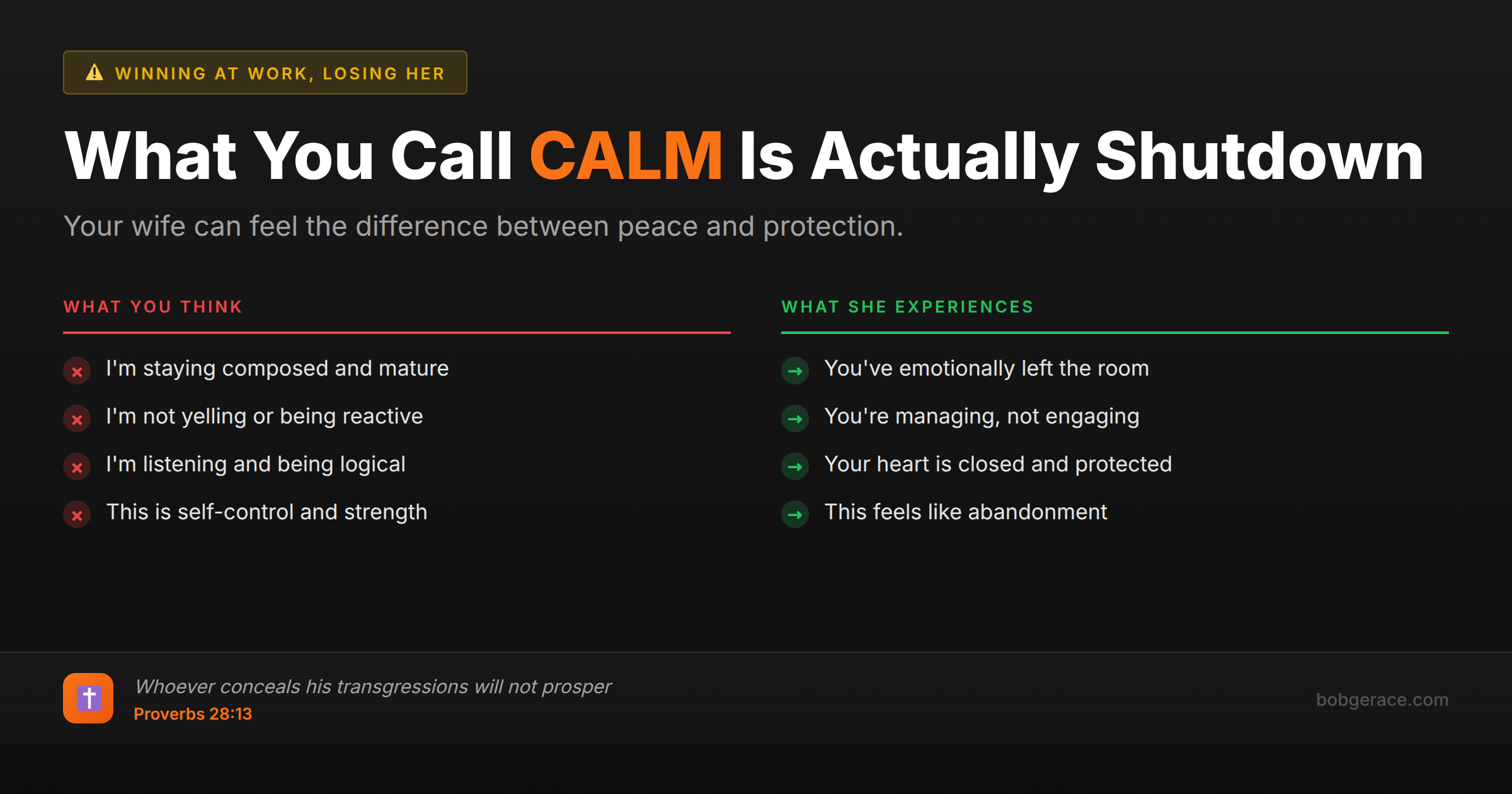
You think you are calm because you are not yelling, not reactive, not visibly upset. You believe that staying composed, logical, and even-toned is maturity. And in many contexts, it is. But in marriage, what you call calm is often emotional shutdown. You are not present. You are protected. Your nervous system has moved into a defensive state that looks like peace but feels like abandonment to your wife. The confusion comes because shutdown mimics self-control. You are not throwing things or storming out. You are sitting there, listening, nodding. But internally, you are gone. Your heart rate is elevated. Your thinking is narrow. You are managing the conversation, not engaging in it. She can feel the difference. What you experience as calm, she experiences as coldness. What you think is strength, she reads as indifference. And that gap is destroying your connection.
The Difference Between Calm and Shutdown
Calm is regulated presence. Shutdown is defended absence. The problem is they look almost identical from the outside. Both involve a steady voice, controlled body language, and minimal emotional expression. But the internal experience is completely different. Calm means you are grounded, open, and able to stay connected even in tension. Shutdown means you are braced, numb, and working hard to avoid feeling anything.
When your wife brings up something hard—her loneliness, your distance, the state of the marriage—you often move into shutdown without realizing it. You think you are being rational. You think you are not making it worse. But your body has left the conversation. You are no longer curious. You are no longer soft. You are in defense mode, and every word out of your mouth is designed to end the discomfort, not deepen the connection.
This is especially common in high-performing men. You have been rewarded your entire life for staying composed under pressure. At work, that is leadership. In marriage, it is often avoidance. Your wife does not need you to be unshakable. She needs you to be reachable. She needs to know that what she says lands, that it matters, that you are affected by her. When you stay calm in a way that communicates nothing touches you, she feels invisible.
The other layer: many men use calm as a weapon. Not consciously, but functionally. When she is emotional and you are not, it creates a power dynamic. You get to be the reasonable one. She becomes the emotional one. You stay in control. She feels out of control. And over time, that dynamic becomes the story. She is too much. You are fine. Except you are not fine. You are just better at hiding.
Why Shutdown Feels Like Calm to You
Shutdown is a parasympathetic nervous system response. It is your body's way of conserving energy and protecting you from overwhelm when fight or flight is not an option. Your heart rate may spike briefly, then drop. Your breathing shallows. Your emotions flatten. You feel a kind of numbness or distance. To you, this feels like calm because you are not agitated. But it is not regulation. It is dissociation.
Most emotionally unavailable men learned early that emotions are unsafe. Maybe your father was volatile, so you learned to go quiet. Maybe your mother was anxious, so you learned to stay steady to keep the peace. Maybe you were shamed for crying, for needing, for feeling. Whatever the origin, your nervous system built a strategy: when emotion shows up, shut it down. That strategy worked. It kept you safe. It helped you succeed. But it also taught you to mistake numbness for peace.
The other piece: you may genuinely believe that staying calm is the right thing to do. You think, 'If I get emotional, it will make things worse. If I stay level, we can solve this.' But your wife is not asking you to solve. She is asking you to feel with her. She is asking you to let her words affect you, to let her pain matter, to show up as a human, not a consultant. When you stay calm in a way that communicates you are untouched, she does not feel heard. She feels managed.
This is not about becoming reactive or losing control. It is about recognizing that true calm includes emotional availability. It includes the ability to feel, to be moved, to let your face show something. If your version of calm requires you to disconnect from your wife, it is not calm. It is a coping mechanism. And it is costing you intimacy.
Jesus Was Not Emotionally Unavailable
Jesus wept. He overturned tables. He felt compassion so deeply it moved him to action. He was angry at injustice. He was grieved by betrayal. He was fully present in every emotion, and he never used calm as a way to avoid connection. His peace was not the absence of feeling. It was the presence of God in the middle of feeling.
Proverbs 28:13 says, 'Whoever conceals his transgressions will not prosper, but he who confesses and forsakes them will obtain mercy.' Emotional unavailability is a form of concealment. You hide what you feel. You hide what her words do to you. You hide your fear, your shame, your inadequacy. You think that makes you strong. But it makes you alone. And it makes her alone.
Ephesians 4:26 says, 'Be angry and do not sin; do not let the sun go down on your anger.' Notice it does not say, 'Do not be angry.' It assumes you will feel. The question is what you do with it. Emotional availability is not about perfect expression. It is about honest presence. It is about letting your wife see what is happening inside you, even when it is uncomfortable.
God does not call you to be a stoic. He calls you to be a man after his own heart. And his heart feels. It breaks. It rejoices. It laments. If you are using calm to avoid being known, you are not reflecting Christ. You are reflecting self-protection. And that is not the same thing as strength.
Action Steps
-
1
Next time your wife brings up something emotional, check your body. Is your chest tight? Is your breathing shallow? If yes, you are likely in shutdown, not calm.
-
2
Say out loud, 'I am working hard to stay calm right now, and I realize I might be shutting down instead. Help me stay with you.' This is vulnerability, not weakness.
-
3
Practice letting your face show something. If she says something that hurts, let your face register it. Do not perform. Just stop hiding.
-
4
Ask yourself: Am I staying calm to stay connected, or to avoid feeling? If it is the latter, name it. 'I think I am avoiding this because it is hard for me.'
-
5
Work with a coach or therapist who understands nervous system regulation. Learn the difference between true calm and defended numbness. Your marriage depends on it.
Related Questions
- How can my wife feel neglected when I work so hard for her?
- How do I know if I am an emotionally unavailable husband?
- Why does my success not make her feel secure?
- What is emotional neglect in marriage?
- What if I do not know how to talk about feelings?
- Why do I feel attacked when she says she needs me?
Also find Bob on
Subscribe for weekly videos on Christian marriage.
Calm Is Not the Same as Connected
If your wife says you are emotionally unavailable and you do not understand why, let's talk. I help men learn the difference between shutdown and presence.
Talk to Bob →