Why do I feel attacked when she says she needs me?
5 min read
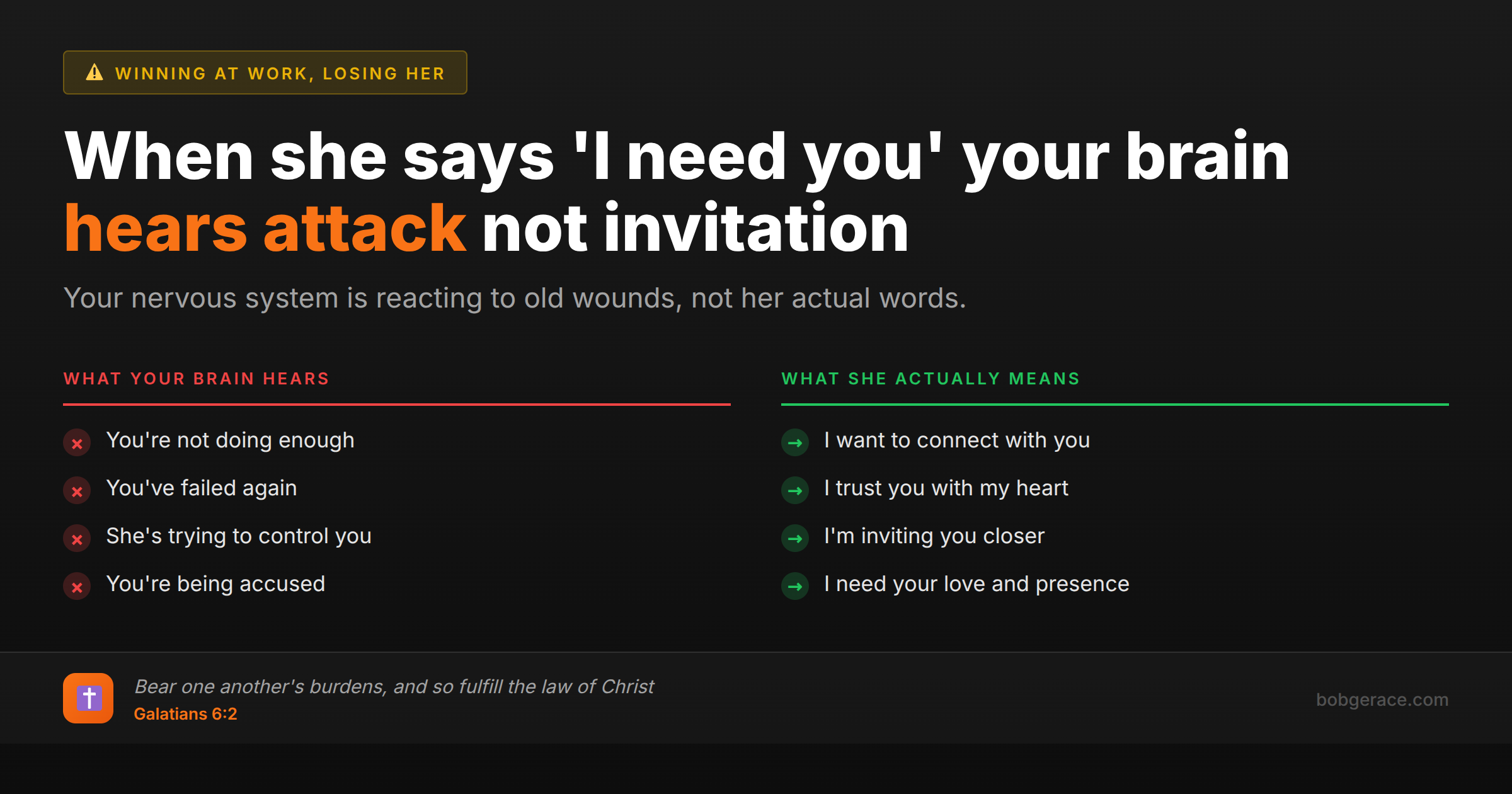
You feel attacked because your nervous system interprets her need as evidence of your failure. Somewhere deep in your wiring, you learned that being needed means you have not done enough, you are not enough, or you are being controlled. So when she says, 'I need you,' your brain does not hear an invitation. It hears an accusation. Your body floods with cortisol. You go into defense mode. You argue, withdraw, or counterattack. None of this is conscious. It is automatic. This response is usually rooted in attachment wounds or performance-based worth. If you grew up in an environment where love was conditional on achievement, you learned to see need as demand. If you had a parent who was emotionally invasive or controlling, you learned to see vulnerability as manipulation. Your wife is not doing either of those things. But your system does not know that. It is reacting to old data. The work is learning to separate her present request from your past pain.
What Her Need Triggers in You
When your wife says she needs you, she is making a bid for connection. She is saying, 'I want you close. I want to feel you with me. I want emotional presence, not just physical proximity.' That is a gift. It means she still believes you can meet her. It means she has not given up. But you do not hear it that way. You hear it as criticism. You hear, 'You are not doing enough. You are failing me. You are inadequate.'
This is not because you are a bad husband. It is because your nervous system has been trained to equate need with failure. If you grew up in a home where your worth was tied to performance, you learned that being needed meant you had not performed well enough. If you had a mother who was emotionally enmeshed or a father who was emotionally absent, you learned that need equals pressure, obligation, or loss of self. So now, when your wife expresses a legitimate need for connection, your system interprets it as a threat.
You do not say, 'Thank you for telling me.' You say, 'What do you mean you need me? I am here every day. I work my ass off for this family. What more do you want?' You are not hearing her. You are hearing the voice in your head that says you are not enough. And you are defending against that voice, not against her. She feels rejected. You feel misunderstood. The cycle deepens. And neither of you knows how to stop it.
The Nervous System Response Behind Defensiveness
Defensiveness is a nervous system state, not a character flaw. When your wife expresses a need, your amygdala scans for threat. If your attachment history includes criticism, control, or conditional love, your brain flags her statement as danger. Your sympathetic nervous system activates. Your heart rate increases. Your thinking brain goes offline. You move into fight or flight. You argue the facts. You list your contributions. You shut down and leave. You are not choosing this response. Your body is executing a survival program.
This is especially common in men with avoidant attachment patterns. You learned early that closeness comes with conditions or pain. So you developed strategies to maintain distance while appearing engaged. You provide. You solve problems. You are reliable. But you do not let her all the way in. When she asks for more emotional presence, it feels like she is asking you to dismantle the very system that has kept you safe. Your nervous system resists. It interprets her need as an invasion, not an invitation.
The way out is not to shame yourself for the response. It is to notice it, name it, and interrupt it. You feel the tightness in your chest. You notice the urge to defend. You pause. You take a breath. You remind yourself: 'She is not my mother. She is not attacking me. She is asking for connection.' Then you respond from your prefrontal cortex, not your amygdala. You say, 'Tell me more about what you need.' That is the work. It is neurobiological, not just relational. And it is absolutely trainable.
Bearing One Another's Burdens
Galatians 6:2 says, 'Bear one another's burdens, and so fulfill the law of Christ.' Your wife's need is not a burden in the negative sense. It is an opportunity to love her the way Christ loves the church. When she says she needs you, she is inviting you into the core of what marriage is: mutual dependence, sacrificial love, and emotional intimacy. She is not trying to control you. She is trying to connect with you.
The problem is that many men have been taught that independence is strength and need is weakness. You have been conditioned to see self-sufficiency as the goal. But that is not the biblical model. The Bible is full of language about dependence, need, and mutual care. We are called to be members of one body. To weep with those who weep. To carry each other's loads. That requires vulnerability on both sides. It requires you to let her need you without interpreting it as failure.
Jesus did not respond to need with defensiveness. When people came to Him desperate, broken, and needy, He did not say, 'What more do you want from Me?' He moved toward them. He saw their need as an invitation to love, not a critique of His adequacy. That is the posture you are called to. When your wife says she needs you, she is giving you the chance to be Christ to her. Not because you are failing. Because you are her husband. And that is what husbands do.
Action Steps
-
1
Next time your wife says she needs you or expresses hurt, pause before responding. Notice what you feel in your body. Name it silently: 'I feel defensive. I feel accused. My chest is tight.' Do not react from that state.
-
2
Practice this response out loud in the mirror: 'Thank you for telling me. Help me understand what you need.' Say it until it feels less foreign. Then use it the next time she makes a bid for connection.
-
3
Write down three times in your childhood when expressing need led to criticism, rejection, or punishment. Recognize that your wife is not those people. She is safe. Your past is not your present.
-
4
Ask her this week: 'When you say you need me, what does that actually mean? What does it look like?' Listen without defending. Let her teach you what she is asking for.
-
5
Pray this daily for one week: 'God, help me see her need as an invitation, not an attack. Calm my nervous system. Teach me to love her the way You love me.' Then notice if your reactivity shifts.
Related Questions
- How can my wife feel neglected when I work so hard for her?
- How do I know if I am an emotionally unavailable husband?
- Why does my success not make her feel secure?
- What is emotional neglect in marriage?
- Why does she remember small moments I forgot?
- How do I become safer without becoming soft or passive?
Also find Bob on
Subscribe for weekly videos on Christian marriage.
Stop Reacting. Start Responding.
Learning to regulate your nervous system and respond to your wife without defensiveness is not something you can willpower your way through. You need a process, accountability, and a guide who gets it. That is what I provide.
Talk to Bob →