Why do I shut down when she wants to talk?
5 min read
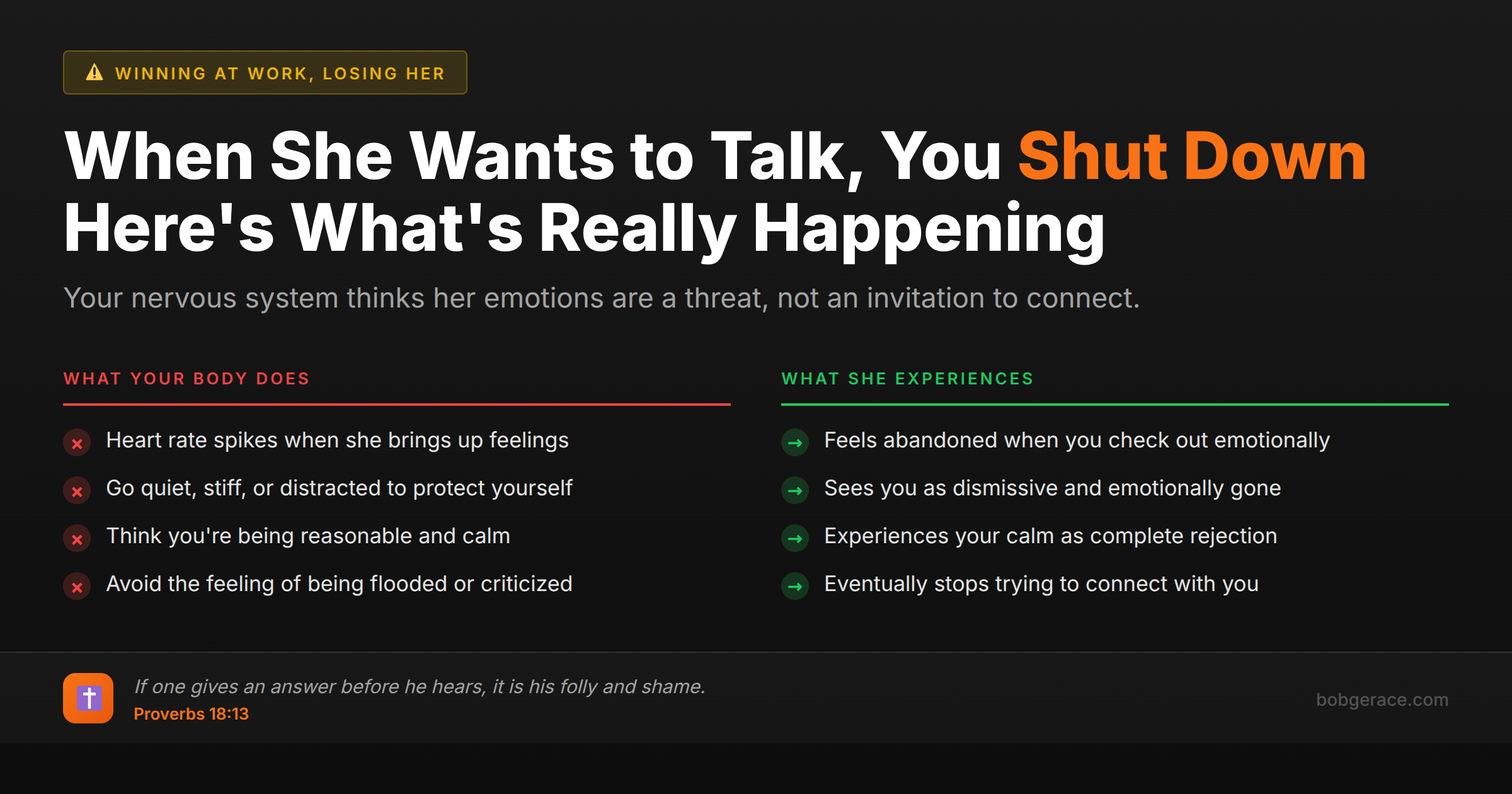
You shut down because your nervous system interprets her emotion as a threat, not an invitation. When she wants to talk—especially about feelings, the marriage, or something you did—your body moves into a defensive state. Your heart rate spikes. Your thinking narrows. You go quiet, stiff, or distracted. This is not weakness. It is your autonomic nervous system doing what it was trained to do: protect you from overwhelm. The problem is that what feels like calm to you feels like abandonment to her. You think you are being reasonable. She experiences you as checked out, dismissive, or emotionally gone. You are not avoiding her on purpose. You are avoiding the feeling of being flooded, criticized, or not enough. But the cost is connection. And over time, she stops trying.
What Shutdown Actually Looks Like in Your Marriage
Shutdown does not always mean silence. Sometimes it is the blank stare. The one-word answers. The sudden need to check your phone, fix something in the garage, or pivot to logistics. You might stay in the room but leave emotionally. Your wife can feel it. She says something vulnerable or frustrated, and within seconds, you are gone.
This usually happens when the conversation touches something uncomfortable: her loneliness, your work hours, sex, money, the kids, or how she feels unseen. The topic does not matter as much as the emotional charge. When her tone shifts or her eyes well up, your system reads danger. You were not taught to stay present in emotional intensity. You were taught to solve, fix, or avoid. So you do.
Most men do not realize they are shutting down. You think you are listening. You think you are calm. But your body has left the conversation. Your breath is shallow. Your jaw is tight. Your mind is scanning for an exit or a rebuttal. She is trying to connect. You are trying to survive. That gap becomes the story of your marriage.
This is not about her being too emotional or you being too logical. It is about two nervous systems that are not synced. Hers is reaching. Yours is retreating. And every time you pull away, she feels more alone. Every time she feels more alone, she escalates or withdraws. The cycle deepens. The distance grows. And eventually, she stops asking you to stay.
Why Your Nervous System Reads Her Emotion as Threat
When your wife wants to talk about something emotional, your body often moves into a state called dorsal vagal shutdown. This is a primitive survival response. It is not conscious. Your heart rate climbs. Your prefrontal cortex—the part of your brain that handles nuance, empathy, and connection—goes offline. Your system prioritizes defense.
For high-performing men, this response is often reinforced by years of training. You learned early that emotions slow you down, that vulnerability is risky, that the way to win is to stay composed and in control. At work, that serves you. In marriage, it kills intimacy. Your wife is not a problem to solve or a performance to manage. She is a person trying to be known. But your system does not distinguish between a tense board meeting and a tense conversation with her.
Shutdown is also a learned response to criticism or conflict. If you grew up in a home where emotion meant chaos, or where you were shamed for feeling, your nervous system built walls. Those walls kept you safe then. Now they keep you isolated. You are not defective. You are defended. And that defense is costing you the marriage.
The other piece: many men shut down because they carry shame about not being enough. When she is upset, you hear, 'You failed.' Even if that is not what she said. So instead of staying and listening, you disconnect to avoid the feeling. The irony is that disconnecting confirms her fear: that you do not care, that she does not matter, that she is alone.
Staying Present Is a Form of Love
Scripture does not call you to be emotionless. It calls you to be present. Proverbs 18:13 says, 'If one gives an answer before he hears, it is his folly and shame.' Shutdown is answering before you hear. It is folly because it breaks connection. It is shame because deep down, you know you left.
Jesus did not avoid hard conversations. He stayed. He wept with Mary and Martha. He let Peter's denial wound him. He listened to the woman at the well without fixing her or fleeing. Presence is not passive. It is active love. It is choosing to stay in the room when your body wants to run.
Ephesians 5 tells husbands to love their wives as Christ loved the church. That love is not transactional. It is sacrificial. It costs you something. Staying present when she is emotional costs you comfort. It costs you control. It costs you the illusion that you can manage her feelings or avoid your own. But it gives her something she cannot get anywhere else: you.
God designed marriage to refine you, not just comfort you. The moments you want to shut down are often the moments where real intimacy is available. Not because you perform perfectly, but because you stay. You let her see you. You let yourself feel. That is where trust is built. That is where love deepens.
Action Steps
-
1
Notice your body when she starts a hard conversation. Where do you feel tension? Chest, jaw, stomach? Name it: 'I am shutting down right now.'
-
2
Say out loud, 'I want to stay present with you, and I am feeling flooded. Can we slow down for a minute?' This is not avoidance. It is honesty.
-
3
Practice box breathing before and during the conversation: four counts in, four hold, four out, four hold. This keeps your nervous system regulated.
-
4
Ask her one clarifying question instead of defending or solving. 'What do you need me to hear right now?' Then listen without rebuttal.
-
5
After the conversation, do not disappear. Stay in the room. Touch her arm. Say, 'Thank you for telling me.' Even if it was hard. Especially if it was hard.
Related Questions
- How can my wife feel neglected when I work so hard for her?
- How do I know if I am an emotionally unavailable husband?
- Why does my success not make her feel secure?
- What is emotional neglect in marriage?
- How do I become safer without becoming soft or passive?
- What if I do not know how to talk about feelings?
Also find Bob on
Subscribe for weekly videos on Christian marriage.
You Do Not Have to Keep Shutting Down
If you are tired of going silent every time she needs you, let's talk. I work with men who want to stay present without losing themselves.
Talk to Bob →