Why does my wife feel alone in our marriage?
6 min read
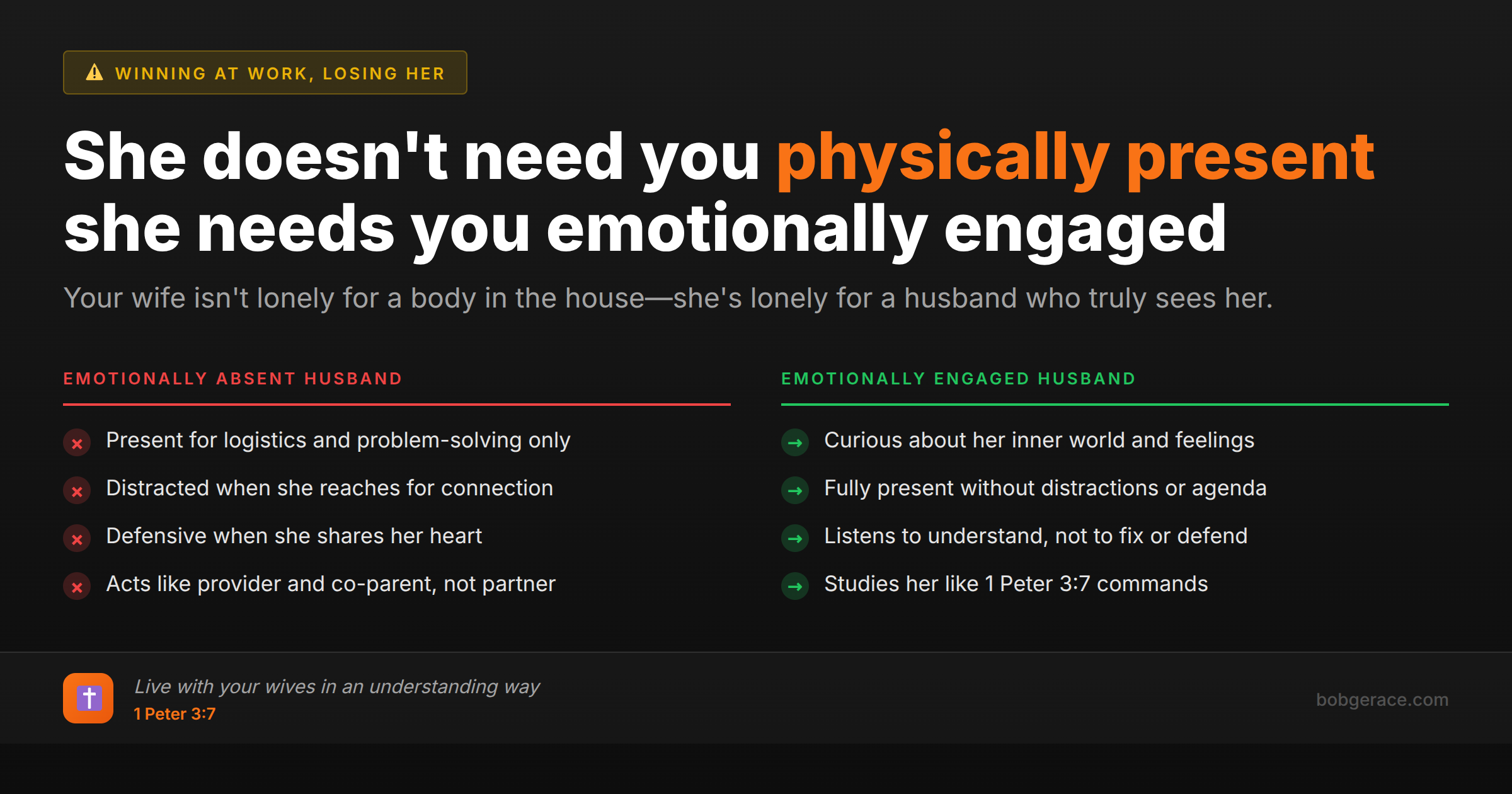
Your wife feels alone in your marriage because emotional presence matters more than physical presence. You can be in the same house, even the same room, and she can still feel completely unseen and unknown. She's not lonely for a body in the house—she's lonely for a husband who is emotionally engaged, curious, responsive, and present. This usually isn't one dramatic failure. It's a pattern where you're distracted, defended, or unavailable when she reaches for connection. You're there for logistics and problem-solving, but not for emotional intimacy. She experiences you as a provider and a co-parent, but not as a partner who truly sees her.
The Difference Between Being There and Being Present
Most men hear "my wife feels alone" and think, "That's ridiculous—I'm right here." And you are. You're in the house. You're at the dinner table. You're in bed next to her. But being physically present is not the same as being emotionally available.
Emotional availability means your wife can reach for you and find you. It means when she talks, you're not just waiting for your turn or thinking about work. It means when she's upset, you don't immediately try to fix it or dismiss it—you stay with her in it. It means she feels seen, known, valued, and prioritized.
For many high-performing men, emotional availability is harder than closing a deal or solving a business problem. You've built a career on being competent, decisive, and solution-oriented. But your wife doesn't need you to solve her—she needs you to be with her.
She feels alone when you're on your phone during dinner. She feels alone when she tries to tell you about her day and you give her a distracted "uh-huh." She feels alone when the only time you touch her is when you want sex. She feels alone when you're more engaged with your work, your hobbies, or your phone than you are with her.
She's not asking you to be perfect. She's asking you to be present. To look at her when she talks. To ask follow-up questions. To notice when she's struggling. To initiate connection that isn't about sex. To be curious about her inner world, not just her to-do list.
The loneliness she feels isn't about you being a bad guy. It's about you being an absent one—even while you're standing right there.
Emotional Unavailability as a Nervous System Defense
Emotional unavailability is often a nervous system defense, not a character flaw. Many high-performing men learned early that emotions are dangerous, weak, or unproductive. You learned to shut down feelings, push through discomfort, and stay focused on the task. This served you well in your career. It's killing your marriage.
When your wife reaches for emotional connection, your nervous system may perceive it as a threat. It feels vulnerable, out of control, or overwhelming. So you defend: you problem-solve, you minimize, you change the subject, you get logical, or you shut down entirely. You're not trying to hurt her—you're trying to regulate yourself.
But what feels like self-protection to you feels like rejection to her. Every time she reaches for you and you deflect, her nervous system registers it as, "I'm not safe with him. He doesn't want to know me. I'm alone."
Over time, this creates an attachment injury. She learns that emotional intimacy with you is painful. So she stops reaching. She becomes self-sufficient, not because she's thriving, but because she's adapted to your unavailability. She's lonely, but she's also protecting herself from the repeated experience of reaching for you and finding no one there.
This dynamic often shows up in what therapists call "pursue-withdraw." She pursues connection, you withdraw. The more she pursues, the more you withdraw. Eventually, she stops pursuing, and you think the problem is solved. But the problem isn't solved—it's just gone underground. She's still lonely. She's just stopped expecting you to do anything about it.
The Call to Know and Be Known
Genesis 2:25 says Adam and Eve were "naked and unashamed." This isn't just about physical nakedness—it's about emotional and spiritual vulnerability. God's design for marriage is that you would be fully known and fully loved. But many men are terrified of being fully known, so they keep their wife at arm's length.
First Peter 3:7 calls you to live with your wife "in an understanding way." The Greek word implies deep knowledge, careful attention, intentional study. You're called to be a student of your wife—not just her preferences and logistics, but her heart, her fears, her dreams, her inner world.
Jesus modeled emotional presence. He wept with those who wept. He noticed people others ignored. He asked questions and listened. He was fully present, even when it was uncomfortable. He didn't fix everyone's problems—He was with them in their pain.
Proverbs 18:2 says, "Fools find no pleasure in understanding but delight in airing their own opinions." Many men approach their wife's emotions with their own opinions, solutions, and defenses. But wisdom delights in understanding—in knowing her, in being curious, in staying present even when it's hard.
Your wife's loneliness is an invitation. It's an invitation to step into the vulnerability and intimacy God designed for marriage. It's uncomfortable, yes. But it's also the path to the connection you both long for.
Action Steps
-
1
Ask your wife: 'When do you feel most alone in our marriage?' Listen to her answer without defending, explaining, or fixing. Just listen and say, 'Thank you for telling me.'
-
2
Identify your go-to defense when she reaches for emotional connection. Do you problem-solve? Minimize? Change the subject? Get quiet? Name the pattern.
-
3
Practice 10 minutes of full presence every day. No phone, no distractions, no agenda. Sit with her and ask, 'How are you?' Then follow up with curiosity.
-
4
Notice when you feel uncomfortable with emotional intimacy. What happens in your body? Where do you feel it? Don't judge it—just notice it.
-
5
Initiate non-sexual physical touch three times a day: a hug, holding her hand, a kiss that isn't a peck. Let her feel that you want to be close to her, not just when you want something.
Related Questions
Also find Bob on
Subscribe for weekly videos on Christian marriage.
Learn to Show Up Emotionally
Emotional availability isn't something you figure out on your own. It's a skill you develop with the right guidance. If your wife feels alone, it's time to get help.
Talk to Bob →