Why does she bring up things from years ago?
6 min read
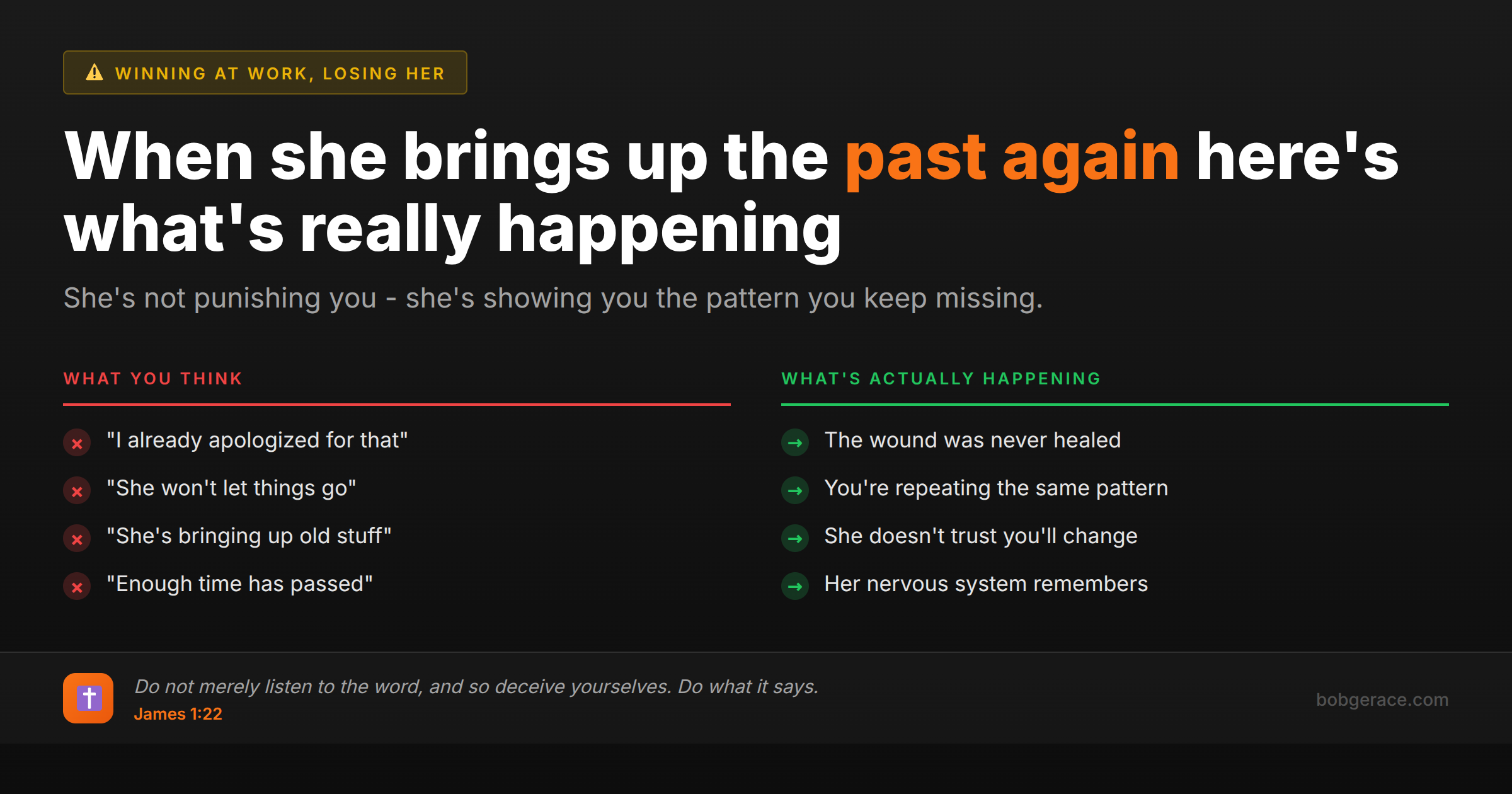
She brings up things from years ago because those events were never fully resolved. You think you apologized or that enough time has passed, but her nervous system still carries the wound. Each time you repeat a similar pattern—dismissing her feelings, prioritizing work, being emotionally unavailable—her brain connects it to the original hurt. She is not trying to punish you. She is trying to show you that the problem never actually went away. Resentment is not about the past. It is about a present reality: she does not trust that you see her, hear her, or will change. When she brings up old events, she is saying, "You are doing it again, and I have been here before." The issue is not her memory. The issue is that you have not addressed the root pattern that caused the pain in the first place. Until you do, the past will keep showing up in your present.
The Resentment Ledger: How Unresolved Pain Compounds
Your wife is not keeping score because she is petty. She is keeping score because her brain is designed to detect patterns and protect her from repeated harm. Every time you promised to be more present and then worked late for three weeks straight, her brain logged it. Every time you said you understood her feelings and then dismissed them the next day, her nervous system recorded the gap between your words and your actions. Every time you initiated sex without first connecting emotionally, her body remembered feeling used.
Resentment builds when there is a repeated cycle of hope and disappointment. She tells you what she needs. You acknowledge it, maybe even apologize. Then you go back to the same behavior. Her brain learns that your words do not predict your actions. So when a new conflict arises, her system pulls up the old evidence to say, "See? This is who he is. This is what he does."
Most men hear her bring up the past and think, "Why can't she let it go? I said I was sorry. That was years ago." But an apology without behavior change is just noise. If you apologized for working too much in 2019 and you are still working too much in 2025, the apology meant nothing. She is not holding a grudge. She is responding to an ongoing pattern that you have not actually changed.
The other dynamic at play is that she may not have felt safe or able to fully express her pain when the original event happened. Maybe you shut her down. Maybe she was pregnant or postpartum and did not have the bandwidth. Maybe she tried to tell you and you minimized it, so she buried it. Now, years later, when she feels the same pain again, it all comes flooding back. She is not being irrational. She is finally giving voice to something that never got resolved.
How the Brain Stores Unresolved Relational Trauma
From a neuroscience perspective, unresolved emotional pain does not just disappear with time. It gets stored in implicit memory—the part of the brain that holds feelings, body sensations, and automatic responses without a clear narrative. When your wife brings up something from years ago, she is not consciously choosing to dredge up the past. Her nervous system is reacting to a present trigger that feels similar to the past wound.
This is how trauma works in relationships. If she felt abandoned when you missed her mother's funeral for a work trip, and now you are missing your daughter's recital for a client meeting, her brain does not see two separate events. It sees one continuous pattern of abandonment. The original pain was never metabolized, never fully seen, never repaired. So it resurfaces every time the pattern repeats.
Attachment theory explains this as well. When a partner repeatedly fails to respond to bids for connection or repair, the other partner's attachment system shifts into hypervigilance. She becomes more sensitive to signs of disconnection because her brain is trying to protect her from future hurt. What looks like her overreacting to a small issue is actually her system responding to years of accumulated small betrayals.
Resentment also has a physiological component. Chronic unaddressed hurt keeps the nervous system in a low-grade state of activation. She may seem calm on the surface, but internally, her body is braced. When she brings up the past, it is often because her system has hit a threshold. The current event was the final straw, and all the unprocessed pain comes with it. You cannot logic her out of this. You have to help her nervous system feel safe again, and that requires consistent, attuned presence over time.
Repentance Means Change, Not Just Regret
In Scripture, repentance is not just saying sorry. The Greek word *metanoia* means a complete change of mind and direction. It means turning away from the sin and walking a new path. If you have apologized for the same behavior repeatedly without changing, you have not repented. You have only expressed regret, and regret without transformation is empty.
James 1:22 says, "Do not merely listen to the word, and so deceive yourselves. Do what it says." The same principle applies in marriage. Do not merely listen to your wife's pain and acknowledge it. Do something about it. Change your behavior. Become a different man. If she brings up the past, it is because the present still looks too much like it.
Proverbs 28:13 says, "Whoever conceals their sins does not prosper, but the one who confesses and renounces them finds mercy." Confession without renouncing the behavior is manipulation. Your wife does not need another apology. She needs to see that you have renounced the pattern that hurt her. She needs evidence that you are becoming a man who sees her, prioritizes her, and follows through.
Jesus also taught that love is demonstrated through action, not just words. In John 14:15, he says, "If you love me, keep my commands." Your wife is not asking you to be perfect. She is asking you to be consistent. She is asking you to prove over time that your love is more than a feeling or a statement. It is a daily choice to put her needs, her heart, and her trust above your comfort, your career, and your pride.
Action Steps
-
1
The next time she brings up something from the past, do not defend yourself or say 'I already apologized for that.' Instead, say: 'I hear you. That hurt you, and I have not fully made it right. Help me understand what you need from me now.'
-
2
Identify one recurring complaint she has made over the years. Write down three specific times you repeated the behavior after promising to change. Own the pattern.
-
3
Ask her this week: 'Is there something I hurt you with in the past that I never fully acknowledged or repaired?' Listen without interrupting. Do not explain. Just receive it.
-
4
Pick one behavior she has asked you to change repeatedly. Commit to 90 days of consistent change, not just a week of effort. Track it. Let her see the follow-through.
-
5
If resentment has built for years, consider working with a coach or counselor who can help you rebuild trust and learn how to repair past wounds, not just manage current conflicts.
Related Questions
Also find Bob on
Subscribe for weekly videos on Christian marriage.
Resentment Does Not Heal on Its Own
If your wife keeps bringing up the past, it is because the present has not changed enough. Resentment is a warning sign, not a character flaw. Let's talk about how to address the root patterns, rebuild trust, and become the kind of man she can stop keeping score with.
Talk to Bob →