She says she's never felt this way before
6 min read
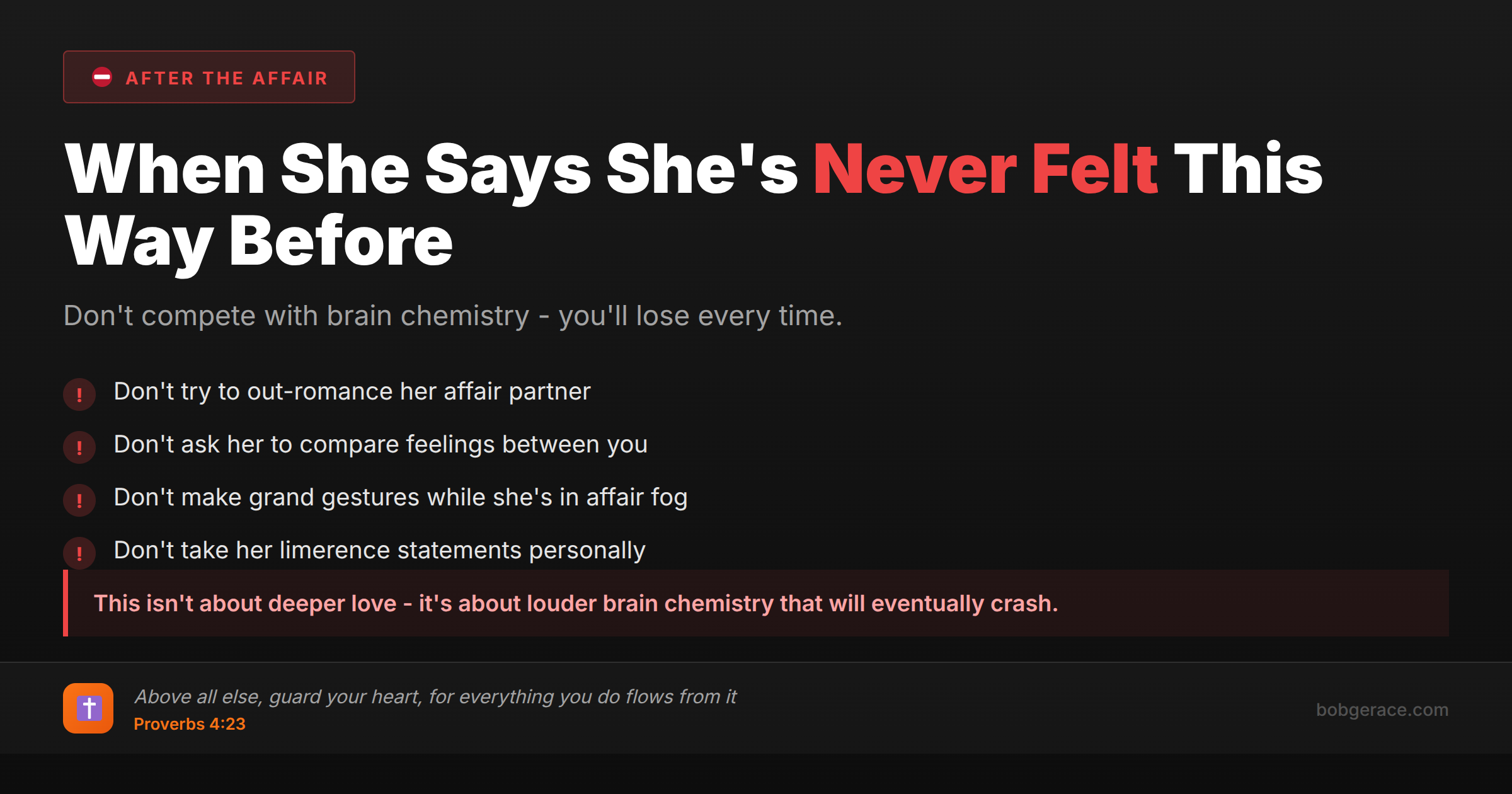
When your wife says she's "never felt this way before" about her affair partner, she's describing limerence - a neurochemical cocktail of dopamine, norepinephrine, and decreased serotonin that creates an addictive obsession disguised as love. This isn't about her lacking feelings for you throughout your marriage; it's about her brain being hijacked by a chemical high that feels more intense than mature love ever could. The phrase "never felt this way before" is so common in affairs that marriage therapists hear it constantly. What she's actually saying is that she's never experienced this particular type of brain chemistry before - the obsessive, all-consuming rush of new attraction combined with the forbidden nature of the relationship. This feeling seems more "real" than marital love because it's louder, not because it's deeper.
The Full Picture
Your wife's declaration that she's "never felt this way before" hits like a dagger to the heart, but you need to understand what's really happening here. She's not making a rational comparison between her feelings for you and her affair partner - she's describing a neurochemical experience that's fundamentally different from mature, committed love.
Limerence is not love. It's an obsessive state characterized by intrusive thoughts, emotional dependency, and an overwhelming need for reciprocation from the other person. When someone is in limerence, their brain produces a cocktail of chemicals similar to those found in cocaine addiction. The dopamine hits from each text, glance, or interaction create a powerful reinforcement cycle that makes the person crave more contact.
This explains why she might say things like "I can't stop thinking about him" or "I've never needed someone like this." These aren't statements about love quality - they're descriptions of addiction symptoms. The reason she "never felt this way before" in your marriage is because healthy, secure love doesn't create obsessive dependency.
The comparison trap is where many betrayed spouses get stuck. You start wondering: "Was our entire marriage a lie? Did she never really love me?" The truth is, she's comparing apples to oranges. Limerence feels more intense than marital love the same way a sugar rush feels more intense than a balanced meal - but only one provides actual nourishment.
The affair fog makes her believe this intensity equals depth, but it's actually the opposite. Surface-level infatuation burns hot precisely because it lacks the complex foundation that real love requires. She's mistaking the drama of uncertainty for passion, and the excitement of secrecy for connection.
What's Really Happening
From a clinical perspective, the statement "I've never felt this way before" is a textbook indicator of limerence, first identified by psychologist Dorothy Tennov in 1979. What we're seeing is a person whose brain chemistry has been altered by the perfect storm of novelty, uncertainty, and barrier-//blog.bobgerace.com/marriage-intelligence-data-driven-crisis-campaign/:driven attraction.
The neurobiological reality is fascinating and tragic. During limerence, the brain's reward system floods with dopamine, creating genuine euphoria. Simultaneously, serotonin levels drop by up to 40% - the same decrease we see in people with obsessive-compulsive disorder. This explains the intrusive thoughts and compulsive behaviors around the affair partner.
When your wife says she's "never felt this way," she's technically correct - but not in the way she thinks. She's never experienced this particular dysfunction of her neurochemical system before. The feeling is real, but it's not love in any meaningful sense. It's closer to a drug-induced state that hijacks the brain's bonding mechanisms.
The cruel irony is that limerence often feels more "real" than secure attachment precisely because it's so disruptive. Healthy love in a marriage operates quietly in the background, providing stability and security without constant drama. But limerence screams for attention, creating the illusion of greater significance.
Most people in limerence genuinely believe they've discovered "true love" for the first time. This isn't conscious deception - their altered brain chemistry makes the experience feel profound and unprecedented. Understanding this helps explain why logical arguments about commitment and family rarely penetrate the affair fog. You're trying to reason with someone whose reasoning centers are compromised.
What Scripture Says
Scripture has much to say about the difference between fleeting feelings and genuine love, warning us repeatedly about being led astray by our emotions and desires.
"Above all else, guard your heart, for everything you do flows from it" (Proverbs 4:23). Your wife has failed to guard her heart, allowing herself to be swept away by feelings that seem overwhelming but are ultimately destructive. The Bible consistently warns against making decisions based purely on emotional intensity.
"The heart is deceitful above all things and beyond cure. Who can understand it?" (Jeremiah 17:9). This verse speaks directly to your situation. Her heart is telling her this affair represents the greatest love she's ever known, but Scripture warns us that our hearts often lie to us, especially when we're in rebellion against God's design.
"But each person is tempted when they are dragged away by their own evil desire and enticed. Then, after desire has conceived, it gives birth to sin; and sin, when it is full-grown, gives birth to death" (James 1:14-15). The progression James describes perfectly matches what happens in limerence - desire grows unchecked until it consumes everything.
"There is a way that appears to be right, but in the end it leads to death" (Proverbs 14:12). Her affair feels "right" to her precisely because she's following her feelings rather than God's wisdom. The intensity makes it seem like the correct path, but Scripture warns us that feelings can be terrible guides.
"Love is patient, love is kind" (1 Corinthians 13:4). True biblical love isn't characterized by desperate obsession or the need to destroy existing commitments. The "love" she thinks she's found lacks the patient, kind, selfless qualities that define genuine love. "Many waters cannot quench love; rivers cannot sweep it away" (Song of Songs 8:7) - yet this new "love" requires her to abandon her covenant, proving it's not the enduring love Scripture describes.
What To Do Right Now
-
1
Don't try to compete with limerence - You cannot out-romance a neurochemical addiction. Trying to win her back through grand gestures or emotional appeals will likely backfire while she's in this state.
-
2
Educate yourself about affair fog - Read about limerence, affair fog, and the neurochemistry of infidelity. Knowledge helps you respond strategically rather than reactively to her statements.
-
3
Stop asking for comparisons - Don't ask her to compare her feelings for you versus him. You're asking someone with compromised judgment to make rational assessments about irrational feelings.
-
4
Establish clear boundaries - While she's "never felt this way before," you've never been betrayed this way before either. Set firm boundaries about what behavior you will and won't accept.
-
5
Document the reality - Keep a journal of her statements and behaviors. When the fog lifts, these records help both of you understand what actually happened versus what she thought was happening.
-
6
Focus on your own healing - Her neurochemical adventure doesn't define your worth. Invest in your own recovery, therapy, and spiritual growth regardless of what she chooses to do.
Related Questions
- What is limerence?
- Is she in love or in limerence?
- How long does limerence last?
- Why does she seem like a different person?
- Is the affair fog real?
- What is the neuroscience of limerence?
- What does 'I love you but I'm not in love with you' really mean?
- Why does she prefer him to me?
- She says he 'gets' her — what does that mean?
Also find Bob on
Subscribe for weekly videos on Christian marriage.
Your Marriage Isn't a Textbook Case
Limerence follows patterns, but your wife's version—and what actually works in your specific marriage—doesn't. A coach who knows your story can see what a framework can't.
Talk to Bob →