Is she in love or in limerence?
6 min read
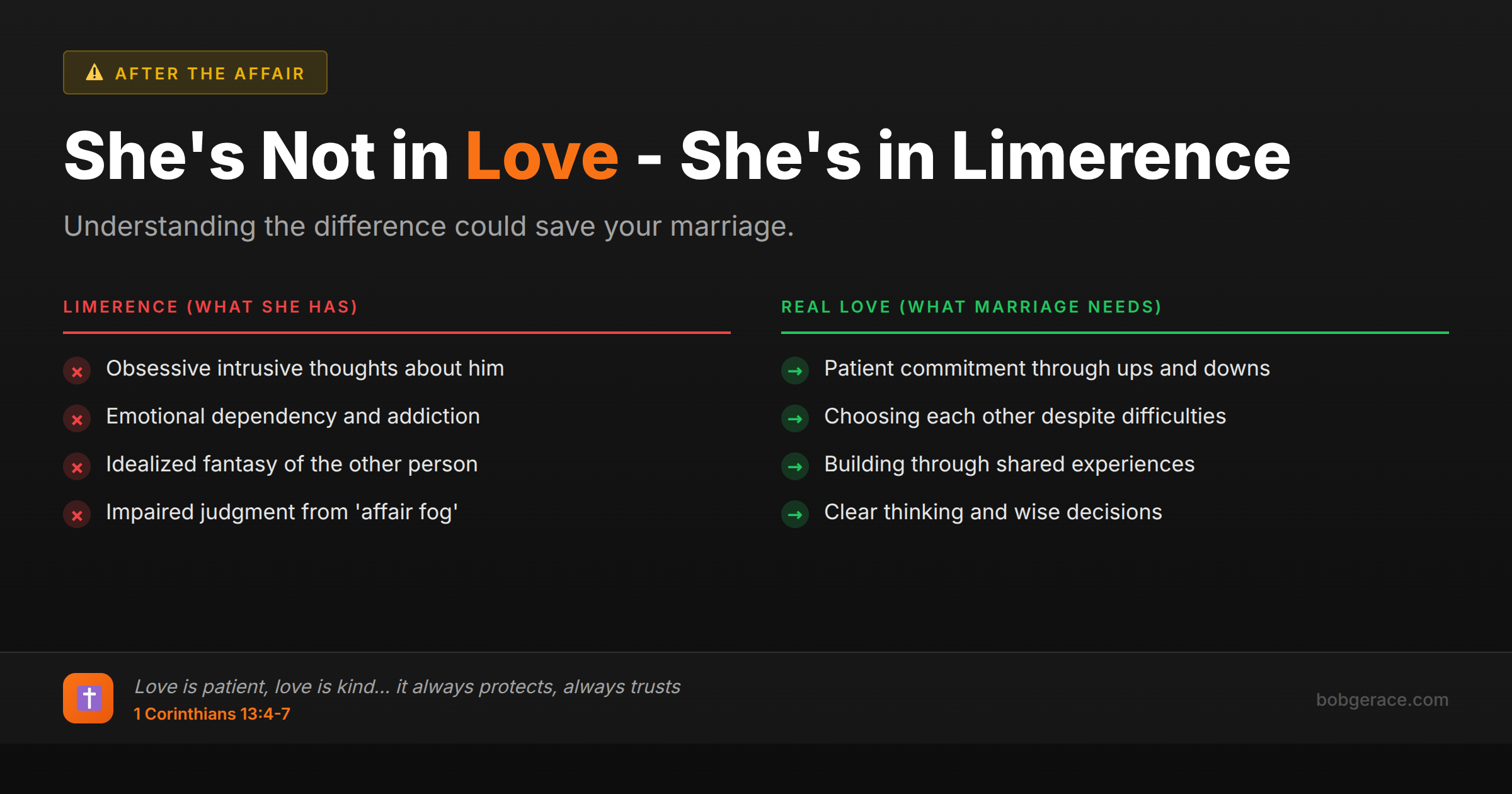
She's almost certainly in limerence, not love. When your wife says she "loves" the other man, she's describing an intense neurochemical addiction that feels like love but isn't. True love builds slowly through shared experiences, commitment, and choosing each other through life's ups and downs. Limerence is an obsessive infatuation characterized by intrusive thoughts, emotional dependency, and an idealized fantasy of the other person. Limerence creates what we call "affair fog" - a state where your wife's judgment is severely impaired by dopamine and other brain chemicals. She can't think clearly about the relationship because she's literally addicted to the emotional highs this person provides. This isn't excuse-making; it's understanding the reality of what you're dealing with so you can respond effectively.
The Full Picture
The brutal truth is that what your wife calls "love" is actually a neurochemical addiction masquerading as romance.
Limerence was first defined by psychologist Dorothy Tennov as an involuntary romantic obsession characterized by intrusive thoughts about the object of affection, an acute longing for reciprocation, and emotional dependency on having that person return their feelings. It's not love - it's a psychological state that hijacks the brain's reward system.
Here's what limerence looks like: - Obsessive thinking about the other person (often 85-95% of waking hours) - Idealizing them while minimizing their flaws - Emotional highs from any contact, devastating lows from perceived rejection - Physical symptoms: racing heart, inability to eat, insomnia - Rewriting marital history to justify the new relationship - Inability to think rationally about the situation
Real love, by contrast, is: - A choice made daily, regardless of feelings - Built on genuine knowledge of the person (flaws included) - Expressed through commitment during difficult times - Focused on the other person's wellbeing, not just your own feelings - Grounded in reality, not fantasy
The affair fog makes everything worse. Your wife literally cannot think clearly right now. Her brain is flooded with dopamine, norepinephrine, and other chemicals that create an addiction-like state. She'll say things like "I've never felt this way before" or "this is real love" - but she's describing a drug high, not mature love.
This is why reasoning with her feels impossible. You're not dealing with her normal thought processes. The woman you married is still there, but she's currently under the influence of one of the most powerful psychological states humans can experience.
What's Really Happening
From a clinical perspective, limerence activates the same //blog.bobgerace.com/social-brain-christian-marriage-identity-relational/:brain regions as cocaine addiction. PET scans show intense activity in the ventral tegmental area and caudate nucleus - the brain's reward and motivation centers. This isn't metaphorical; it's literal addiction.
The key neurochemicals involved include dopamine (creating intense pleasure and motivation), norepinephrine (causing racing thoughts and physical symptoms), and phenylethylamine (producing euphoric feelings). These chemicals create a cycle: contact with the limerent object triggers a dopamine release, followed by withdrawal symptoms that drive obsessive thoughts about the next "hit."
What makes limerence particularly destructive in marriages is its impact on memory and perception. The brain literally rewrites the past to support the current obsession. Happy marital memories are suppressed or reinterpreted negatively, while interactions with the affair partner are amplified and idealized.
The good news is that limerence is temporary. It typically lasts 18 months to 3 years, though it can end much sooner if contact with the limerent object is eliminated. The brain's neuroplasticity means these pathways can be rewired, but it requires complete cessation of contact - partial contact actually strengthens the addiction through intermittent reinforcement.
Treatment involves helping the limerent person understand they're experiencing a psychological state, not true love. Cognitive-behavioral therapy can help them recognize distorted thinking patterns, while couples therapy can begin rebuilding the marriage once the acute limerence phase ends.
What Scripture Says
Scripture gives us a clear picture of what real love looks like - and it's nothing like the obsessive infatuation your wife is experiencing.
1 Corinthians 13:4-7 describes authentic love: "Love is patient, love is kind. It does not envy, it does not boast, it is not proud. It does not dishonor others, it is not self-seeking, it is not easily angered, it keeps no record of wrongs. Love does not delight in evil but rejoices with the truth. It always protects, always trusts, always hopes, always perseveres."
Limerence fails every one of these tests. It's impatient (demanding immediate gratification), dishonoring (destroying marriage vows), self-seeking (prioritizing feelings over family), and delights in deception rather than truth.
Jeremiah 17:9 warns us: "The heart is deceitful above all things and beyond cure. Who can understand it?" Your wife's heart is deceiving her right now, convincing her that betrayal feels like love.
Proverbs 27:6 tells us "Wounds from a friend can be trusted, but an enemy multiplies kisses." The affair partner is multiplying kisses while wounding her soul and destroying her family.
1 John 4:7-8 reminds us that "love comes from God" - and God never leads us to break covenant commitments. Any "love" that requires betraying your spouse and children is not from God.
As her husband, you're called to love her even in this condition (Ephesians 5:25), but loving her doesn't mean enabling her sin or accepting ongoing betrayal. Sometimes love requires setting firm boundaries and allowing consequences to do their work.
God can heal even this situation, but it requires your wife to recognize her condition and choose the difficult path of ending all contact with the other person. Prayer, patience, and wisdom are your tools - along with appropriate consequences that protect your family.
What To Do Right Now
-
1
Stop trying to reason with her about her "feelings" - you can't logic someone out of a neurochemical addiction
-
2
Insist on complete no-contact with the affair partner as a non-negotiable condition for working on the marriage
-
3
Document everything - her statements, behaviors, and choices - in case you need this information later
-
4
Set clear boundaries with consequences you're actually willing to enforce
-
5
Find a therapist who understands limerence and affair fog, not one who will validate her "authentic feelings"
-
6
Build your own support system and focus on what you can control - your responses, choices, and healing
Related Questions
- What is limerence?
- How long does limerence last?
- Can I wait out the limerence?
- Is the affair fog real?
- When will she wake up?
- What is the neuroscience of limerence?
- Why does she seem like a different person?
- She says she's never felt this way before
- What is 'emotional disengagement'?
- Why does she prefer him to me?
Also find Bob on
Subscribe for weekly videos on Christian marriage.
Get a Coach on This Today
Limerence doesn't follow a script. A coach who knows your specific situation can tell you what to do tomorrow, not just what limerence is.
Talk to Bob →