What does flexible but firm look like?
6 min read
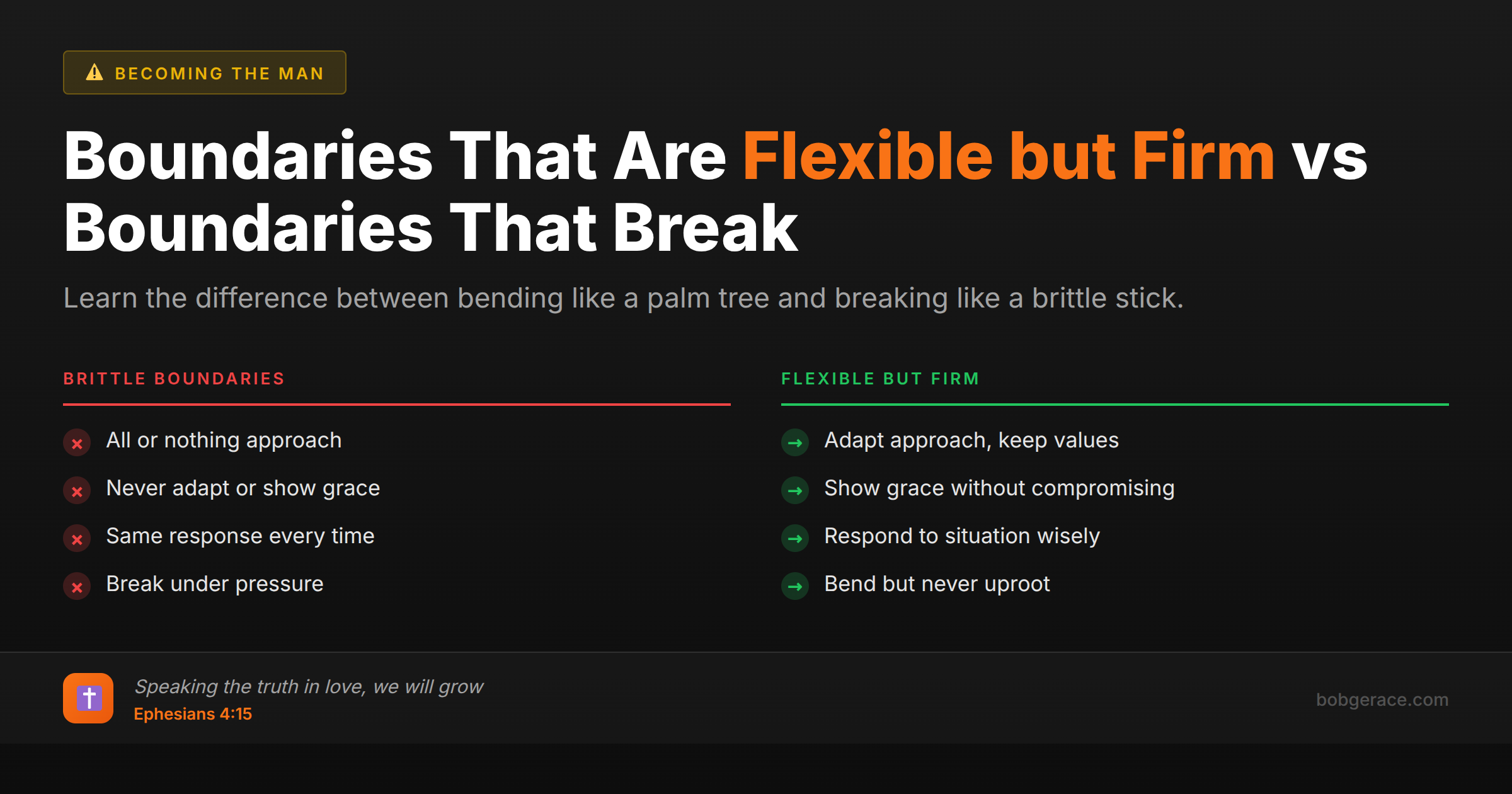
Flexible but firm boundaries mean you can adapt your approach while never compromising your core values or safety. Think of it like a palm tree - it bends with the storm but doesn't break or uproot. In marriage, this looks like being willing to negotiate timing, methods, or circumstances, but staying unmovable on your fundamental standards. For example, if your boundary is 'no disrespectful communication,' flexibility might mean giving grace when your husband is stressed and speaks harshly once, while firmness means consistently addressing the behavior and not tolerating a pattern of disrespect. You adapt your response to the situation without abandoning the boundary itself.
The Full Picture
Flexible but firm is the sweet spot of healthy boundary setting - where love meets strength, and grace meets truth. Most women struggle with being either too rigid (which damages relationships) or too permeable (which enables dysfunction).
Flexibility shows up in your *how*, *when*, and *where* - the methods, timing, and circumstances around your boundaries. Maybe your boundary is "I need advance notice for social commitments," but you can be flexible about last-minute plans for genuine emergencies while staying firm about not accepting chronic poor planning.
Firmness appears in your *what* and *why* - your core values, safety requirements, and non-negotiables. These don't change based on moods, manipulation, or pressure. If emotional safety is a boundary, it stays a boundary whether your husband is having a good day or a terrible one.
This balance requires emotional maturity and clear thinking. You need to know the difference between your negotiables and non-negotiables *before* you're in the heat of the moment. Write them down. Pray about them. Know what's truly important versus what's just preference.
The key is consistency with compassion. Your husband needs to know that while you're reasonable and loving, you're not a pushover. You'll work with him, but you won't work against yourself. This actually creates more security in your marriage because he knows where he stands and that your love includes healthy limits.
Remember: flexibility without firmness is enabling, but firmness without flexibility is controlling. The goal is to be like Jesus - full of grace and truth, never compromising truth but always delivering it with love.
What's Really Happening
From a clinical perspective, flexible but firm boundaries represent secure attachment in action. Women with this boundary style have typically developed what we call 'earned security' - they've learned to balance their own needs with relationship dynamics.
Neurologically, this approach engages your prefrontal cortex (executive functioning) rather than your amygdala (fight-or-flight). When you're flexible but firm, you're thinking clearly rather than reacting emotionally. This creates better outcomes because decisions made from a regulated nervous system are more sustainable and effective.
Psychologically, this boundary style prevents the extremes that damage relationships. Rigid boundaries often stem from fear or past trauma - you're protecting yourself but potentially pushing others away. Permeable boundaries typically come from codependency or people-pleasing - you're seeking connection but losing yourself in the process.
Flexible but firm boundaries require self-differentiation - the ability to be yourself while staying in relationship with others. This means you can hold your position without becoming defensive or aggressive, and you can consider your partner's perspective without automatically changing your mind.
The clinical benefit is that this approach actually reduces conflict over time. When your partner knows you're reasonable but reliable, they stop testing your boundaries and start respecting them. It's the testing that creates most of the drama, not the boundaries themselves.
This boundary style also models emotional regulation for your family system, creating healthier patterns for everyone involved.
What Scripture Says
Scripture beautifully demonstrates the balance of flexibility and firmness throughout God's character and His instructions for relationships.
Jesus perfectly modeled flexible but firm boundaries. In John 2:13-16, He firmly cleansed the temple when His Father's house was disrespected, yet in John 8:3-11, He showed flexibility and grace to the woman caught in adultery while still addressing her sin with "go and sin no more."
*"Speaking the truth in love, we will grow to become in every respect the mature body of him who is the head, that is, Christ."* - Ephesians 4:15. Truth without love is harsh; love without truth is meaningless. Flexible but firm boundaries speak truth in love.
*"Above all else, guard your heart, for everything you do flows from it."* - Proverbs 4:23. This is about being firm with what you allow to influence your inner life, while being flexible in how you navigate relationships.
*"Be as shrewd as snakes and as innocent as doves."* - Matthew 10:16. Jesus calls us to be wise (firm in our discernment) and innocent (flexible in our approach), not naive or harsh.
*"A gentle answer turns away wrath, but a harsh word stirs up anger."* - Proverbs 15:1. This shows flexibility in delivery while maintaining firmness in your position.
*"Let your 'Yes' be 'Yes,' and your 'No,' 'No.'"* - Matthew 5:37. This speaks to firmness - mean what you say and say what you mean, while the context implies doing so with integrity and love.
God Himself demonstrates this balance - He is unchanging in His character and standards (Malachi 3:6) yet meets us where we are with compassion (Lamentations 3:22-23). Our boundary-setting should reflect His nature.
What To Do Right Now
-
1
Identify your non-negotiables - List 3-5 core values or safety requirements that should never be compromised, regardless of circumstances or pressure
-
2
Define your flexible areas - Write down where you can be adaptable in timing, methods, or approach while maintaining your core boundaries
-
3
Create boundary scripts - Prepare calm, clear phrases like 'I understand you're frustrated, and I'm still not willing to accept being yelled at'
-
4
Practice the pause - When challenged on a boundary, take 10 seconds to breathe and respond from your values rather than emotions
-
5
Set implementation timelines - Give grace periods for behavior changes while being clear about your expectations and consequences
-
6
Review and adjust monthly - Evaluate whether your boundaries are working effectively and make refinements as needed without abandoning core principles
Related Questions
Ready to Master Healthy Boundaries?
Learn the complete framework for setting boundaries that strengthen your marriage rather than strain it.
Work With Bob →