What boundaries are non-negotiable?
6 min read
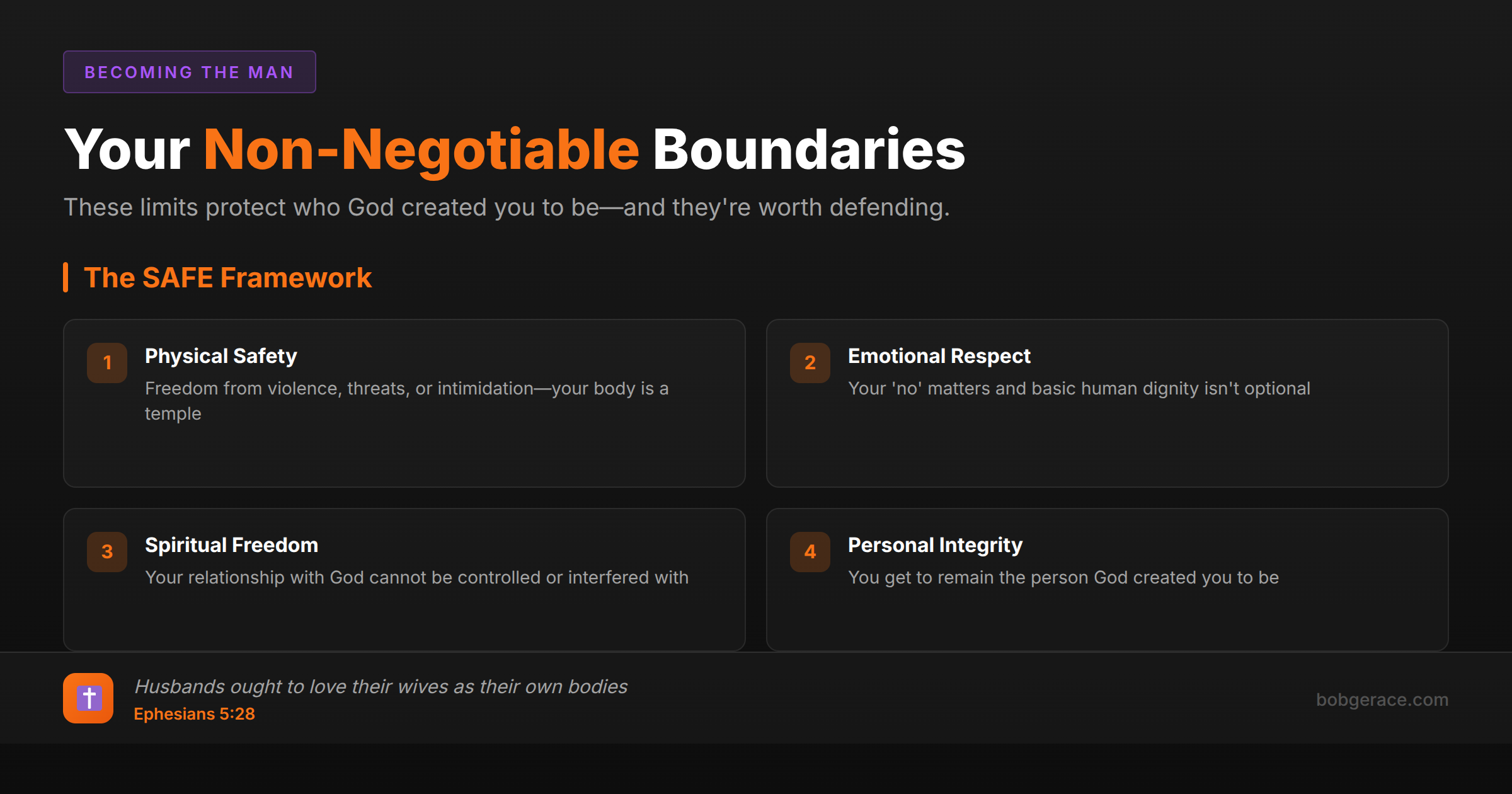
Non-negotiable boundaries are the fundamental limits that protect your physical safety, emotional well-being, and spiritual integrity. These include freedom from physical violence, emotional abuse, threats, or intimidation. You also have the right to be treated with basic respect, to have your 'no' honored, and to maintain your relationship with God without interference. These boundaries aren't about controlling your husband—they're about protecting the person God created you to be. When these foundational limits are crossed, the marriage relationship itself is damaged. Establishing and maintaining these boundaries actually serves your marriage by creating the safety needed for genuine love and intimacy to flourish.
The Full Picture
Understanding non-negotiable boundaries starts with recognizing that some things are simply unacceptable in any healthy relationship. These aren't preferences or wishes—they're fundamental requirements for your safety and well-being.
Physical safety tops the list. No one has the right to hurt you physically, threaten violence, or make you fear for your safety. This includes throwing objects, blocking your path, or any form of physical intimidation.
Emotional safety is equally crucial. Constant criticism, name-calling, humiliation, or attempts to isolate you from family and friends cross non-negotiable lines. You deserve to be spoken to with basic human dignity.
Sexual boundaries are sacred. Consent matters in marriage. Sexual coercion, pressure after you've said no, or demands for sexual activities that violate your conscience are never acceptable.
Financial abuse often gets overlooked but is equally serious. You have the right to know about family finances, access money for basic needs, and not have money used as a weapon of control.
Spiritual freedom cannot be compromised. No one should interfere with your relationship with God, prevent you from attending church, or mock your faith. Your spiritual life is between you and God.
These boundaries exist not to punish your husband but to protect the foundation that makes a healthy marriage possible. When these limits are respected, both spouses can feel safe enough to be vulnerable, loving, and authentic with each other.
What's Really Happening
From a clinical perspective, non-negotiable boundaries serve as the foundation for psychological safety in relationships. When these boundaries are violated, we see predictable patterns: increased anxiety, depression, trauma responses, and erosion of self-worth.
Many women struggle to identify their non-negotiables because they've been conditioned to prioritize others' comfort over their own safety. This often stems from childhood experiences where boundaries were not modeled or respected, or from misunderstood religious teachings about submission and sacrifice.
The neurobiological impact of boundary violations is significant. Chronic stress from living without adequate boundaries triggers the fight-flight-freeze response, making it difficult to think clearly or advocate for yourself. This creates a cycle where boundary violations become normalized.
What's crucial to understand is that healthy boundaries actually improve relationships. They create predictability and safety, which are prerequisites for emotional intimacy. When both partners know where the lines are, they can relax and connect more authentically.
Establishing non-negotiable boundaries often requires professional support, especially if there's been a pattern of violations. The process involves reconnecting with your inherent worth, developing assertiveness skills, and sometimes addressing trauma responses. Remember, setting boundaries isn't selfish—it's essential for your mental health and the health of your marriage.
What Scripture Says
God's design for marriage never includes harm, abuse, or the destruction of human dignity. Scripture provides clear guidance on the non-negotiable boundaries that honor God and protect His children.
Ephesians 5:28-29 tells us: *"Husbands ought to love their wives as their own bodies. He who loves his wife loves himself. After all, no one ever hated their own body, but they feed and care for their body."* This passage establishes that love in marriage should nourish and protect, never harm or diminish.
1 Corinthians 13:4-5 defines love clearly: *"Love is patient, love is kind. It does not envy, it does not boast, it is not proud. It does not dishonor others, it is not self-seeking, it is not easily angered, it keeps no record of wrongs."* Behavior that dishonors, seeks to harm, or consistently shows anger violates God's definition of love.
Psalm 139:14 reminds us: *"I praise you because I am fearfully and wonderfully made; your works are wonderful, I know that full well."* You are God's precious creation, deserving of respect and protection. Accepting abuse dishonors the One who made you.
Matthew 22:39 commands us to *"love your neighbor as yourself."* This includes loving yourself enough to refuse treatment that God would never want for any of His children.
Galatians 5:22-23 describes the fruit of the Spirit: *"love, joy, peace, forbearance, kindness, goodness, faithfulness, gentleness and self-control."* Relationships should reflect these qualities, not fear, anxiety, and walking on eggshells.
God desires marriages that reflect His love—protective, nurturing, and honoring of human dignity.
What To Do Right Now
-
1
Write down your current non-negotiable boundaries - be specific about what behaviors you will not accept
-
2
Identify which of these boundaries are currently being violated in your marriage
-
3
Document incidents when these boundaries are crossed - dates, details, and your responses
-
4
Communicate these boundaries clearly to your husband during a calm moment, using 'I' statements
-
5
Develop a safety plan for how you'll respond when boundaries are violated, including support people to call
-
6
Seek support from a counselor, pastor, or trusted friend to help you maintain these boundaries consistently
Related Questions
Need Help Establishing Healthy Boundaries?
Setting and maintaining non-negotiable boundaries can feel overwhelming, especially if they've been violated for a long time. You don't have to figure this out alone.
Get Support →