What consequences are appropriate?
6 min read
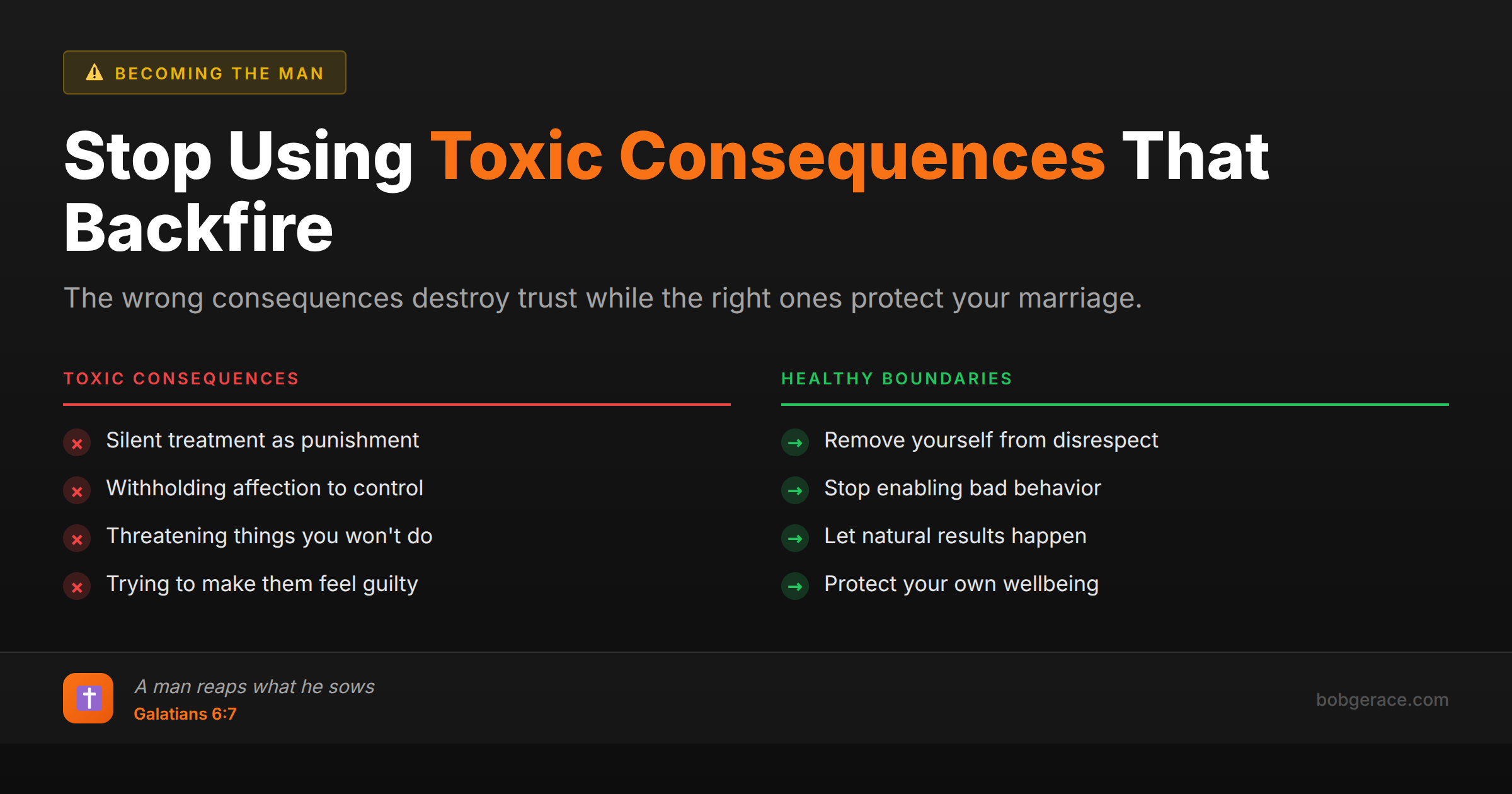
Appropriate consequences in marriage must be proportionate, enforceable, and focused on protecting your wellbeing rather than punishing your spouse. Natural consequences work best - like not covering for irresponsible behavior, removing yourself from disrespectful situations, or stopping enabling patterns that harm your marriage. The goal isn't to control or manipulate, but to maintain your integrity and create space for genuine change. Consequences should match the boundary violation and be something you can actually follow through on consistently. Remember, you're not trying to parent your spouse or force specific outcomes - you're simply no longer participating in patterns that damage your relationship or compromise your values.
The Full Picture
Setting boundaries without consequences is like posting speed limit signs without any enforcement - they become meaningless suggestions rather than protective guidelines. But here's what most women get wrong: they either choose consequences that are too harsh and unsustainable, or they threaten consequences they never intend to follow through on.
Effective consequences have four essential characteristics:
First, they must be proportionate. The consequence should match the severity and frequency of the boundary violation. A nuclear response to a minor infraction destroys credibility and escalates conflict unnecessarily. Second, they must be enforceable - you need to be willing and able to follow through every single time. Empty threats actually weaken your position.
Third, consequences should be self-protective rather than punitive. You're not trying to hurt your husband or teach him a lesson - you're removing yourself from harmful situations and refusing to enable destructive patterns. Finally, they must be clearly communicated beforehand, not sprung on him in the heat of conflict.
Natural consequences work better than imposed ones. Instead of creating artificial punishments, let the natural results of his choices play out while you protect yourself. If he's chronically late, stop waiting and delaying your own plans. If he's financially irresponsible, separate your finances appropriately. If he's disrespectful, remove yourself from the conversation.
The key is consistency. One firmly enforced boundary with appropriate consequences is worth more than ten boundaries you don't maintain.
What's Really Happening
From a therapeutic perspective, consequences in marriage serve as reality-based feedback systems that help break dysfunctional relationship patterns. Many women struggle with consequence-setting because they've been socialized to prioritize harmony over healthy relationship dynamics.
The most effective consequences operate on what we call the 'natural outcomes principle' - they're logical extensions of the boundary violation rather than arbitrary punishments. When someone violates your physical space, the natural consequence is creating distance. When someone breaks trust, the natural consequence is reduced intimacy and increased verification.
I often see women choose consequences that are either too emotional (silent treatment, withholding affection) or too extreme (threatening divorce over minor issues). Both approaches backfire because they create power struggles rather than promoting genuine change. The goal is to create conditions where respectful behavior becomes the easier path.
It's crucial to understand that consequences aren't about changing your spouse - that's outside your control. They're about maintaining your own emotional and physical safety while demonstrating that certain behaviors have natural costs. This approach respects both your dignity and your husband's agency to choose his response.
Women who successfully implement consequences report feeling more empowered and less resentful because they're no longer victims of their circumstances - they're actively protecting their wellbeing while remaining open to reconciliation when genuine change occurs.
What Scripture Says
Scripture provides a clear framework for appropriate consequences that balance love with accountability. The goal is always restoration, not retaliation.
Galatians 6:7 reminds us that consequences are part of God's design: "Do not be deceived: God cannot be mocked. A man reaps what he sows." Allowing natural consequences isn't unloving - it's allowing God's built-in systems to work.
Matthew 18:15-17 outlines the progression of accountability in relationships: address issues directly first, involve others if necessary, and create appropriate distance if there's no repentance. This isn't about punishment but about protecting the relationship and encouraging change.
Proverbs 27:5-6 teaches us: "Better is open rebuke than hidden love. Wounds from a friend can be trusted." Sometimes loving consequences feel harsh in the moment but serve the greater good of the relationship.
1 Corinthians 13:5 tells us love "does not dishonor others, it is not self-seeking, it is not easily angered, it keeps no record of wrongs." This means consequences should be about protection and restoration, not keeping score or seeking revenge.
Romans 12:18 instructs us: "If it is possible, as far as it depends on you, live at peace with everyone." You're responsible for your part - including maintaining healthy boundaries - but you can't control your spouse's response.
The biblical model shows us that consequences serve love, not oppose it. They create space for genuine repentance and change while protecting the integrity of the relationship.
What To Do Right Now
-
1
Identify one specific boundary that's being regularly violated and needs a clear consequence
-
2
Choose a natural consequence that you're willing and able to enforce consistently
-
3
Communicate the consequence clearly during a calm moment, not in the heat of conflict
-
4
Follow through immediately and consistently the next time the boundary is crossed
-
5
Focus on protecting yourself rather than trying to control or change your spouse's behavior
-
6
Review and adjust consequences based on their effectiveness and your ability to maintain them
Related Questions
Need Help Implementing Healthy Consequences?
Setting appropriate consequences is challenging work that requires wisdom and support. Let's create a personalized plan that protects your marriage while encouraging positive change.
Get Support →