What makes boundaries healthy?
6 min read
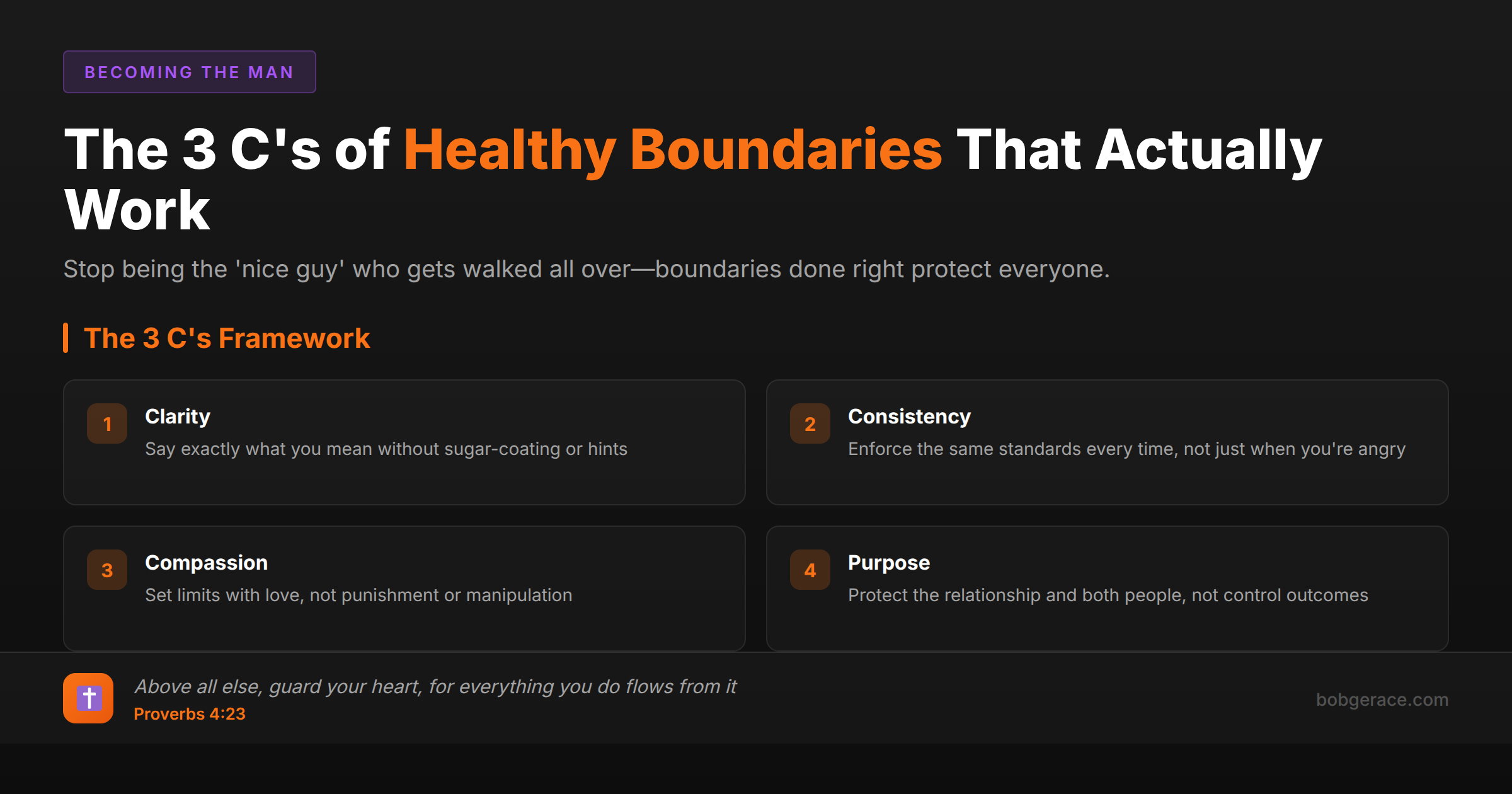
Healthy boundaries are characterized by clarity, consistency, and compassion. They're clearly communicated, reasonable in scope, and enforced with love rather than anger or manipulation. Healthy boundaries protect both people in the relationship while maintaining connection and intimacy. The key difference between healthy and unhealthy boundaries lies in their purpose and implementation. Healthy boundaries are designed to preserve the relationship and individual well-being, not to control or punish. They're flexible when appropriate, consistently maintained, and communicated with respect and kindness.
The Full Picture
Healthy boundaries in marriage aren't walls—they're gates with hinges. They open and close as needed, allowing intimacy while protecting individual identity and well-being. Understanding what makes boundaries healthy versus unhealthy can transform your marriage from a battlefield into a sanctuary.
Clear and Specific Healthy boundaries are crystal clear. Instead of saying "I need space," a healthy boundary sounds like: "I need 30 minutes after work to decompress before we discuss our day." Vague boundaries create confusion and conflict. Your spouse shouldn't have to guess what you need or where the line is drawn.
Consistently Enforced A boundary that's enforced sometimes but ignored other times isn't really a boundary—it's a suggestion. Healthy boundaries are maintained consistently, regardless of mood, circumstances, or your spouse's reaction. This consistency builds trust and security in the relationship.
Motivated by Love, Not Control The healthiest boundaries come from a place of love—for yourself and your spouse. They're designed to protect the relationship, not to punish or control your partner. When boundaries are set in anger or used as weapons, they become unhealthy manipulation tools.
Flexible When Appropriate Healthy boundaries have room for adjustment. Life happens, emergencies occur, and sometimes flexibility is needed. The key is that adjustments are conscious choices, not cave-ins due to pressure or guilt.
Mutual Respect In healthy marriages, both partners recognize each other's right to have boundaries. There's no guilt-tripping, boundary-testing, or dismissive attitudes. Boundaries are seen as necessary for individual health and, ultimately, relationship health.
What's Really Happening
From a clinical perspective, healthy boundaries are essential for psychological well-being and relationship satisfaction. Research consistently shows that couples with clearly defined, mutually respected boundaries report higher levels of intimacy and lower levels of conflict.
Healthy boundaries serve several crucial psychological functions. First, they maintain individual identity within the relationship. When people lose their sense of self in marriage, resentment and codependency often follow. Boundaries help preserve the "I" within the "we."
Second, healthy boundaries reduce anxiety and stress. When you know where the limits are—both yours and your spouse's—you can relax and be authentic. Uncertainty about boundaries keeps people walking on eggshells, which is exhausting for both partners.
The neurobiological aspect is fascinating. When boundaries are respected, our nervous system feels safe. This safety allows for deeper emotional connection and vulnerability. Conversely, when boundaries are violated repeatedly, our nervous system stays in a defensive state, making intimacy nearly impossible.
I often see couples struggle with the difference between healthy boundaries and walls. Walls are permanent barriers built from hurt and designed to keep everyone out. Healthy boundaries are permeable membranes that filter what comes in and goes out based on what's healthy for the relationship.
The most successful couples I work with understand that boundaries aren't about winning or losing—they're about creating a relationship where both people can thrive. When one person thrives at the expense of the other, the relationship ultimately suffers.
What Scripture Says
Scripture provides a beautiful framework for healthy boundaries that honor both individual dignity and relational unity. God Himself models healthy boundaries—He's clear about His expectations, consistent in His love, and protective of what's sacred.
Individual Worth and Responsibility "Above all else, guard your heart, for everything you do flows from it" (Proverbs 4:23). This verse establishes our responsibility to protect our inner life. Healthy boundaries aren't selfish—they're biblical stewardship of the heart and mind God has given us.
Clear Communication "All you need to say is simply 'Yes' or 'No'; anything beyond this comes from the evil one" (Matthew 5:37). Jesus advocated for clear, honest communication. Healthy boundaries require this same directness—no manipulation, guilt-tripping, or passive-aggressive hints.
Mutual Respect in Marriage "However, each one of you also must love his wife as he loves himself, and the wife must respect her husband" (Ephesians 5:33). Love and respect naturally include honoring each other's boundaries. We can't truly love someone while consistently violating their stated limits.
Gentle Restoration "Brothers and sisters, if someone is caught in a sin, you who live by the Spirit should restore that person gently" (Galatians 6:1). Even when enforcing boundaries due to harmful behavior, the goal is restoration, not punishment. Healthy boundaries are maintained with gentleness and hope.
Personal Responsibility "Each one should test their own actions" (Galatians 6:4). We're responsible for our own choices and responses. Healthy boundaries acknowledge this truth—we can't control our spouse's behavior, but we can control our own responses.
Unity Without Loss of Identity "That is why a man leaves his father and mother and is united to his wife, and they become one flesh" (Genesis 2:24). Biblical unity doesn't mean losing individual identity. Healthy boundaries actually enhance unity by allowing two whole people to come together authentically.
What To Do Right Now
-
1
Identify one area where you need clearer boundaries and write down specifically what that boundary looks like
-
2
Practice stating your boundary using "I" statements without justifying or over-explaining your needs
-
3
Ask your spouse if there are any boundaries they need that you haven't been respecting
-
4
Choose one boundary you currently have and evaluate whether you're enforcing it consistently and lovingly
-
5
Discuss with your spouse how you can both support each other's boundaries rather than seeing them as obstacles
-
6
Commit to addressing boundary violations immediately and directly rather than letting resentment build over time
Related Questions
- What is a boundary vs. an ultimatum?
- How do I enforce without controlling?
- What boundaries are non-negotiable?
- What consequences are appropriate?
- What does flexible but firm look like?
- What if boundaries feel harsh to me?
- What boundaries should I set?
- What's the difference between boundary and ultimatum?
- How do I set boundaries without controlling?
- What does the Bible say about boundaries?
Also find Bob on
Subscribe for weekly videos on Christian marriage.
Boundaries That Fit Your Marriage
What works in your specific situation depends on context a tool can't see. A coach calibrates to where you actually are.
Talk to Bob →