What if boundaries feel harsh to me?
6 min read
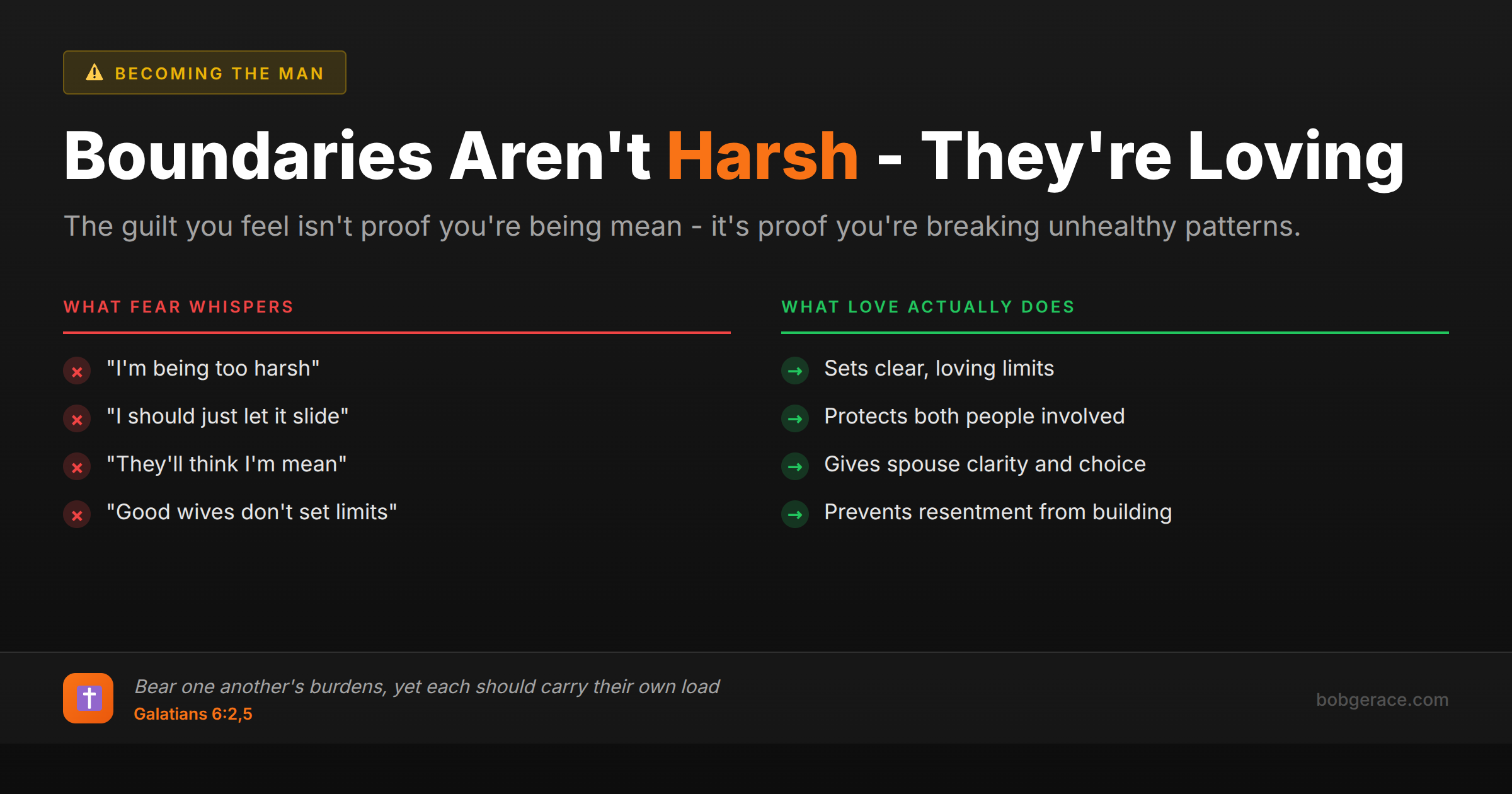
If boundaries feel harsh to you, you're likely confusing harshness with firmness - and that confusion is costing your marriage dearly. True boundaries aren't harsh; they're loving acts of protection for both you and your relationship. When you feel guilt about setting limits, you're experiencing the discomfort of breaking unhealthy patterns, not evidence that you're being mean. The harshness you fear isn't in the boundary itself - it's in continuing to enable destructive behaviors while resentment builds inside you. A boundary delivered with love and clarity is actually the kindest thing you can do. It gives your spouse the gift of knowing exactly where you stand and the opportunity to choose a healthier response.
The Full Picture
Here's what's really happening when boundaries feel harsh to you: you've been trained to believe that your needs don't matter. Somewhere along the way, you learned that being "good" means saying yes to everything, absorbing others' emotions, and never making waves. Now when you try to set a healthy limit, it feels foreign and mean because you're breaking a lifetime of conditioning.
But let me be crystal clear - there's nothing harsh about protecting your marriage. When you don't set boundaries, you're not being kind. You're being dishonest. You're pretending everything is fine while resentment builds inside you like a pressure cooker. You're robbing your spouse of the chance to grow and change because you never clearly communicate what's unacceptable.
The real harshness is in the explosion that's coming when you finally can't take it anymore. The real cruelty is in the years of silent suffering that could have been avoided with clear, loving communication. Every day you delay setting necessary boundaries, you're choosing short-term comfort over long-term health.
Boundaries aren't walls - they're property lines. They don't shut people out; they create safety for connection to flourish. When you know where you stand and your spouse knows where they stand, intimacy actually increases because the relationship has structure and predictability.
The discomfort you feel isn't proof you're being harsh. It's proof you're doing something different, something healthy, something that your marriage desperately needs.
What's Really Happening
When boundaries feel harsh, we're typically dealing with what I call "boundary guilt" - a learned emotional response rooted in early attachment patterns and family-of-origin messaging. Many women were raised with implicit or explicit messages that their worth comes from keeping others happy, even at their own expense.
This creates a neurological association between self-advocacy and danger. Your nervous system literally interprets boundary-setting as a threat to relationship security because it challenges the survival strategy you've been using since childhood. The anxiety you feel isn't evidence that boundaries are wrong - it's evidence that you're rewiring old programming.
What we see clinically is that women who struggle with "harsh" boundary feelings often have hyperactive empathy centers in their brains. They're so attuned to others' potential discomfort that they can't distinguish between causing harm and causing healthy discomfort that leads to growth.
The therapeutic work involves learning to tolerate the temporary discomfort of disappointing others while recognizing that clear expectations actually reduce long-term conflict. Boundaries create emotional safety by establishing predictable patterns of interaction. When both partners know the rules of engagement, anxiety decreases and intimacy increases.
Remember: healthy boundaries feel uncomfortable at first because you're building new neural pathways. The harshness you perceive is often just the unfamiliarity of prioritizing your own wellbeing alongside others' needs.
What Scripture Says
Scripture is abundantly clear that boundaries aren't harsh - they're essential expressions of God's design for relationships. Galatians 6:2 tells us to "bear one another's burdens," but verse 5 immediately clarifies that "each one should carry their own load." This isn't contradiction; it's the perfect balance of mutual support within proper boundaries.
Proverbs 27:5-6 declares, "Better is open rebuke than hidden love. Wounds from a friend can be trusted, but an enemy multiplies kisses." When you avoid setting boundaries because they might feel harsh, you're actually withholding the loving correction that could transform your marriage. Sometimes the most loving thing you can do is create temporary discomfort that leads to lasting health.
Matthew 18:15-17 gives us Jesus's own boundary framework: address issues directly, escalate with witnesses if necessary, and ultimately separate from those who refuse to change destructive patterns. This isn't harsh - it's wisdom. Christ himself set firm boundaries throughout his ministry, including walking away from people who wouldn't respect his message.
Ephesians 4:15 calls us to "speak the truth in love" - not speak what feels comfortable, but what is true. When you consistently avoid difficult conversations because boundaries feel harsh, you're actually being unloving by withholding truth that could set your spouse free.
1 Corinthians 13:7 says love "protects" - and sometimes protection requires firm limits. The most loving wives aren't those who never set boundaries; they're those who set them clearly, consistently, and with genuine care for the relationship's long-term health.
What To Do Right Now
-
1
Reframe your perspective - Write down three ways that avoiding boundaries has actually been harsh to your marriage, then list three ways clear limits would be loving
-
2
Start small and specific - Choose one minor boundary you can practice this week, focusing on clear communication rather than perfect comfort
-
3
Script your boundary statement - Write out exactly what you'll say using 'I' statements: 'I feel respected when...' or 'I'm not available for...'
-
4
Prepare for pushback - Expect initial resistance and plan your response: 'I understand you're upset, and this boundary still stands'
-
5
Focus on delivery tone - Practice saying your boundary with firmness and kindness, not anger or apology - this isn't negotiable, but it's not personal
-
6
Follow through consistently - The first time you enforce your boundary will feel the hardest, but consistency proves you meant what you said and builds respect
Related Questions
- What is a boundary vs. an ultimatum?
- What makes boundaries healthy?
- What does flexible but firm look like?
- What boundaries are non-negotiable?
- How do I enforce without controlling?
- What does self-protective boundary-setting look like?
- What boundaries should I set?
- What's the difference between boundary and ultimatum?
- What makes boundaries effective vs. empty threats?
- How do I set boundaries without controlling?
Also find Bob on
Subscribe for weekly videos on Christian marriage.
Your Marriage Isn't a Template Case
A coach who knows your story can help you calibrate boundaries that fit your actual situation—firm where you need to be, without the guilt spiral that keeps you stuck.
Talk to Bob →