What is a boundary vs. an ultimatum?
6 min read
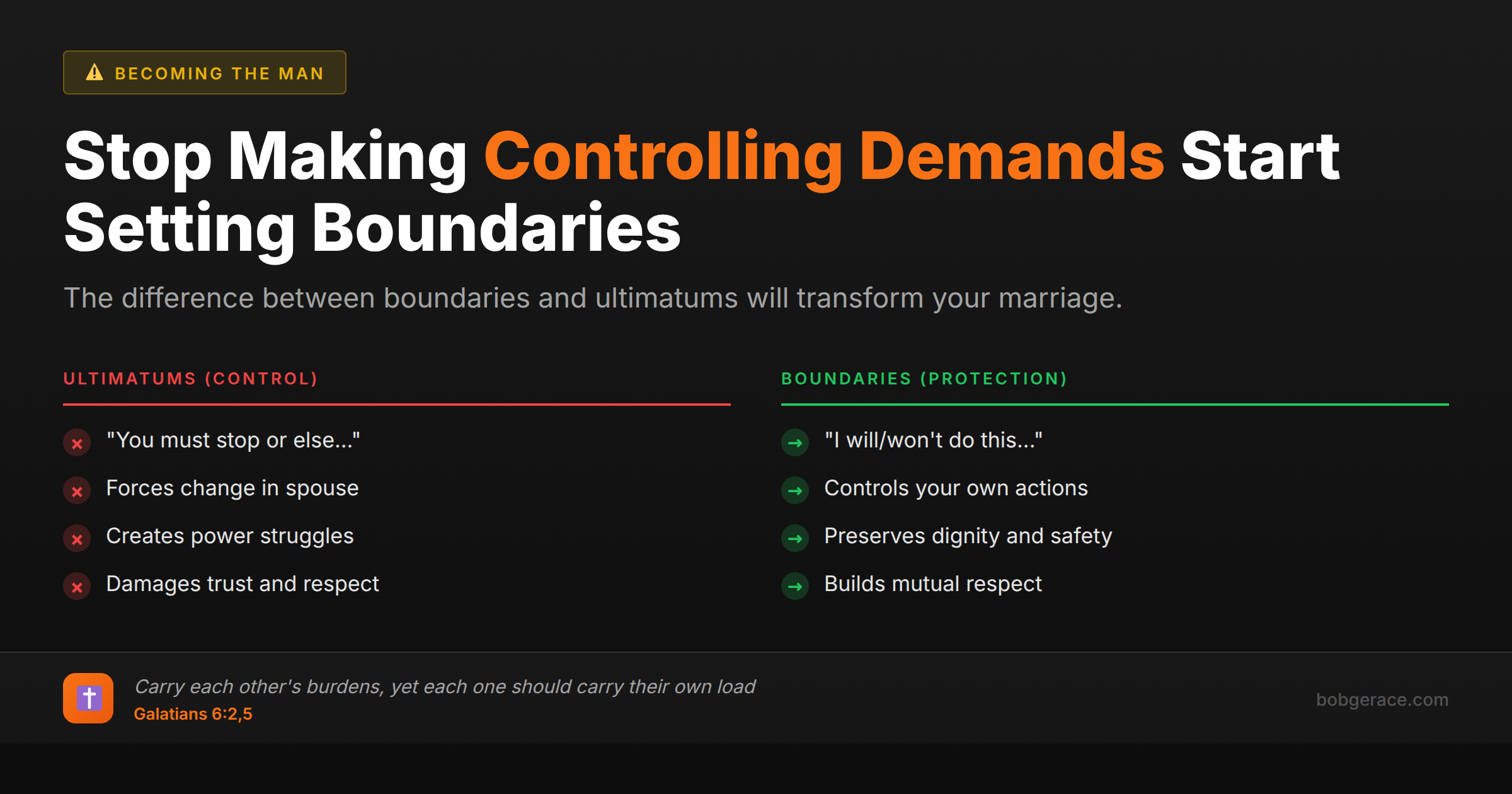
A boundary is about protecting yourself by controlling your own actions and responses, while an ultimatum is about controlling someone else's behavior through threats or demands. Boundaries say 'I will...' or 'I won't...' and focus on what you can control. Ultimatums say 'You must...' or 'If you don't...' and attempt to force change in your spouse. For example, a boundary might be 'I won't engage in conversation when you're yelling at me' versus an ultimatum like 'You better stop yelling or else.' Boundaries preserve dignity and create safety; ultimatums often damage trust and create power struggles. Understanding this distinction is crucial for building a healthy marriage based on mutual respect rather than control.
The Full Picture
The confusion between boundaries and ultimatums destroys more marriages than most couples realize. Here's the truth: boundaries are about self-protection, ultimatums are about spouse-control.
When you set a boundary, you're taking responsibility for your own well-being. You're saying, 'This is what I will or won't do to protect my heart, mind, and spirit.' A boundary might sound like: 'I will leave the room when conversations become disrespectful' or 'I won't discuss our problems when either of us is angry.'
Ultimatums, on the other hand, are demands designed to force your spouse to change. They're rooted in fear, frustration, and often desperation. An ultimatum sounds like: 'If you don't start helping with housework, I'm done' or 'You better choose between your family and me.'
The key difference is control. Boundaries control what you can actually control—yourself. Ultimatums attempt to control what you cannot—another person's choices. This is why boundaries build trust while ultimatums erode it.
Boundaries are also consistent and calm. They're not emotional reactions but thoughtful decisions about how you'll protect yourself. Ultimatums are often delivered in anger, born from accumulated resentment, and designed to shock your spouse into compliance.
Here's what makes this tricky: sometimes boundaries can sound like ultimatums. The difference isn't always in the words—it's in the heart behind them. Are you trying to protect yourself or control your spouse?
What's Really Happening
From a therapeutic perspective, the boundary-versus-ultimatum distinction reflects two completely different attachment strategies and emotional regulation patterns. Boundaries emerge from secure attachment—they're self-soothing, protective mechanisms that preserve both individual integrity and relationship connection.
Ultimatums typically stem from anxious or disorganized attachment patterns. They're dysregulated attempts to create safety through control, but they actually increase relational insecurity. When someone issues an ultimatum, they're essentially saying, 'I feel so powerless that I must force you to change to feel safe.'
Neurologically, boundaries activate our prefrontal cortex—the thinking brain that can plan, consider consequences, and maintain emotional regulation. Ultimatums often come from our limbic system—the emotional brain in fight-or-flight mode that perceives threat and reacts defensively.
The beautiful thing about healthy boundaries is that they actually increase intimacy over time. They create predictable safety, which allows vulnerability to flourish. Your spouse learns they can trust your responses, and you learn you can maintain your sense of self within the relationship.
Ultimatums create what we call 'trauma bonding'—cycles of tension, crisis, and temporary relief that actually reinforce dysfunction. The receiving partner may comply out of fear rather than genuine change, leading to resentment and eventual rebellion.
For women especially, learning to set boundaries rather than issue ultimatums often requires healing from people-pleasing patterns and reclaiming their right to self-protection without guilt.
What Scripture Says
Scripture beautifully illustrates the difference between godly boundaries and controlling ultimatums. Proverbs 27:14 warns us: 'Whoever blesses their neighbor with a loud voice in the early morning will be counted as cursing.' This shows us that even good intentions, when delivered poorly (like ultimatums), can cause harm.
Galatians 6:2-5 gives us the perfect framework: 'Carry each other's burdens, and in this way you will fulfill the law of Christ... Each one should test their own actions... for each one should carry their own load.' We're called to support each other while maintaining personal responsibility—exactly what boundaries accomplish.
Jesus Himself modeled healthy boundaries throughout His ministry. In Mark 1:35-37, when the disciples found Him praying and said everyone was looking for Him, Jesus said, 'Let us go somewhere else.' He protected His relationship with the Father without condemning others for their needs.
The Bible also warns against manipulation and control. 2 Corinthians 1:17 shows Paul defending himself against accusations of being wishy-washy, but notice he doesn't issue ultimatums—he explains his heart and lets others choose their response.
Ephesians 4:15 calls us to 'speak the truth in love'—which perfectly describes healthy boundaries. We're honest about our limits and needs while maintaining love and respect for our spouse.
Most importantly, 1 Corinthians 13:5 tells us that love 'is not self-seeking' and 'keeps no record of wrongs.' True boundaries flow from love—protecting the relationship rather than punishing the person.
What To Do Right Now
-
1
Examine your motivation: Before setting any boundary, ask yourself: 'Am I trying to protect myself or control my spouse?' Pray for clarity on your true intentions.
-
2
Use 'I' statements: Replace 'You must...' with 'I will...' Focus on your actions and responses rather than demanding changes from your spouse.
-
3
Start small and consistent: Choose one simple boundary you can actually maintain, like 'I will take a 10-minute break when discussions become heated.'
-
4
Communicate calmly: Share your boundary when emotions are low, explaining it as self-care rather than spouse-correction. 'I've realized I need to...'
-
5
Follow through peacefully: When you enforce a boundary, do it without anger, explanation, or punishment. Simply implement what you said you would do.
-
6
Stay open to dialogue: After enforcing a boundary, be available for calm conversation about how to move forward together as a team.
Related Questions
- What boundaries should I set?
- What's the difference between boundary and ultimatum?
- What makes boundaries effective vs. empty threats?
- What is a 'natural consequence' vs. 'punishment'?
- How do I set boundaries without controlling?
- What does 'holding space' while 'holding boundary' look like?
- What boundaries are non-negotiable?
- What consequences are appropriate?
- How do I enforce without controlling?
- What does flexible but firm look like?
Also find Bob on
Subscribe for weekly videos on Christian marriage.
Setting boundaries in your actual marriage
Knowing the difference is one thing. Saying it to your wife without it turning into a fight is another. A coach helps you practice the words before you need them.
Talk to Bob →