What does taking responsibility sound like?
6 min read
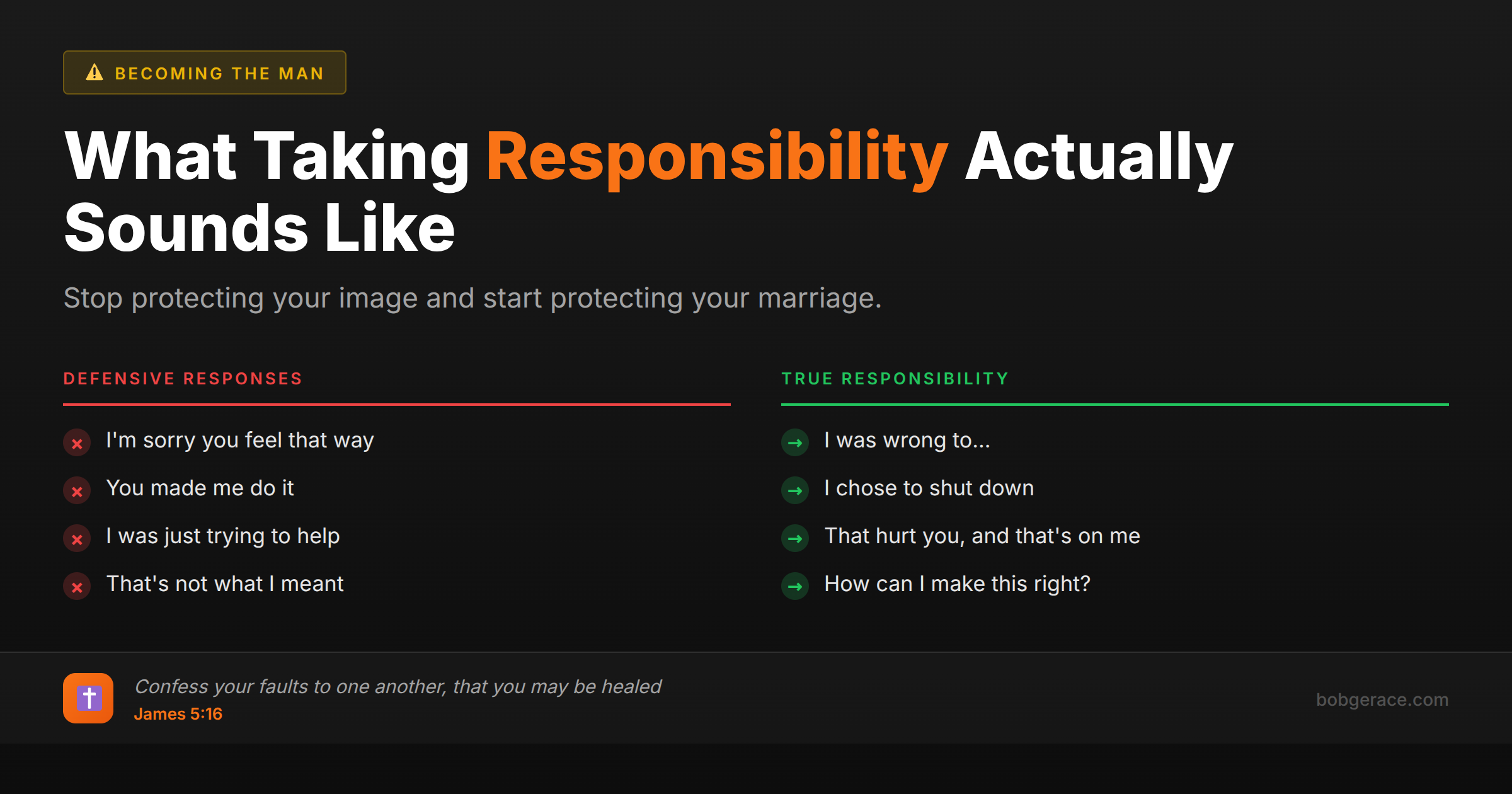
Taking responsibility sounds like owning your actions without deflection, blame-shifting, or excuses. It's saying 'I was wrong' instead of 'I'm sorry you feel that way.' True responsibility includes acknowledging the specific behavior, recognizing its impact on your spouse, and committing to change. Real responsibility sounds vulnerable and specific: 'I chose to shut down when you tried to talk to me, and I know that hurt you. That's on me, not you.' It's the difference between defensive responses that protect your image and humble responses that protect your marriage. When you truly take responsibility, your words create safety instead of more conflict.
The Full Picture
Most of us think we're taking responsibility when we're actually doing damage control. We say things like 'I'm sorry if I hurt you' or 'I didn't mean it that way' – but these phrases actually avoid responsibility while appearing to take it.
What responsibility doesn't sound like: - 'I'm sorry you're upset' (focuses on their reaction, not your action) - 'That wasn't my intention' (deflects from impact to intention) - 'I was just trying to help' (justifies the behavior) - 'You misunderstood me' (makes it their fault) - 'I was having a bad day' (explains away the choice)
What responsibility actually sounds like: - 'I chose to respond harshly, and that was wrong' - 'I see how my words hurt you – that's on me' - 'I was selfish in that moment and didn't consider your feelings' - 'I made a mistake and I want to make it right' - 'My behavior was unacceptable, regardless of how I was feeling'
The difference is ownership versus management. Responsibility owns the choice and its impact. Pseudo-responsibility tries to manage your spouse's perception while protecting your ego. True responsibility is uncomfortable because it requires admitting you were wrong without any safety nets or escape clauses.
When you take real responsibility, you're not trying to minimize the damage or control how your spouse responds. You're simply acknowledging reality: you made a choice, it had an impact, and you own both. This kind of honesty creates the foundation for genuine healing and change in your marriage.
What's Really Happening
From an attachment perspective, our ability to take responsibility is directly tied to our emotional safety and self-worth. When we have secure attachment, we can acknowledge mistakes because our identity isn't threatened by being wrong. However, those with insecure attachment patterns often experience responsibility-taking as an existential threat.
Anxiously attached individuals may take excessive responsibility, even for things that aren't their fault, as a way to maintain connection: 'It's all my fault, please don't leave me.' Avoidantly attached people typically resist responsibility because admitting fault feels like vulnerability they can't afford: 'If I'm wrong, you might get too close or expect too much from me.'
Neurologically, taking responsibility activates our threat detection system. The brain interprets admitting fault as social danger, triggering fight-flight-freeze responses. This is why we instinctively deflect, explain, or justify – our nervous system is trying to protect us from perceived rejection or abandonment.
Healthy responsibility-taking requires emotional regulation and distress tolerance. It means sitting with the discomfort of being imperfect without immediately moving to self-protection. This is a learned skill that develops as we experience safety in relationship – when our spouse responds to our vulnerability with grace rather than attack.
The transformative power of genuine responsibility lies in its ability to break negative cycles. When you own your part without defensiveness, it often disarms your spouse's anger and creates space for connection rather than escalation.
What Scripture Says
Scripture calls us to radical honesty and humble accountability in our relationships. God's design for marriage includes the safety to be known fully, including our failures and flaws.
James 5:16 tells us to 'confess your faults to one another and pray for one another, that you may be healed.' Notice that healing comes through confession, not concealment. Taking responsibility creates the conditions for God's healing work in your marriage.
Psalm 51:3-4 shows David's model of responsibility: 'For I acknowledge my transgressions, and my sin is always before me. Against You, You only, have I sinned, and done this evil in Your sight.' David doesn't minimize, justify, or shift blame – he owns his choices completely.
1 John 1:9 promises that 'if we confess our sins, He is faithful and just to forgive us our sins and to cleanse us from all unrighteousness.' This principle applies to marriage – confession opens the door to forgiveness and restoration.
Matthew 7:3-5 challenges us to address our own issues first: 'Why do you look at the speck in your brother's eye, but do not consider the plank in your own eye?' Taking responsibility means focusing on your plank, not their speck.
Ephesians 4:15 calls us to 'speak truth in love' – and this includes speaking truth about our own failures. Love doesn't hide behind excuses; it courageously owns its mistakes.
Proverbs 28:13 declares: 'He who covers his sins will not prosper, but whoever confesses and forsakes them will have mercy.' Covering our failures destroys marriages; confessing them creates space for mercy and growth.
What To Do Right Now
-
1
Identify one recent conflict where you haven't fully owned your part
-
2
Write down what you actually did wrong, without including what your spouse did
-
3
Practice saying 'I was wrong to...' without adding 'but' or explanations
-
4
Approach your spouse and take responsibility using specific, vulnerable language
-
5
Don't expect immediate forgiveness or try to fix their response
-
6
Ask what you can do to make it right and follow through consistently
Related Questions
- What does 'taking responsibility' actually look like?
- What is defensiveness in Gottman's Four Horsemen?
- What's the antidote to defensiveness?
- How do I receive feedback without counter-attacking?
- What does a non-defensive response sound like?
- What does humility in conflict look like?
- What does genuine repair look like for old wounds?
- What is an 'apology' vs. 'repair' vs. 'attunement'?
- What does 'godly sorrow' look like in practice?
- What does repentance look like for accumulated sin?
Also find Bob on
Subscribe for weekly videos on Christian marriage.
Your Marriage Needs More Than Theory
Taking responsibility in your actual arguments—with your wife's specific triggers and your defensive patterns—requires a coach who knows your story. Bob works with husbands who are done guessing.
Talk to Bob →