What should I see in how he handles my emotions?
6 min read
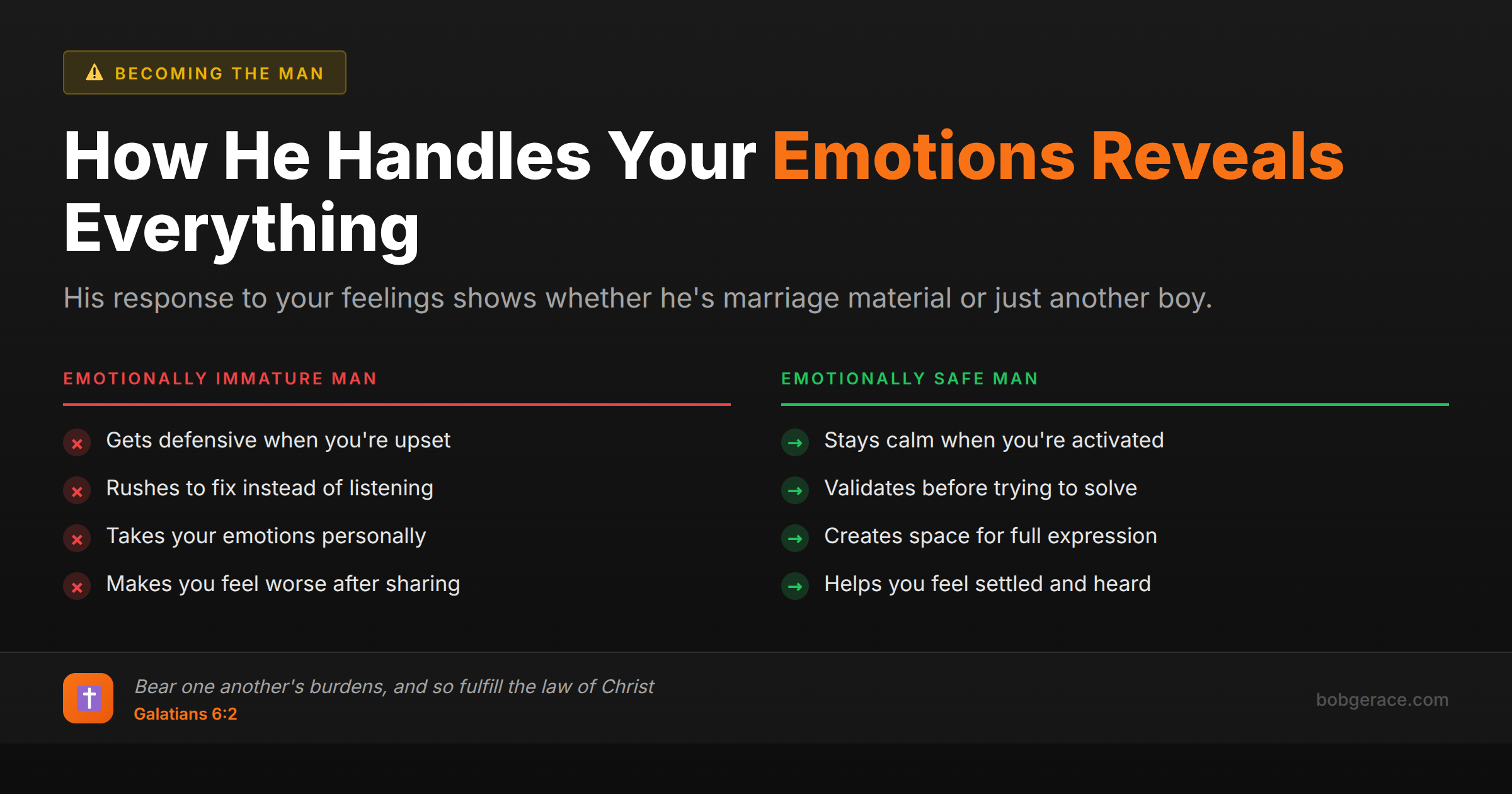
A man who handles your emotions well demonstrates consistent emotional safety through his responses. You should see him remain calm when you're upset, validate your feelings without immediately trying to fix or dismiss them, and create space for you to express yourself fully. He doesn't take your emotions personally or become defensive when you share difficult feelings. Look for someone who asks clarifying questions, mirrors back what he hears, and shows genuine concern for your emotional state. He should be able to sit with your discomfort without rushing to make it go away, and his presence should generally help you feel more settled, not more activated. These responses indicate secure attachment and emotional maturity.
The Full Picture
When evaluating how your husband handles your emotions, you're essentially assessing his capacity for emotional co-regulation - his ability to remain stable and supportive when you're experiencing intense feelings. This is one of the most crucial indicators of relationship safety and long-term compatibility.
Healthy emotional responses include staying physically present when you're upset, maintaining calm body language and tone of voice, and offering appropriate physical comfort when welcomed. He should demonstrate curiosity about your inner world rather than judgment, asking questions like "Help me understand what you're feeling" rather than "Why are you being so sensitive?"
Red flags to watch for include dismissive responses ("You're overreacting"), immediate problem-solving without permission ("Here's what you should do"), emotional escalation (matching or exceeding your intensity), physical withdrawal or stonewalling, or making your emotions about him ("Great, now you've ruined my day too").
The goal isn't perfection - every person will occasionally respond poorly to strong emotions. What matters is the consistent pattern over time and his willingness to repair when he misses the mark. A secure partner will notice when he's handled something poorly and initiate conversations to make it right.
Timing also matters. While he should always maintain basic respect and safety, the deepest emotional processing might need to happen when you're both calm and connected, not in the heat of the moment.
What's Really Happening
From an attachment perspective, how your partner responds to your emotions either strengthens or weakens your sense of safety in the relationship. When someone consistently responds with empathy and regulation, they're functioning as a secure base - helping your nervous system return to calm more quickly than you could alone.
Research shows that individuals with secure attachment styles naturally offer what we call "earned security" to their partners. They've learned to tolerate emotional intensity without becoming dysregulated themselves. This creates an upward spiral where both partners feel safer being vulnerable over time.
Conversely, partners who become defensive, dismissive, or overwhelmed by emotions often carry their own attachment wounds. They may have learned early in life that emotions are dangerous or shameful, leading them to unconsciously shut down emotional expression in others. This isn't necessarily malicious, but it does create cycles of disconnection.
The nervous system perspective is crucial here. When you express emotions and receive attunement in return, your stress response system learns that vulnerability leads to connection rather than rejection. This builds resilience and trust. When emotions are consistently met with invalidation or escalation, your system learns to either suppress feelings or express them more intensely to be heard - neither of which serves the relationship long-term.
What Scripture Says
Scripture provides clear guidance on how we should respond to others' emotions, particularly within marriage. Galatians 6:2 instructs us to "Bear one another's burdens, and so fulfill the law of Christ." This means your husband should willingly share in your emotional load rather than dismissing or minimizing your feelings.
1 Peter 3:7 specifically addresses husbands: "Husbands, live with your wives in an understanding way, showing honor to the woman as the weaker vessel, since they are heirs with you of the grace of life." The word "understanding" here implies deep knowledge and consideration of your emotional needs and responses.
Ephesians 4:32 calls for mutual compassion: "Be kind to one another, tenderhearted, forgiving one another, as God in Christ forgave you." Tenderheartedness specifically speaks to emotional sensitivity and responsiveness - the opposite of hardness or dismissiveness when someone is hurting.
James 1:19 provides practical wisdom: "Let every person be quick to hear, slow to speak, slow to anger." This perfectly describes healthy emotional response - prioritizing listening over immediate reactions, choosing words carefully, and managing one's own emotional triggers.
Romans 12:15 commands us to "Rejoice with those who rejoice, weep with those who weep." Your husband should be able to enter into your emotional experience rather than standing apart from it. God designed marriage as a place where emotions are shared and validated, not judged or controlled.
What To Do Right Now
-
1
Observe patterns over time - Keep mental notes of how he typically responds when you're upset, excited, anxious, or celebrating for at least 2-3 weeks
-
2
Test his response directly - Share a moderately emotional experience and notice whether he stays present, asks questions, or becomes defensive
-
3
Notice your body's reaction - Pay attention to whether you feel more calm or more activated after sharing emotions with him
-
4
Address concerning patterns - If you see consistent dismissiveness or defensiveness, bring this to his attention during a calm moment
-
5
Appreciate positive responses - When he handles your emotions well, specifically acknowledge and thank him for creating safety
-
6
Seek help if needed - If emotional disconnection persists despite conversations, consider couples counseling to develop better patterns together
Related Questions
- What should I see in how he handles stress?
- What does non-defensive response look like?
- What does taking responsibility sound like?
- How will he handle my doubt if he's genuine?
- What does secure attachment behavior look like in him?
- What will he do when I test him?
- What does emotional attunement look like?
- How do I listen without fixing?
- What does 'holding space' actually mean?
- How do I become a safe emotional presence?
Also find Bob on
Subscribe for weekly videos on Christian marriage.
Stuck on what this looks like in your marriage?
A coach who knows your specific history can help you see what's actually happening between you two — and what needs to shift first.
Talk to Bob →