What does non-defensive response look like?
6 min read
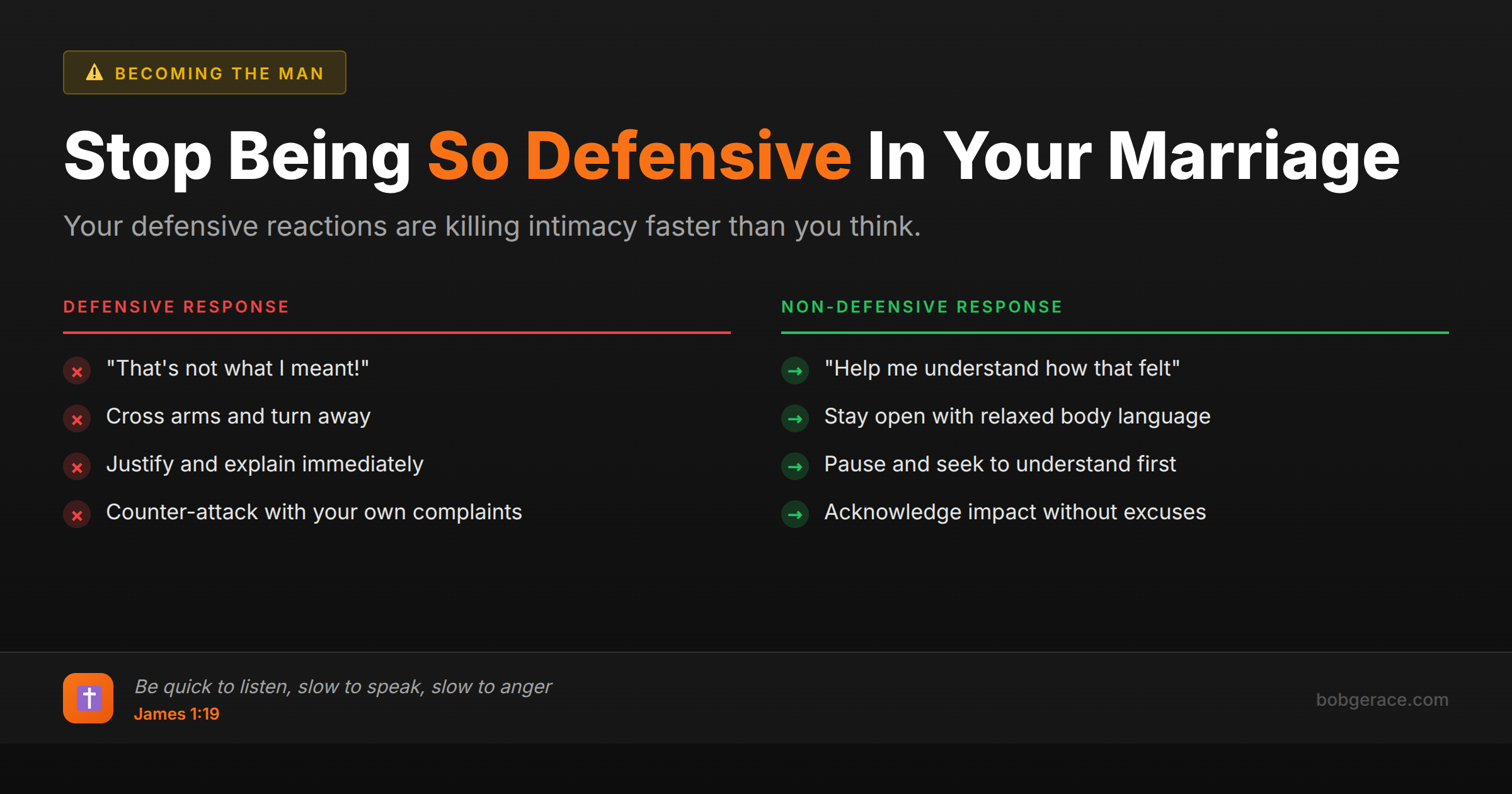
A non-defensive response is marked by curiosity rather than protection. Instead of immediately explaining, justifying, or counter-attacking when your husband raises a concern, you pause and genuinely seek to understand his experience. This looks like saying "Help me understand what that felt like for you" rather than "That's not what I meant." Your body language stays open—no crossed arms, eye-rolling, or turning away. Non-defensive responding means acknowledging impact even when intent was different. You can say "I hear that my words hurt you, and I'm sorry" without having to prove you're innocent. It's choosing connection over being right, relationship over self-protection. This doesn't mean becoming a doormat—it means becoming secure enough to hear hard things without your nervous system hijacking the conversation.
The Full Picture
Defensiveness is your nervous system's attempt to protect you from perceived threat. When your husband expresses disappointment, frustration, or hurt, your brain often interprets this as an attack on your character or worthiness. The defensive response kicks in automatically—you explain, justify, deflect, or attack back.
But defensiveness kills intimacy. Every time you defend, you send the message that his feelings aren't valid or that being right matters more than his heart. Over time, this creates distance and teaches him to either fight harder or shut down completely.
Non-defensive responding requires rewiring your automatic patterns. It starts with recognizing the physical sensations of defensiveness—the tightness in your chest, the urge to interrupt, the mental scramble for justifications. These are your early warning signs.
The shift happens when you choose curiosity over self-protection. Instead of asking "How do I prove I'm not wrong?" you ask "What is he really telling me about his experience?" This doesn't mean you're automatically wrong or that his perspective is the only truth. It means you're secure enough to hear him fully before responding.
Non-defensive responding actually makes you stronger, not weaker. When you can hear criticism without crumbling or attacking, you demonstrate emotional maturity. When you can acknowledge impact without losing your sense of self, you show true strength. This creates safety for deeper honesty and connection in your marriage.
What's Really Happening
Defensiveness is fundamentally about attachment insecurity. When we perceive criticism or conflict, our attachment system activates to protect the bond. Ironically, defensive responses often damage the very relationship they're trying to preserve.
From an attachment perspective, defensive responses typically fall into two categories: anxious defensiveness (over-explaining, seeking reassurance, emotional flooding) or avoidant defensiveness (shutting down, deflecting, intellectualizing). Both stem from early learned patterns of how to maintain connection when feeling threatened.
Non-defensive responding indicates secure attachment functioning. It demonstrates the ability to regulate your nervous system enough to stay present with your partner's emotional reality. This requires what we call "mentalization"—the capacity to understand that your partner's feelings make sense from their perspective, even if you disagree.
The neurobiological shift from defensive to non-defensive responding involves moving from limbic reactivity to prefrontal cortex engagement. This happens through practices like deep breathing, grounding techniques, and self-soothing. Over time, these new neural pathways become more automatic, allowing for more secure responses even under stress.
Remember: non-defensive doesn't mean non-responsive. You're not becoming passive or losing your voice. You're creating space for both perspectives to coexist, which is the foundation of secure relationship dynamics.
What Scripture Says
Scripture consistently calls us toward humility and understanding in our relationships. "Be quick to listen, slow to speak, slow to anger" (James 1:19) perfectly captures the heart of non-defensive responding. When we rush to defend ourselves, we're being slow to listen and quick to speak.
"Above all, clothe yourselves with love, which binds us all together in perfect harmony" (Colossians 3:14). Love chooses understanding over being understood. It prioritizes the relationship over individual ego. This doesn't mean sacrificing truth, but approaching it with gentleness.
"A gentle answer turns away wrath, but a harsh word stirs up anger" (Proverbs 15:1). Defensive responses are rarely gentle—they're self-protective and often sharp. When we respond with curiosity and openness instead of defensiveness, we often defuse tension rather than escalate it.
"Let each of you look not only to his own interests, but also to the interests of others" (Philippians 2:4). Defensiveness is entirely focused on protecting our own interests—our reputation, our rightness, our comfort. Non-defensive responding demonstrates genuine care for your husband's heart and experience.
"Therefore, confess your sins to one another and pray for one another, that you may be healed" (James 5:16). This requires the ability to hear feedback without immediately defending. True confession becomes possible only when we can acknowledge impact without shame spirals or self-justification.
"Humble yourselves before the Lord, and he will exalt you" (James 4:10). There's profound strength in the humility to say "Help me understand" instead of "Here's why you're wrong."
What To Do Right Now
-
1
Notice your body's defensive signals—tension, heat, racing heart—and pause instead of immediately responding
-
2
Take three deep breaths and remind yourself: 'His feelings make sense to him, and I can handle hearing them'
-
3
Ask a curious question like 'Help me understand what that was like for you' or 'What did you need from me in that moment?'
-
4
Reflect back what you hear before adding your perspective: 'So you felt dismissed when I looked at my phone during our conversation'
-
5
Acknowledge impact even if intent was different: 'I hear that hurt you, and I'm sorry' comes before 'That wasn't my intention'
-
6
Share your perspective only after fully hearing his, using 'I' statements and staying focused on understanding rather than winning
Related Questions
- Why do I get defensive every time?
- I can't take criticism without exploding
- How do I hear her without defending myself?
- What's the antidote to defensiveness?
- How do I receive feedback without counter-attacking?
- What does 'taking responsibility' actually look like?
- What are markers of genuine remorse vs. guilt?
- What does genuine repair look like for old wounds?
- What does humility in process look like?
- How do I not let lawyers poison what's left?
Also find Bob on
Subscribe for weekly videos on Christian marriage.
Your Defensiveness Has a Pattern
A coach who knows your marriage can spot what triggers you and help you rewire the response before the next conversation goes sideways.
Talk to Bob →