Should I confront immediately or wait?
6 min read
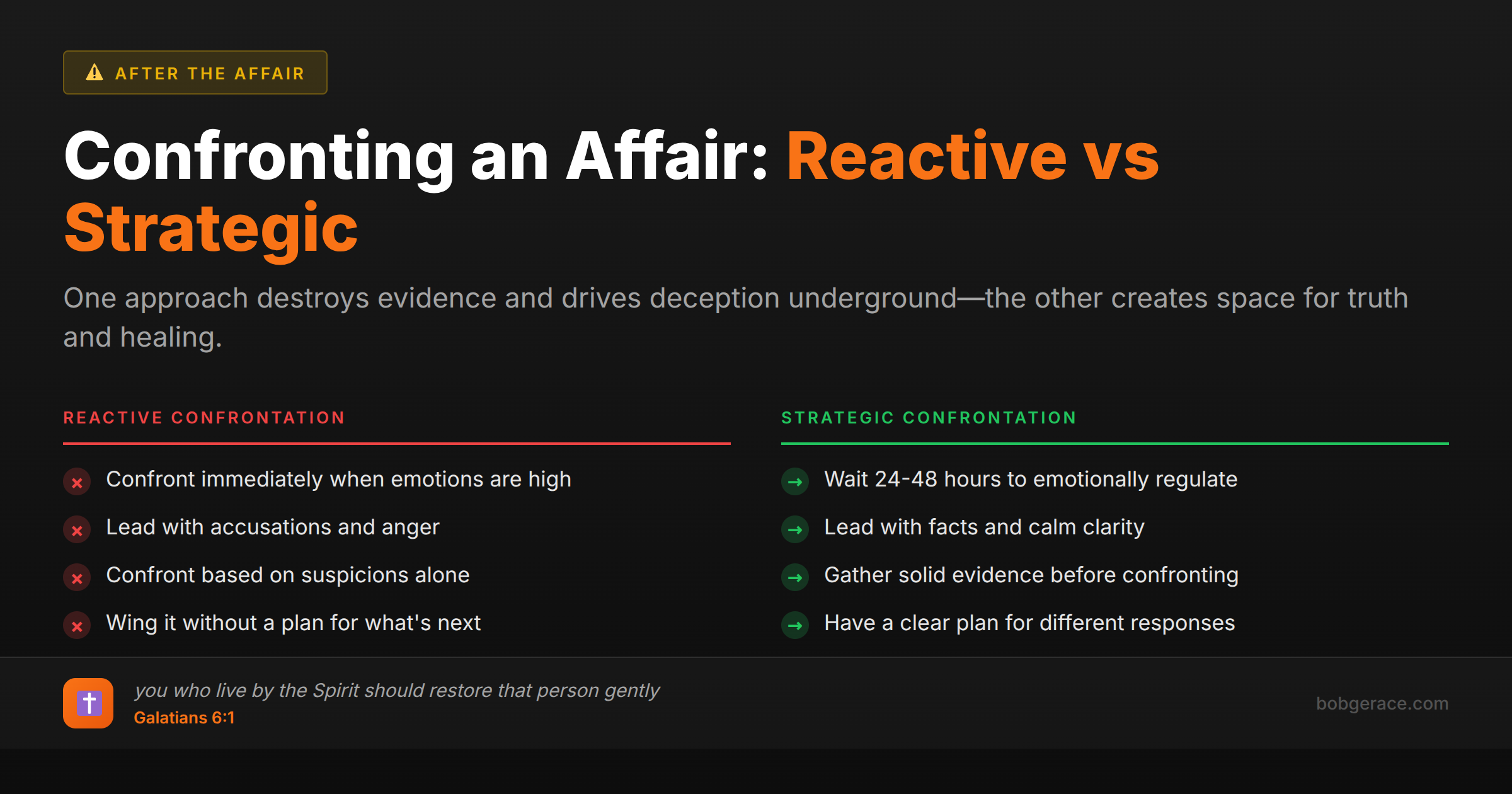
The answer depends on what you know and what you can handle. If you have solid evidence and you're emotionally prepared for any response, confronting can stop the bleeding immediately. But if you're operating on suspicion or you're not ready for denial, gaslighting, or escalation, waiting to gather more information and prepare yourself is often wiser. The key is this: confrontation without preparation often backfires. It can drive the affair underground, give them time to coordinate stories, or trigger defensive responses that make recovery harder. However, waiting too long while torturing yourself isn't healthy either. The sweet spot is confronting when you have enough evidence to be confident, you're emotionally regulated, and you have a clear plan for what comes next.
The Full Picture
Here's what most people don't understand about confrontation timing: it's not about catching them in the act. It's about positioning yourself for the best possible outcome, whatever that looks like for your marriage.
Why immediate confrontation can backfire: - You're operating on emotion rather than strategy - You might not have enough evidence to overcome denial - They can spin the narrative to make you look paranoid - It gives them time to coordinate stories with the other person - You haven't prepared for the various responses they might give
Why waiting indefinitely is also problematic: - The emotional toll of carrying this knowledge alone is devastating - The affair continues to develop and deepen - You might start acting differently, tipping them off anyway - Your mental health deteriorates from the stress and uncertainty - You lose precious time if reconciliation is possible
The strategic middle ground: Take time to gather evidence, but not forever. Take time to prepare emotionally, but don't use preparation as avoidance. Most importantly, get support from someone who can help you think clearly - whether that's a trusted friend, counselor, or coach.
Remember, confrontation isn't just about revealing what you know. It's about creating an opportunity for truth, accountability, and potentially restoration. That requires more than just catching them off guard.
What's Really Happening
From a therapeutic standpoint, the timing of confrontation significantly impacts both immediate and long-term outcomes. Research shows that confrontations driven by high emotional reactivity tend to activate the unfaithful partner's defensive systems, making honest disclosure less likely.
What we see clinically is that rushed confrontations often result in what I call 'disclosure in installments' - where the unfaithful spouse admits only to what they think you already know, revealing additional details slowly over time. This pattern is particularly damaging to the betrayed spouse's ability to //blog.bobgerace.com/ttc-protocol-christian-marriage-regulate-body-crisis/:process and heal from the trauma.
The neurobiological reality is that discovery of infidelity triggers acute stress responses similar to PTSD. When you confront while in this activated state, your prefrontal cortex - responsible for executive decision-making - is compromised. This is why many people report saying things during confrontation that they later regret, or failing to ask important questions they had planned to ask.
Optimal timing occurs when you've moved from reactive to responsive mode. This doesn't mean you're not hurt or angry - those feelings are completely valid. It means you can access your rational thinking alongside your emotions. Practically, this often means waiting 24-72 hours after a triggering discovery, using that time for emotional regulation and strategic planning rather than evidence-gathering alone.
What Scripture Says
Scripture gives us clear guidance on confrontation, but it emphasizes wisdom in timing and approach. Proverbs 27:5-6 tells us, *"Better is open rebuke than hidden love. Wounds from a friend can be trusted, but an enemy multiplies kisses."* This doesn't mean we confront in anger, but that truth-telling is an act of love.
Galatians 6:1 provides the heart posture: *"Brothers and sisters, if someone is caught in a sin, you who live by the Spirit should restore that person gently. But watch yourselves, or you also may be tempted."* The word 'gently' here doesn't mean weakly - it means with the goal of restoration, not destruction.
Proverbs 15:23 speaks to timing: *"A person finds joy in giving an apt reply—and how good is a timely word!"* Wisdom knows not just what to say, but when to say it. Ecclesiastes 3:7 reminds us there is *"a time to be silent and a time to speak."*
Matthew 18:15 gives us the framework: *"If your brother or sister sins, go and point out their fault, just between the two of you. If they listen to you, you have won them over."* Notice this assumes preparation and the right heart attitude.
The biblical pattern isn't immediate emotional reaction - it's wise, loving, restorative confrontation at the right time with the right heart. Even Jesus, when He cleansed the temple, acted with intention and purpose, not just raw emotion.
What To Do Right Now
-
1
Pause and breathe - If you just discovered something, give yourself 24-48 hours before confronting. Use this time to process, not to spiral.
-
2
Assess your evidence - Write down what you know versus what you suspect. Confrontation works best when you have facts, not just feelings.
-
3
Get support - Call a trusted friend, counselor, or coach who can help you think clearly and prepare for different scenarios.
-
4
Plan your approach - Decide when, where, and how you'll have this conversation. Choose a time when you won't be interrupted and both of you are relatively calm.
-
5
Prepare for responses - Think through how you'll handle denial, partial truth, or full confession. What are your boundaries? What are you hoping to accomplish?
-
6
Pray for wisdom and strength - Ask God to prepare both your heart and your spouse's heart for truth, and for the possibility of healing and restoration.
Related Questions
- I found texts — do I confront her?
- Should I gather more evidence first?
- What are the risks of confronting too soon?
- What are the risks of waiting too long?
- How do I confirm she's actually cheating?
- What evidence should I secure?
- What do I say when she asks for divorce?
- How do I not lose my mind right now?
- What is 'betrayal trauma' and do I have it?
- How do I function at work after hearing this?
Also find Bob on
Subscribe for weekly videos on Christian marriage.
You Don't Have to Decide This Alone
Timing a confrontation isn't a formula—it's specific to your marriage, your evidence, and where you are emotionally. A coach who knows your situation can help you prepare for what comes next.
Talk to Bob →