How do I protect myself legally without being adversarial?
6 min read
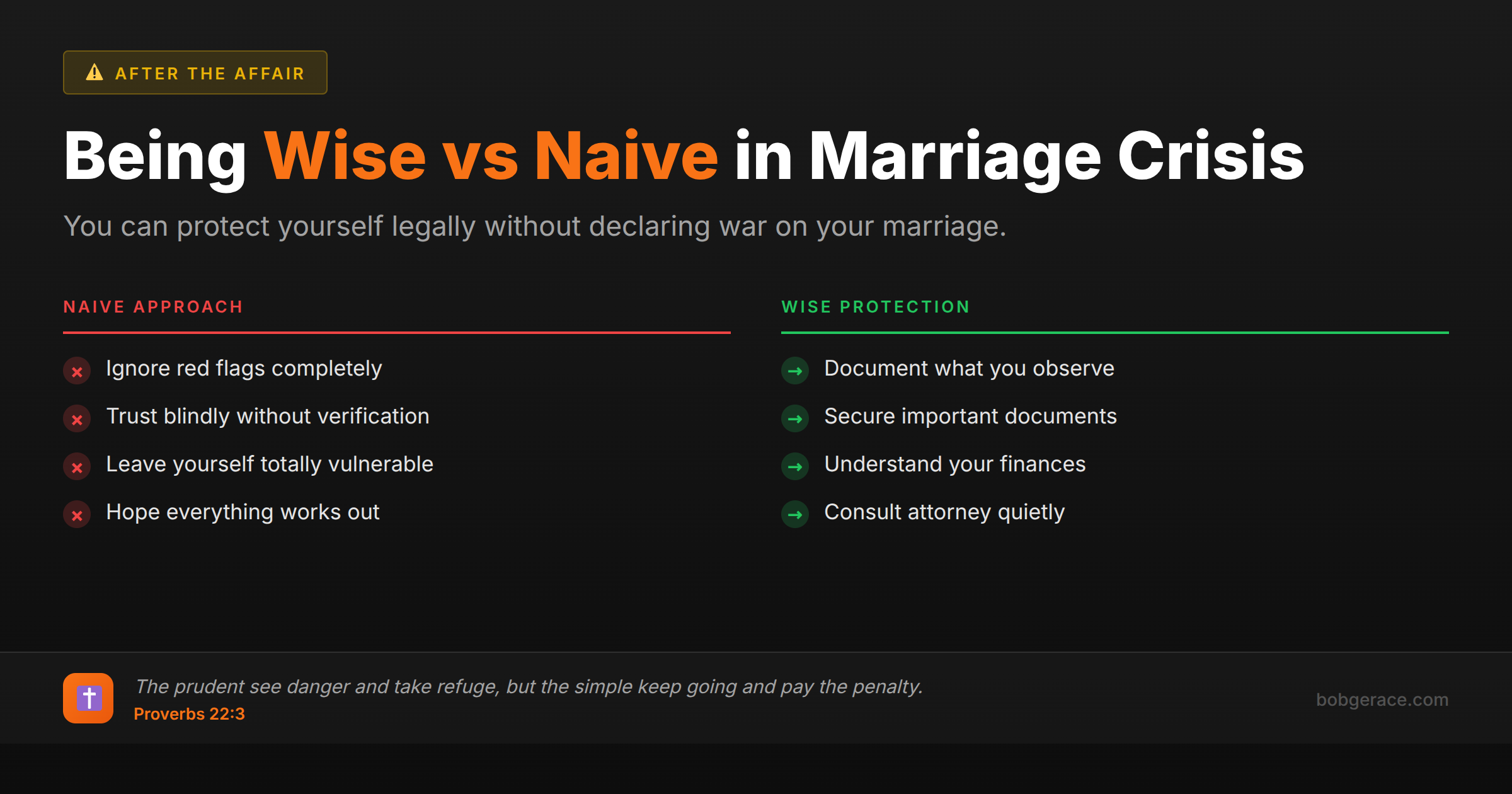
Protecting yourself legally doesn't mean you're giving up on your marriage or preparing for war. Think of it like wearing a seatbelt – it's a precaution, not a plan to crash. You can document important information, understand your rights, and secure essential records while still working toward restoration. The key is being wise and prepared without taking aggressive actions that could damage trust or escalate conflict. This approach allows you to sleep better at night knowing you've been responsible, while keeping the door open for healing and reconciliation in your relationship.
The Full Picture
When you discover there's another man in your wife's life, your world shifts dramatically. Suddenly you're not just dealing with emotional devastation – you're facing potential legal and financial exposure that could affect your future for years to come. The natural response is either to do nothing (hoping it will all work out) or to immediately lawyer up and go on the offensive. Both extremes can be costly mistakes.
The middle path requires wisdom and strategic thinking. You need to protect your interests without poisoning the well for potential reconciliation. This isn't about being sneaky or deceptive – it's about being responsible and prepared while keeping hope alive for your marriage.
Understanding the difference between protection and aggression is crucial. Protection involves gathering information, understanding your rights, and making copies of important documents. Aggression involves threatening legal action, moving money around secretly, or taking steps that could be seen as hostile. One preserves your options; the other often destroys them.
The reality is that affairs often lead to poor decision-making on both sides. Your wife may be making choices that could affect joint assets, family finances, or even child custody arrangements. By being prepared legally, you're not assuming the worst – you're being responsible for your family's future regardless of which direction your marriage heads.
This approach also demonstrates maturity and leadership. Rather than being reactive or vindictive, you're showing that you can handle crisis with wisdom and grace. This actually increases your chances of reconciliation because it shows your wife a man who can be trusted to make good decisions under pressure.
What's Really Happening
From a therapeutic perspective, the desire to protect yourself legally during a marital crisis is both natural and necessary. What we see clinically is that men who take reasonable protective measures actually fare better emotionally and relationally than those who either ignore the practical realities or become overly aggressive.
The key is understanding the psychological impact of your approach. When you take measured, reasonable steps to protect yourself, you're actually reducing your own anxiety and sense of powerlessness. This emotional stability allows you to engage more effectively in the work of reconciliation. Conversely, men who either do nothing or go into full legal attack mode often find themselves either paralyzed by fear or consumed by anger – neither state is conducive to healing a marriage.
Your wife's response to your protective measures will also be telling. If she reacts with extreme anger or defensiveness to reasonable precautions, it may indicate she's already considering her own legal options or making financial decisions without your knowledge. If she understands and accepts your need to be prepared, it suggests she still has investment in treating you fairly.
The trauma of infidelity often impairs judgment on both sides. By maintaining clear thinking and taking reasonable precautions, you're actually providing stability for both yourself and potentially for her as she works through her own confusion. This //blog.bobgerace.com/sexual-leadership-christian-marriage-beyond-performance/:leadership can be attractive and may contribute to her eventual decision to end the affair and work on the marriage.
What Scripture Says
The Bible doesn't call us to be naive about the realities of a fallen world, even within marriage. While we're called to love, forgive, and work toward reconciliation, we're also called to be wise and prudent in our dealings.
Proverbs 22:3 tells us, *"The prudent see danger and take refuge, but the simple keep going and pay the penalty."* Taking reasonable legal precautions isn't a lack of faith – it's biblical wisdom. You can protect yourself while still hoping and working for restoration.
In Luke 14:28, Jesus says, *"Suppose one of you wants to build a tower. Won't you first sit down and estimate the cost to see if you have enough money to complete it?"* This principle of counting the cost and planning wisely applies to protecting your family's future during a marital crisis.
Proverbs 27:14 reminds us, *"In the heart of man plans his way, but the Lord establishes his steps."* You can make wise preparations while still trusting God for the outcome. Planning doesn't demonstrate a lack of faith – it demonstrates good stewardship.
Jesus himself instructed his disciples in Luke 22:36, *"If you don't have a sword, sell your cloak and buy one."* While this wasn't about physical violence, it shows that reasonable preparation for potential difficulty is wise and biblical.
Romans 13:1-4 establishes that legal systems are ordained by God for protection and justice. Using these systems appropriately to protect yourself and your family isn't unspiritual – it's utilizing the structures God has provided for our protection.
The goal isn't to harm but to be prepared for any outcome while working toward the best possible outcome – the restoration of your marriage.
What To Do Right Now
-
1
Document everything - Keep a private record of dates, conversations, and observable behaviors. Don't investigate obsessively, but note what you naturally observe.
-
2
Secure important documents - Make copies of financial statements, tax returns, insurance policies, and property deeds. Store them safely off-site.
-
3
Understand your financial picture - Know what accounts exist, what debts you have, and what assets are in joint names vs. individual names.
-
4
Consult with an attorney quietly - Have one confidential consultation to understand your rights and options. Don't retain them yet, just get informed.
-
5
Protect your credit - Monitor your credit reports and consider freezing your credit to prevent new accounts being opened without your knowledge.
-
6
Maintain normal financial patterns - Don't move money around or make major financial changes that could be seen as hiding assets or preparing for divorce.
Related Questions
- What evidence should I secure?
- Should I screenshot everything?
- What do I do about finances immediately?
- Should I confront immediately or wait?
- What are the risks of confronting too soon?
- What are the risks of waiting too long?
- What financial protections should I put in place?
- How do I protect assets without being aggressive?
- What do I concede vs. what do I hold firm on?
- How do I protect myself without escalating?
Also find Bob on
Subscribe for weekly videos on Christian marriage.
Get a Coach Who Knows Your Marriage
Legal moves in your specific situation — what protects you without blowing up trust. A coach sees what you can't see when you're in it.
Talk to Bob →