Should I screenshot everything?
6 min read
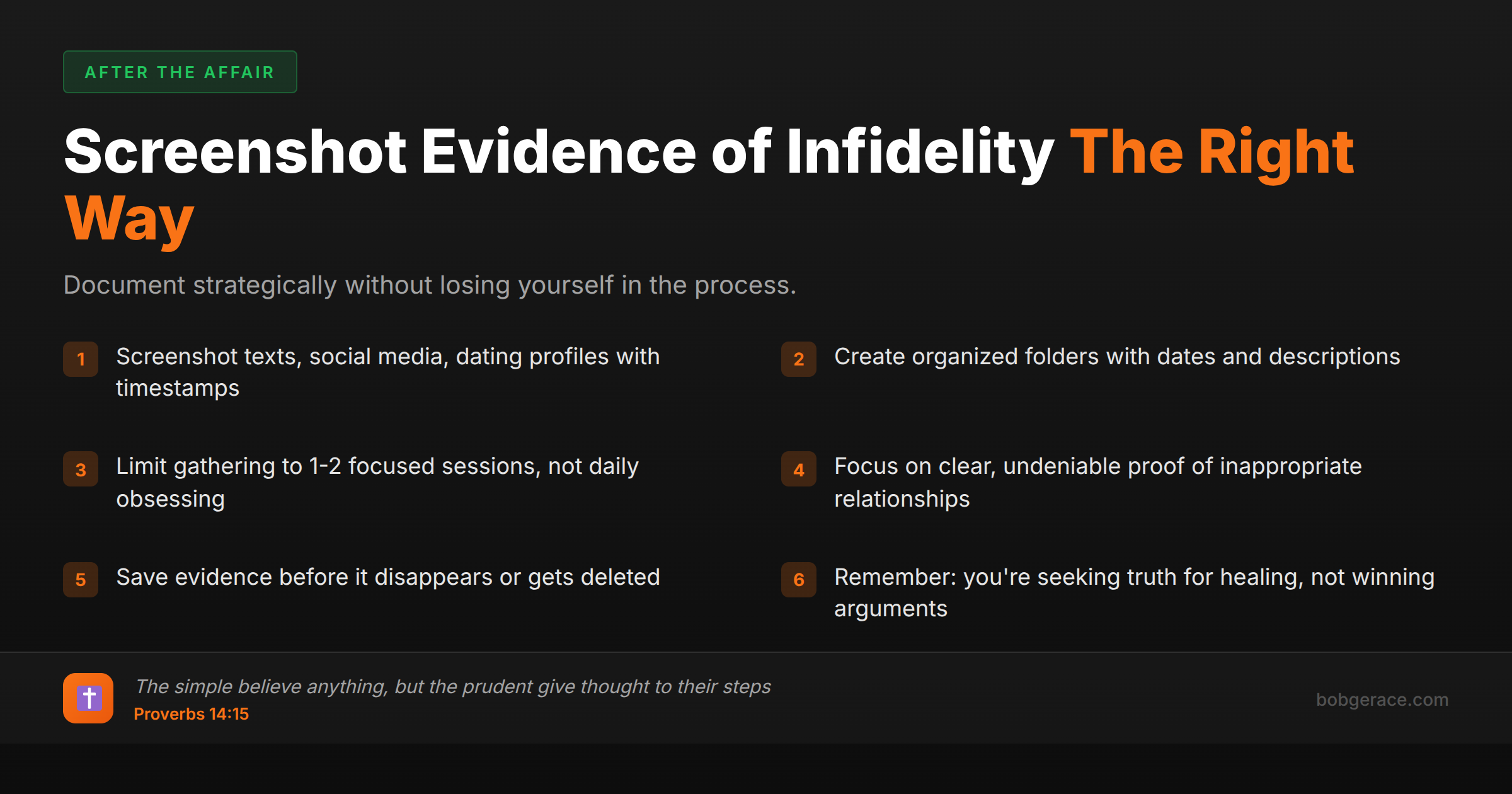
Yes, but be strategic about it. When you discover evidence of infidelity, your instinct is to capture everything - and you should. Screenshot text messages, social media interactions, dating app profiles, and any suspicious communications before they disappear. However, don't let evidence gathering consume your life or compromise your integrity. Focus on clear, undeniable proof rather than trying to document every suspicious moment. Save screenshots with timestamps and organize them chronologically. Remember, you're not building a legal case - you're seeking truth and clarity for your marriage. The goal isn't to "win" an argument but to address reality and move toward healing or healthy resolution.
The Full Picture
When you suspect your spouse is involved with another person, documenting evidence becomes crucial - but it needs to be done wisely. Screenshots serve multiple important purposes: they preserve evidence that could disappear, provide concrete proof when confronting denial, and help you maintain clarity when you're being gaslit or manipulated.
Start with the obvious targets: suspicious text messages, social media interactions, dating app profiles, email communications, and unusual call logs. Don't just screenshot the "smoking gun" messages - capture context too. Save the conversation threads that show the progression of the relationship.
Timing matters tremendously. Many people discover evidence late at night when their spouse is asleep or away. This is actually ideal - you have time to methodically document without rushing. Take screenshots of everything relevant, but don't spend hours analyzing every detail in the moment.
Organization is key for your sanity. Create a dedicated folder on your phone or computer. Name files with dates and brief descriptions. This isn't just about having proof - it's about maintaining your own mental clarity when you're dealing with the emotional chaos of discovery.
Remember the legal landscape. While you're married, you generally have legal access to shared devices and accounts. However, hacking into personal accounts or installing spyware crosses ethical and legal lines. Stay within bounds of what you can legitimately access.
Don't become obsessed with finding more. Once you have clear evidence of infidelity, additional screenshots won't change the fundamental reality. Focus on what you need to make informed decisions about your marriage, not on building an exhaustive case file.
What's Really Happening
The compulsion to screenshot everything reflects a normal psychological response to betrayal trauma. When your reality has been shattered by deception, your mind desperately seeks concrete evidence to anchor itself to truth. This documentation behavior serves several psychological functions.
First, it's a form of reality //blog.bobgerace.com/marriage-growth-christian-husband-testing-season/:testing. Betrayed spouses often experience gaslighting - being told their perceptions are wrong, they're "paranoid," or they're "imagining things." Screenshots provide irrefutable proof that validates their instincts and experiences. This validation is crucial for mental health recovery.
Second, documentation can provide a sense of control in a completely out-of-control situation. When your spouse's behavior is unpredictable and deceptive, having concrete evidence feels like having power. However, this can become compulsive if not managed carefully.
The danger lies in becoming consumed by the investigation process. Some betrayed spouses spend hours daily searching for new evidence, checking devices, and analyzing every interaction. This hypervigilance, while understandable, can become traumatizing in itself and prevent emotional healing.
I recommend clients gather sufficient evidence to confirm their suspicions, then shift focus to processing the emotional impact and deciding on next steps. Continuing to seek more and more proof often indicates difficulty accepting the painful reality that's already been established. The goal should be clarity and decision-making, not building an overwhelming case file that keeps you trapped in investigation mode.
What Scripture Says
Scripture supports the pursuit of truth while warning against destructive behaviors that can consume us. "The simple believe anything, but the prudent give thought to their steps" (Proverbs 14:15). Wisdom requires us to verify what we're being told rather than blindly accepting explanations that don't align with evidence.
"Surely you desire truth in the inner parts; you teach me wisdom in the inmost place" (Psalm 51:6). God values truth and transparency. When deception has entered your marriage, seeking evidence isn't about being vindictive - it's about pursuing the truth that God desires in relationships.
However, Scripture also warns about becoming consumed by investigation: "Above all else, guard your heart, for everything you do flows from it" (Proverbs 4:23). While gathering evidence is wise, don't let it poison your heart with bitterness, obsession, or desire for revenge.
"Be as shrewd as snakes and as innocent as doves" (Matthew 10:16). Jesus calls us to be wise and discerning while maintaining our integrity. Document what you need to know the truth, but don't compromise your own character through deceptive or vengeful actions.
"If your brother or sister sins, go and point out their fault, just between the two of you" (Matthew 18:15). The ultimate goal of discovering truth isn't to destroy your spouse but to address the sin and seek restoration. Evidence should serve the purpose of honest confrontation and accountability.
"Do not be overcome by evil, but overcome evil with good" (Romans 12:21). Let your response to betrayal reflect God's character - seek truth, pursue justice, but don't let the process corrupt your own heart or actions.
What To Do Right Now
-
1
Document systematically - Screenshot key evidence including text messages, social media interactions, dating profiles, and suspicious communications with timestamps
-
2
Organize immediately - Create a dedicated folder and name files with dates and brief descriptions to maintain clarity
-
3
Set boundaries for yourself - Limit evidence gathering to 1-2 focused sessions rather than obsessive daily searching
-
4
Focus on clear proof - Prioritize undeniable evidence of inappropriate relationships over circumstantial details
-
5
Preserve original sources - Keep screenshots in multiple locations and note where original evidence can be found if needed
-
6
Plan your confrontation - Once you have sufficient proof, prepare for an honest conversation rather than continuing to investigate indefinitely
Related Questions
You Don't Have to Navigate This Alone
Discovering evidence of betrayal is overwhelming. Get personalized guidance on handling proof, confronting wisely, and protecting your heart through this crisis.
Get Support →