Should I tell anyone right now?
6 min read
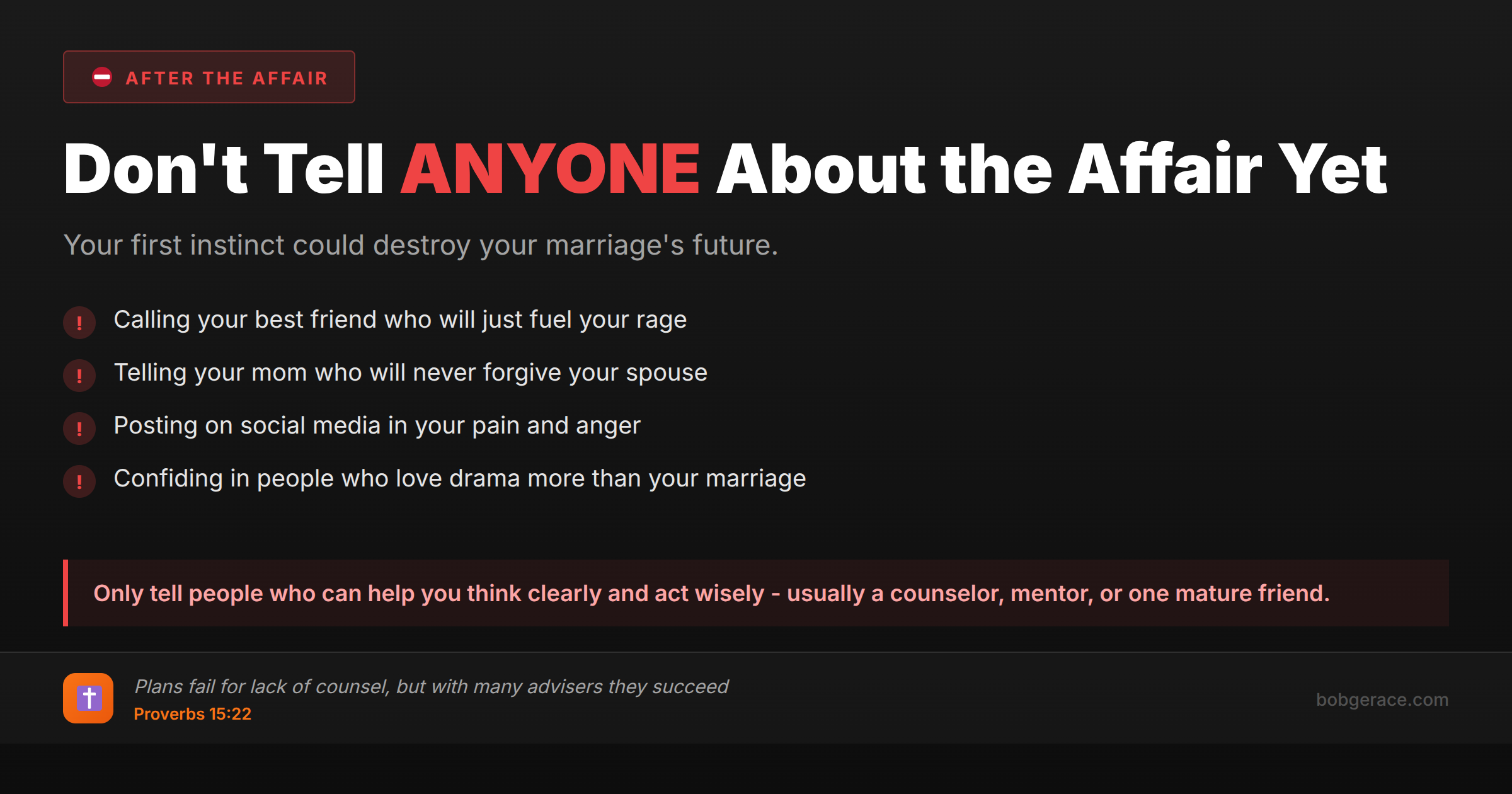
The short answer is: be extremely selective and strategic about who you tell right now. Your first instinct might be to call your best friend, your mom, or blast it on social media - but hold off. The people you tell in these early hours will shape your recovery journey in ways you can't imagine yet. Here's my rule: only tell people who can genuinely help you think clearly and act wisely. That usually means a professional counselor, a mature mentor, or one trusted friend who won't just fuel your anger. Everyone else can wait. This isn't about keeping secrets - it's about protecting your marriage's future and giving yourself space to make decisions from wisdom, not just pain.
The Full Picture
When you discover there's another man, your world explodes. Everything you thought you knew gets turned upside down, and the urge to tell someone - anyone - is overwhelming. But here's what I've learned from walking hundreds of men through this nightmare: who you tell in the first 48-72 hours can make or break your recovery.
The problem isn't that you want to tell people. The problem is that most people have no idea how to help a marriage survive infidelity. They mean well, but they'll either push you toward divorce court or give you advice that makes things worse. Your brother-in-law who's been divorced twice? Not your guy right now. Your drinking buddy who hates your wife anyway? Definitely not.
The people you should consider telling immediately: - A professional marriage counselor or coach - A mature, married mentor who's weathered serious storms - One trusted friend who can think strategically and keep confidences - A pastor or spiritual advisor (if you trust their discretion)
The people you should NOT tell yet: - Your parents or her parents - Your children (absolutely not yet) - Mutual friends who might feel compelled to "pick sides" - Coworkers or casual acquaintances - Social media (never)
Why? Because once you tell people, you can't untell them. If your marriage recovers - and many do - you'll have to live with the fact that your mom will always remember your wife as "the cheater" or your kids will carry scars from information they weren't ready to handle.
This isn't about protecting her. This is about protecting your options and your family's future. The goal right now isn't to build a case against your wife. It's to get the support you need to think clearly and act wisely in the most important crisis of your marriage.
What's Really Happening
From a clinical perspective, the betrayed partner's impulse to disclose immediately serves several psychological functions: it seeks validation for their pain, attempts to regain control, and tries to recruit allies. However, premature disclosure often creates what we call "secondary trauma" - additional complications that hinder recovery.
Research shows that couples who engage in strategic disclosure have better outcomes than those who experience chaotic, uncontrolled revelation. The key is understanding that your emotional state right now is essentially one of acute trauma. Your prefrontal cortex - the part of your brain responsible for executive decision-making - is compromised while your amygdala is in overdrive.
This neurobiological reality means the decisions you make in the immediate aftermath may not align with your long-term values or goals. Professional support becomes crucial because a trained therapist can help regulate your nervous system and provide the cognitive framework you temporarily can't access.
The concept of "containment" in affair recovery isn't about secrecy - it's about creating a safe space for processing and decision-making. When too many voices enter the conversation too early, it creates what I call "recovery chaos" where well-meaning advice creates additional pressure and confusion.
Timing disclosure appropriately allows you to //blog.bobgerace.com/christian-marriage-death-protocol-kill-old-patterns/:process your emotions, gather information, and make decisions from a place of clarity rather than crisis. This strategic approach significantly improves the chances of both individual healing and, if desired, marital recovery.
What Scripture Says
Scripture gives us clear guidance about wisdom in crisis and the importance of seeking godly counsel. Proverbs 19:20 tells us, "Listen to advice and accept discipline, and at the end you will be counted among the wise." Notice it doesn't say listen to *everyone's* advice - it implies seeking *wise* counsel.
Proverbs 15:22 reinforces this: "Plans fail for lack of counsel, but with many advisers they succeed." The key word here is "advisers" - not gossips, not people who will just agree with you, but genuine advisers who can help you think through complex decisions.
When it comes to discretion, Proverbs 11:13 is crystal clear: "A gossip betrays a confidence, but a trustworthy person keeps a secret." This works both ways - you need to be discerning about who you trust with this information, and you need to choose people who won't spread it further.
Matthew 18:15-17 gives us the biblical pattern for addressing sin and conflict. While this passage is often applied to church discipline, the principle applies here: start with the smallest circle possible and expand only as necessary. Jesus advocates for handling serious issues with wisdom and appropriate boundaries.
James 1:5 promises, "If any of you lacks wisdom, you should ask God for wisdom, and God, who gives generously to all without finding fault, will give it to you." In this crisis, you desperately need wisdom - both divine wisdom through prayer and practical wisdom through godly counselors.
The biblical approach isn't about hiding sin or avoiding accountability. It's about handling devastating situations with wisdom, seeking appropriate counsel, and protecting the people and relationships God has entrusted to your care.
What To Do Right Now
-
1
Take 24 hours before telling anyone else - Give yourself time to process the initial shock and think strategically about your next moves
-
2
Identify one professional counselor or coach - Find someone who specializes in affair recovery and can provide objective, expert guidance
-
3
Choose one trusted confidant maximum - Select someone who is discreet, wise, and won't just fuel your anger or push you toward divorce
-
4
Write down your thoughts privately first - Journal or record your feelings so you can process without immediately involving others
-
5
Pray for wisdom about timing and approach - Ask God to guide your decisions about when and how to expand your circle of support
-
6
Create a communication plan for later - Think through how and when you might tell others, but don't execute it yet
Related Questions
- I just found out — what do I do in the next hour?
- What evidence should I secure?
- Should I confront immediately or wait?
- What are the risks of confronting too soon?
- What do I do about finances immediately?
- How do I protect myself legally without being adversarial?
- How do I function at work after hearing this?
- Should I tell anyone right away?
- What support do I need?
- Why do I need other men?
Also find Bob on
Subscribe for weekly videos on Christian marriage.
Bring Your Actual Situation to Bob
Who you tell, when you tell them, what you say next — these decisions matter in your specific marriage. A coach who knows your story can help you think clearly when your head is spinning.
Talk to Bob →