What does the other man represent that I don't?
6 min read
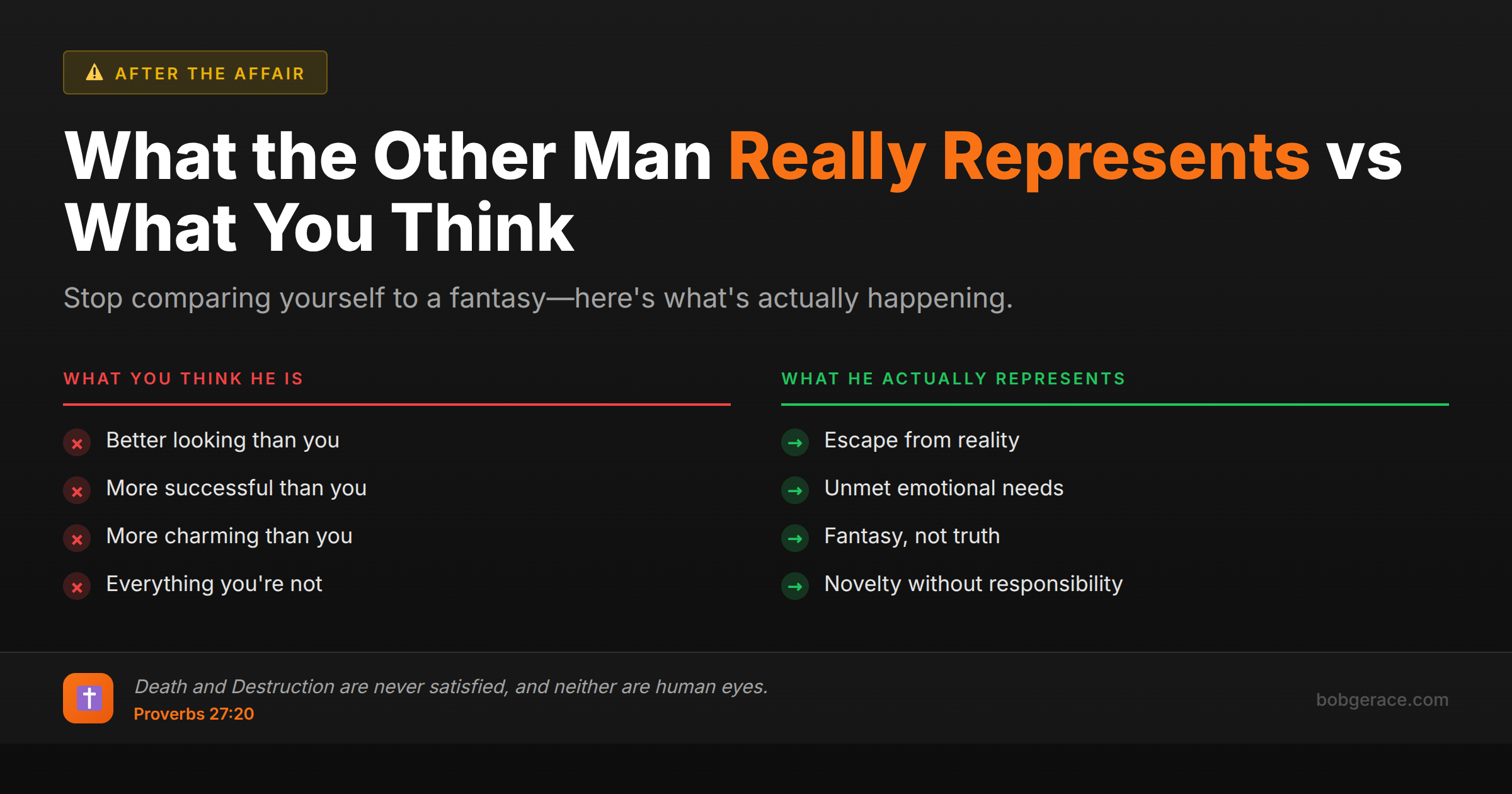
The other man rarely represents what you think he does. He's not necessarily better looking, more successful, or more charming than you. Instead, he represents an escape from reality, unmet emotional needs, and often the fantasy of who your wife wishes she could be rather than who she actually is. Most affairs happen because of what's missing emotionally in the marriage, not because the other person is superior. He represents novelty, excitement, and freedom from responsibility. He gets the best version of your wife while you've been dealing with mortgages, parenting stress, and daily life. This isn't about your inadequacy—it's about understanding that affairs are built on fantasy, not reality.
The Full Picture
Here's what I want you to understand: the other man isn't your replacement, he's an escape route. After working with hundreds of men in your situation, I can tell you that the affair partner rarely possesses qualities you lack. Instead, he represents something entirely different.
## What He Actually Represents
The other man represents freedom from consequences. While you're dealing with bills, children's schedules, work stress, and the weight of real responsibility, he gets to be the fun guy. He doesn't have to parent your kids, fix the leaky faucet, or discuss the family budget. He gets the highlight reel while you've been living in the real world.
He also represents emotional escape. If your wife has been feeling unappreciated, misunderstood, or emotionally disconnected, he becomes the person who makes her feel heard and valued. This isn't because he's better at relationships—it's because there's no real relationship pressure. It's easy to be charming when you don't have to navigate real life together.
## The Fantasy Factor
Affairs thrive on fantasy. The other man represents who your wife thinks she could be if she had a different life. Maybe she sees herself as more adventurous, more desirable, or more interesting when she's with him. This fantasy version of herself is intoxicating, but it's not sustainable because it's not based in reality.
Stop comparing yourself to a fantasy. You're a real person dealing with real life, real responsibilities, and real challenges. He's playing a role in someone else's escape from reality.
What's Really Happening
From a clinical perspective, affair partners typically fulfill specific psychological functions rather than representing superior qualities. Research shows that most people don't have affairs because their partner is inadequate, but because certain emotional or psychological needs aren't being met within the marriage.
The other man often represents what psychologists call a 'transitional object'—something that helps your wife cope with internal conflict or dissatisfaction. He might represent autonomy if she feels controlled, excitement if life feels mundane, or //blog.bobgerace.com/male-emotional-validation-marriage-stop-blame-game/:validation if she feels unappreciated. Understanding this can help you see that the affair is more about her internal state than your external qualities.
Neurologically, affairs trigger the brain's reward system through novelty and risk. The other man benefits from what we call 'intermittent reinforcement'—sporadic, unpredictable positive interactions that create a powerful psychological bond. You, as the spouse, can't compete with this artificially heightened brain chemistry because real relationships don't operate on constant novelty and risk.
It's crucial to understand that affairs often represent attempts to resolve internal conflicts or unmet developmental needs. The other man becomes a projection screen for your wife's unfulfilled desires or unexpressed parts of herself. This psychological dynamic explains why many people in affairs describe feeling like 'a different person' with their affair partner—because they're accessing suppressed aspects of their identity.
What Scripture Says
Scripture gives us wisdom about the nature of sin and temptation that applies directly to your situation. Understanding what drives people toward forbidden relationships can help you see this situation more clearly.
Proverbs 27:20 tells us, *"Death and Destruction are never satisfied, and neither are human eyes."* The other man represents the grass-is-greener mentality—the belief that satisfaction can be found in something or someone new. But this is an illusion that leads to destruction.
1 John 2:16 explains the root of temptation: *"For everything in the world—the lust of the flesh, the lust of the eyes, and the pride of life—comes not from the Father but from the world."* The other man appeals to these three areas: physical attraction (lust of the flesh), the desire for what looks appealing (lust of the eyes), and the ego boost of being wanted (pride of life).
James 1:14-15 shows us how sin progresses: *"But each person is tempted when they are dragged away by their own evil desire and enticed. Then, after desire has conceived, it gives birth to sin; and sin, when it is full-grown, gives birth to death."* The other man didn't create the desire—he became the object of desires that were already present.
Ecclesiastes 4:12 reminds us of the power of covenant: *"Though one may be overpowered, two can defend themselves. A cord of three strands is not quickly broken."* The other man represents a breaking of the three-strand cord (you, your wife, and God), but that cord can be rewoven stronger than before.
Remember, Psalm 139:14 declares that you are *"fearfully and wonderfully made."* Your worth isn't determined by comparison to another man, but by God's design and purpose for your life. Romans 8:28 promises that God works all things together for good for those who love Him—even this painful situation can become part of His redemptive plan for your marriage.
What To Do Right Now
-
1
Stop the comparison game immediately—write down three ways you've been a good husband and focus on facts, not fantasies about him
-
2
Identify the real issues—list what emotional needs weren't being met in your marriage before the affair started
-
3
Focus on your own growth—start working on becoming the best version of yourself, regardless of what happens with your marriage
-
4
Seek professional guidance—get help from someone who understands affair recovery and can help you navigate this process
-
5
Establish boundaries with information—stop seeking details about him or their relationship that will only fuel unhealthy comparisons
-
6
Begin rebuilding your identity—reconnect with your values, goals, and the man God created you to be, independent of this situation
Related Questions
- Why does she prefer him to me?
- He's not even as good as me — why him?
- She says he 'gets' her — what does that mean?
- What is 'affair partner idealization' and why is it happening?
- How does affair partner represent projected fantasies?
- What unmet needs does he symbolize?
- Was I not enough for her?
- How do I become a man worth choosing without competing?
- What did I not receive from my father that I need?
Also find Bob on
Subscribe for weekly videos on Christian marriage.
You Don't Need to Guess Alone
A coach who knows your marriage can tell you what's actually happening here—not just theory. Bring this situation to someone who's seen it before.
Talk to Bob →