What are risks vs. benefits of exposure?
6 min read
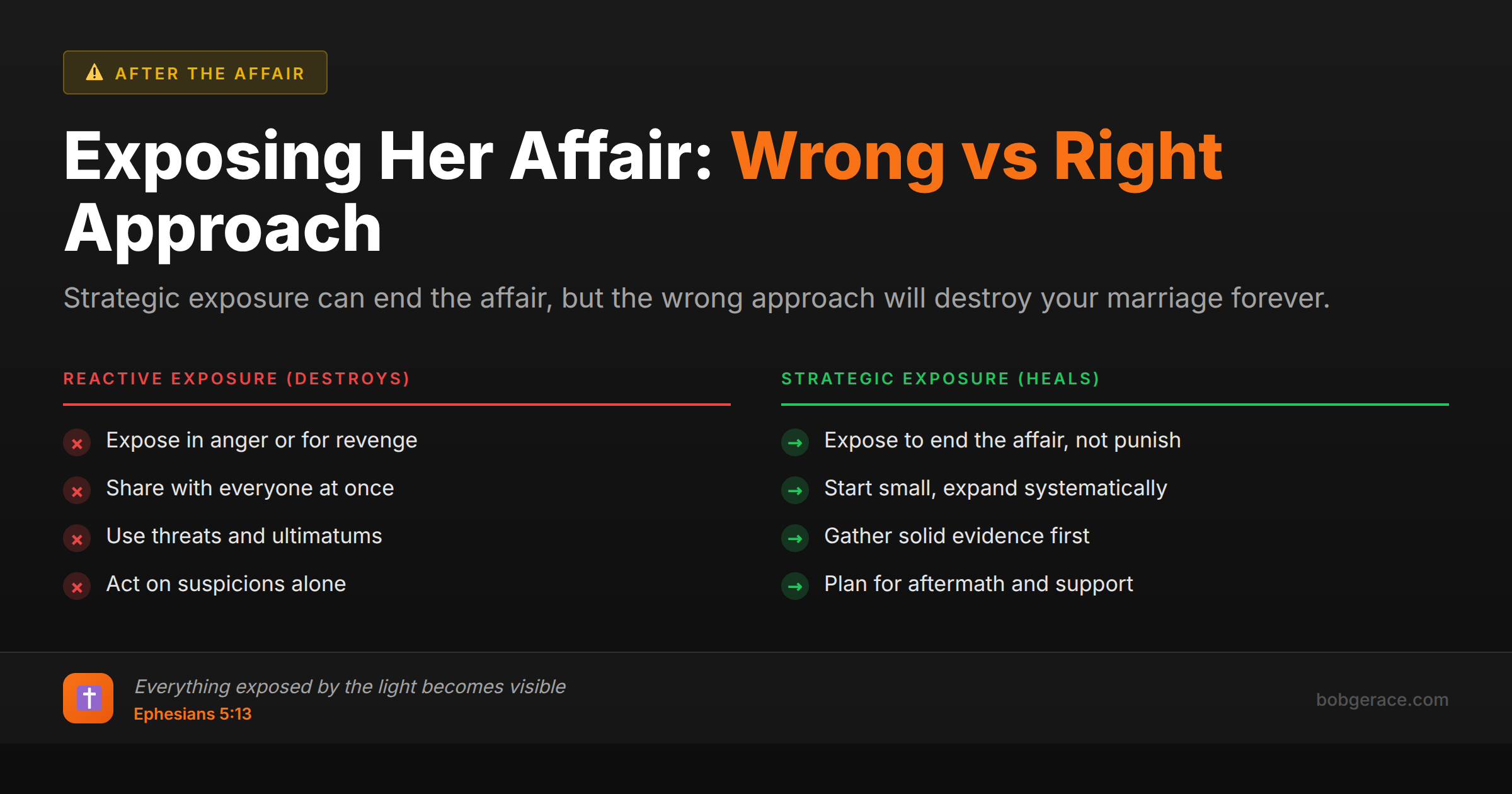
Exposing your wife's affair is a double-edged sword that requires careful consideration. The benefits include breaking the secrecy that affairs thrive on, creating accountability, potentially ending the affair immediately, and getting support from family and friends. However, the risks are significant: escalation of conflict, potential retaliation, loss of privacy, damage to children, and burning bridges for reconciliation. The key is strategic timing and method. Exposure works best when done systematically - starting with the other man's spouse, then close family, and finally broader circles if necessary. Never expose in anger or as revenge. The goal should be ending the affair and creating conditions for healing, not punishment. Consider your wife's mental state, your children's wellbeing, and your own safety before proceeding.
The Full Picture
Exposure is one of the most controversial topics in affair recovery, and for good reason. It's a nuclear option that can either save your marriage or blow it apart completely.
The Benefits Are Real: - Breaks the fantasy bubble - Affairs thrive in secrecy and darkness - Creates immediate consequences - Often ends affairs within days - Mobilizes your support system - Family and friends can rally around you - Levels the playing field - No more living a lie while she gets comfort from others - Forces decision-making - She can't keep straddling the fence indefinitely - Protects the other betrayed spouse - They deserve to know what's happening
But the Risks Are Severe: - Escalation and retaliation - She may become vindictive or dangerous - Loss of reconciliation opportunity - Some wives never forgive being exposed - Damage to children - Kids may learn details they're not ready for - Professional consequences - Workplace affairs can destroy careers - Legal complications - Could impact divorce proceedings or custody - Mental health crises - Some people have severe reactions to exposure
The timing and method matter everything. Exposure done in anger, as revenge, or without strategic thinking usually backfires spectacularly. But exposure done thoughtfully, with clear goals, and as a last resort to save the marriage can be incredibly effective.
Most affairs end within 72 hours of proper exposure. The shame, consequences, and reality check are often too much for the fantasy to survive.
What's Really Happening
From a clinical perspective, exposure activates several powerful psychological mechanisms simultaneously. When affairs are exposed, the neurochemical high that sustains the affair relationship - driven by dopamine, norepinephrine, and other reward chemicals - crashes dramatically. The fantasy bubble that affairs require to survive simply cannot withstand the harsh light of reality and consequences.
However, exposure also triggers the threat detection system in both partners. For the unfaithful spouse, this can activate fight-flight-freeze responses that may include aggression, complete withdrawal, or emotional shutdown. We often see what I call 'exposure trauma' - a temporary but intense psychological state where the exposed partner feels cornered and may make irrational decisions.
The key clinical consideration is timing and the unfaithful partner's psychological state. If someone is already in crisis, suicidal, or has a history of severe mental health issues, exposure must be handled with extreme caution. I've seen cases where poorly timed exposure led to hospitalization, suicide attempts, or complete psychological breaks.
That said, when done strategically, exposure can be therapeutically beneficial. It forces the unfaithful partner to confront reality, creates external accountability structures, and often provides the betrayed spouse with much-needed support systems. The //blog.bobgerace.com/shame-script-interruption-marriage-reset-sexual-intimacy/:shame that comes with exposure, while painful, can also be a catalyst for genuine remorse and change.
The most successful exposures I've witnessed were done with clear therapeutic goals, adequate safety planning, and usually with professional guidance to manage the inevitable crisis that follows.
What Scripture Says
Scripture provides clear guidance on dealing with sin, including when and how to expose wrongdoing. The principle of bringing darkness into light is fundamental to Christian living.
Ephesians 5:11-13 instructs us: *"Have nothing to do with the fruitless deeds of darkness, but rather expose them. It is shameful even to mention what the disobedient do in secret. But everything exposed by the light becomes visible—and everything that is illuminated becomes a light."* This passage directly addresses exposing hidden sin.
Matthew 18:15-17 gives us the process for confronting sin: *"If your brother or sister sins, go and point out their fault, just between the two of you. If they listen to you, you have won them over. But if they will not listen, take one or two others along, so that 'every matter may be established by the testimony of two or three witnesses.' If they still refuse to listen, tell it to the church."* This shows escalating exposure when private confrontation fails.
1 Timothy 5:20 states: *"But those elders who are sinning you are to reprove before everyone, so that the others may take warning."* There's a place for public accountability when private methods fail.
Galatians 6:1 reminds us of our motivation: *"Brothers and sisters, if someone is caught in a sin, you who live by the Spirit should restore that person gently."* Exposure should always be motivated by restoration, not revenge.
The biblical model isn't about punishment—it's about bringing sin into the light so healing and restoration can occur. God Himself exposes our sin not to destroy us, but to lead us to repentance and freedom.
What To Do Right Now
-
1
Assess your safety situation - Consider if exposure might trigger dangerous retaliation or escalation before proceeding
-
2
Gather solid evidence - Don't expose based on suspicions; have concrete proof that can't be denied or minimized
-
3
Plan your approach strategically - Start with the other man's spouse, then close family, then broader circles if needed
-
4
Prepare for the aftermath - Have support systems ready and expect 72 hours of crisis and potential chaos
-
5
Focus on ending the affair - Make it clear that exposure will continue until all contact stops permanently
-
6
Document everything - Keep records of the affair and any threats or retaliation that may follow exposure
Related Questions
- Should I confront the other man?
- Should I contact the other man's wife?
- Should I expose the affair publicly?
- What does research say about confronting the affair partner?
- How do I compete with the affair partner?
- What boundaries should I set?
- What is a boundary vs. an ultimatum?
- How do I enforce without controlling?
- What's the difference between justice and revenge?
- What does 'overcome evil with good' look like here?
Also find Bob on
Subscribe for weekly videos on Christian marriage.
Exposure Timing Is Everything
This decision can end the affair or blow up your marriage. Bob has walked hundreds of men through exposure—what worked, what backfired, what your specific situation needs right now.
Talk to Bob →