How do I support their relationship with her when she's hurting me?
5 min read
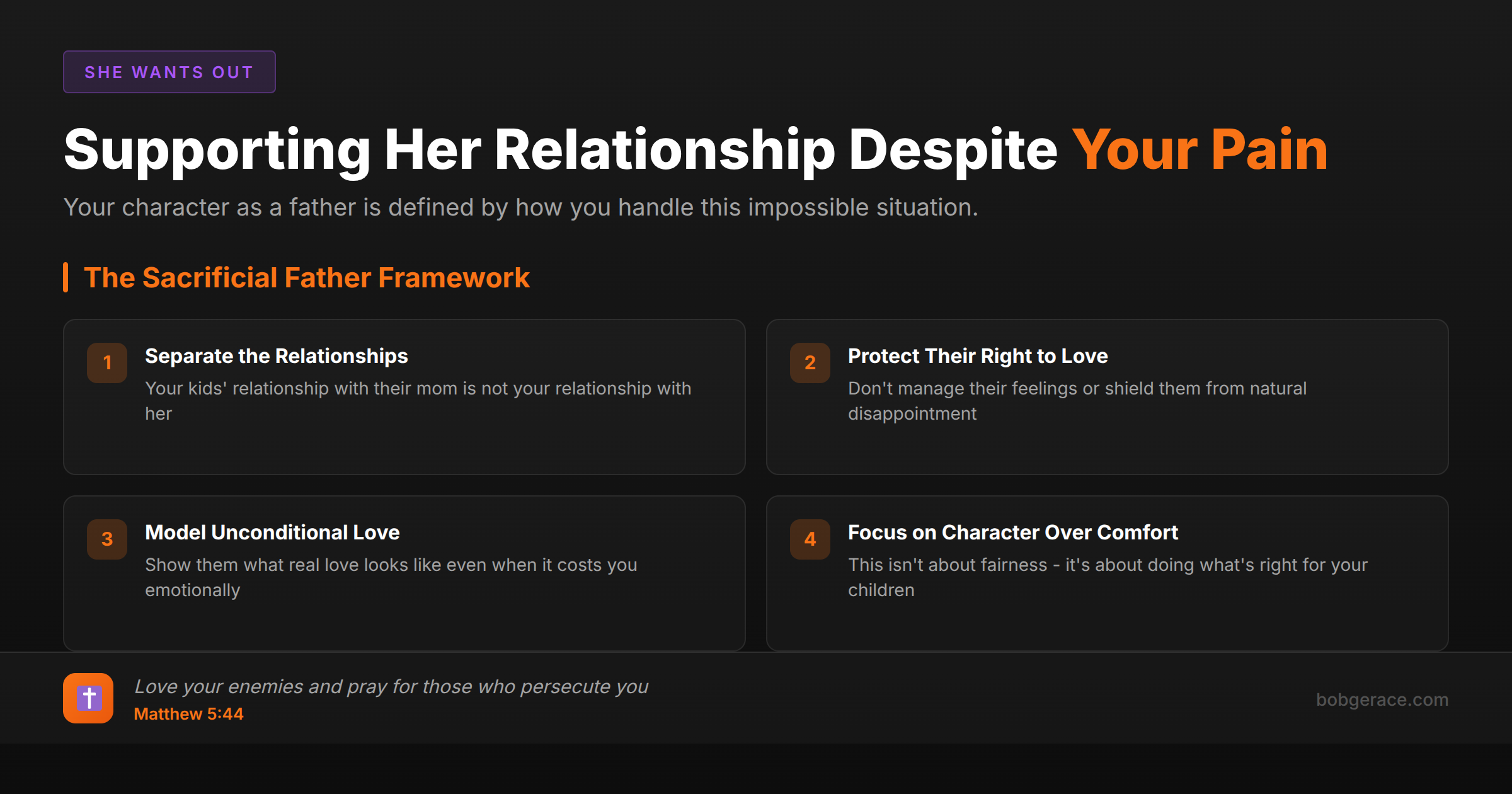
This is one of the hardest parts of separation and divorce - watching your kids love someone who's causing you pain. But here's the truth: your children's relationship with their mother is separate from your relationship with her. Your job isn't to manage their feelings about her or protect them from disappointment - it's to protect their right to love both parents freely. The way you handle this will define your character as a father and shape how your children see love, conflict, and integrity. When you support their relationship with her despite your pain, you're showing them what unconditional love looks like. Yes, it hurts. Yes, it feels unfair. But this isn't about fairness - it's about doing what's right for your kids, even when it costs you emotionally.
The Full Picture
Supporting your children's relationship with their mother when she's hurting you requires you to compartmentalize like never before. This means creating clear mental and emotional boundaries between your role as her ex-husband and your role as co-parent to your children.
The reality is this: Your kids didn't choose this situation, and they shouldn't pay the price for adult conflicts. When you badmouth their mother, withhold support for their relationship, or let your pain show in ways that make them feel guilty for loving her, you're asking them to carry a burden that isn't theirs.
Here's what many fathers get wrong: They think supporting their ex means being fake or betraying their own feelings. That's not it. Supporting your children's relationship with their mother means:
• Facilitating communication without inserting yourself into their conversations • Speaking neutrally about her in front of the kids, even when you're angry • Encouraging their time together without making them feel guilty • Not seeking emotional support from your children about your relationship struggles
The hardest part is that she might not reciprocate this grace. She might continue to speak negatively about you or make co-parenting difficult. Your children are watching how you respond. They're learning what it means to take the high road, to love unconditionally, and to put others' needs above your own pain.
Remember: Your children's mental health and their ability to form healthy relationships in the future depends partly on how well they can maintain loving relationships with both parents. When you support this, even through your pain, you're investing in their long-term wellbeing and showing them what real love looks like.
What's Really Happening
From a clinical perspective, what you're experiencing is emotional compartmentalization under duress - one of the most challenging psychological tasks adults face during family transitions. Research consistently shows that children's adjustment to divorce depends heavily on the level of parental conflict they witness and their ability to maintain meaningful relationships with both parents.
The psychological concept at work here is called "parental loyalty conflicts." When children sense that loving one parent hurts the other, they experience significant stress that can manifest as anxiety, depression, behavioral problems, or emotional withdrawal. Your children are essentially trying to love two people while managing the fear that this love might cause pain to someone they care about.
Neurologically, your brain is fighting you on this. When someone hurts us, our limbic system activates threat responses that make it incredibly difficult to separate that person from the threat they represent. Your brain literally sees supporting her relationship with the kids as supporting someone who has harmed you. This is why this feels so counterintuitive and emotionally exhausting.
The clinical term for what you're being asked to do is "emotional regulation in service of attachment." You're regulating your own emotional responses to preserve your children's attachment security. Studies show that children who maintain secure attachments to both parents during and after divorce show significantly better outcomes in academic performance, peer relationships, and future romantic relationships.
What makes this particularly challenging is that you're grieving multiple losses simultaneously - your marriage, your intact family, and often your day-to-day relationship with your children. Supporting their relationship with her can feel like supporting the very thing that caused these losses. However, research demonstrates that fathers who successfully navigate this paradox report higher long-term satisfaction with their parental relationships and better co-parenting outcomes over time.
What Scripture Says
Scripture calls us to a love that transcends our natural responses to pain and conflict. 1 Corinthians 13:4-7 defines love as patient, kind, not easily angered, and keeping no record of wrongs - and this applies to how we love our children, even when it requires us to support relationships that cause us pain.
Matthew 5:44 challenges us directly: "But I tell you, love your enemies and pray for those who persecute you." While your ex-wife shouldn't be your enemy, when she's hurting you, loving her through supporting your children's relationship with her becomes an act of obedience to Christ's command.
Philippians 2:3-4 instructs us: "Do nothing out of selfish ambition or vain conceit. Rather, in humility value others above yourselves, not looking to your own interests but each of you to the interests of the others." Your children's interests include having a healthy relationship with their mother, even when supporting this costs you emotionally.
1 Peter 2:21-23 reminds us that Christ suffered without retaliating, entrusting himself to God who judges justly. When you choose to support your children's relationship with their mother despite your pain, you're following Christ's example of enduring suffering for the sake of others.
Romans 12:18 says, "If it is possible, as far as it depends on you, live at peace with everyone." This doesn't mean being passive or accepting abuse, but it means doing everything within your power to create an environment where your children can thrive.
Finally, Galatians 6:9 encourages us: "Let us not become weary in doing good, for at the proper time we will reap a harvest if we do not give up." The good you're doing by supporting your children's relationship with their mother will bear fruit in their lives, even if you can't see it now.
What To Do Right Now
-
1
Create a mantra for difficult moments: 'This is about my children's wellbeing, not my pain' and repeat it when you feel triggered during co-parenting interactions
-
2
Establish a 24-hour rule before responding to any communication from your ex-wife that triggers strong emotions, allowing time for your protective instincts to settle
-
3
Develop specific phrases to use with your children like 'Your mom loves you' or 'I'm glad you had fun with mom' and practice saying them until they feel natural
-
4
Find a trusted friend, counselor, or support group where you can process your pain about the relationship WITHOUT involving your children in these conversations
-
5
Set clear boundaries about when and how you'll discuss co-parenting logistics with your ex-wife, keeping these conversations separate from your children's time with you
-
6
Document positive moments when your children return from time with their mother, reminding yourself that their happiness with her doesn't diminish their love for you
Related Questions
- How do I tell the kids?
- How do I not badmouth her when I'm furious?
- What do kids need most from dad during divorce?
- How do I be a good dad through this?
- How do I model Christ to my kids in this?
- What does faithful fatherhood look like through divorce?
- How do I love my enemy when he's sleeping with my wife?
- What does 'overcome evil with good' look like here?
- How do I forgive when I'm still hurt?
- What does 'long-suffering' mean?
Also find Bob on
Subscribe for weekly videos on Christian marriage.
You Don't Have to Figure This Out Alone
Co-parenting through this kind of pain isn't something you guess at. A coach who knows your specific situation can help you protect your kids without losing yourself in the process.
Talk to Bob →