How do I document concerning behavior without being paranoid?
6 min read
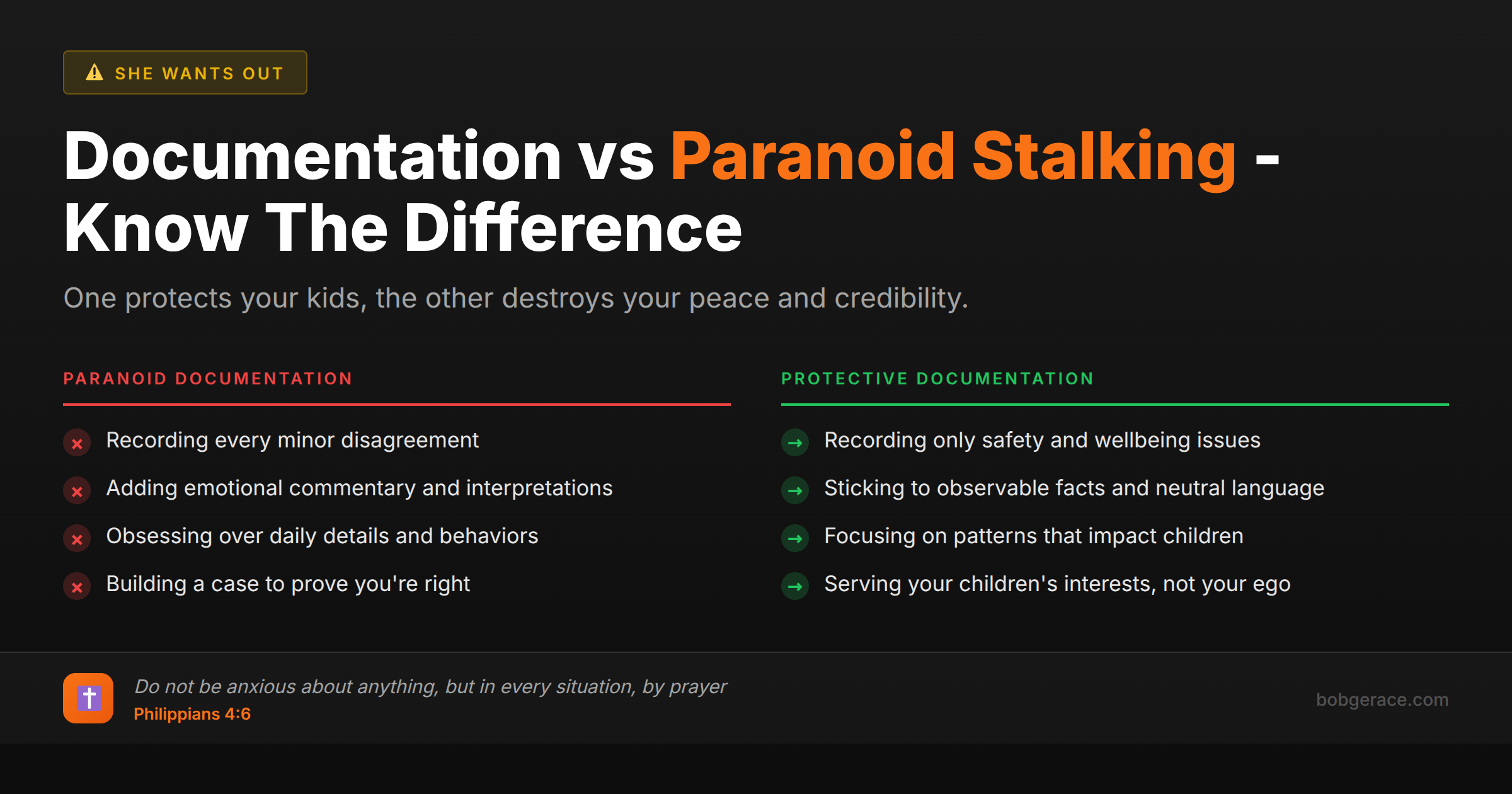
The line between protective documentation and paranoid surveillance comes down to motivation and method. Document when behavior directly affects your children's safety, wellbeing, or your ability to parent effectively. Focus on observable facts, not interpretations or emotions. Record date, time, what happened, who was present, and the impact on the children. Skip the emotional commentary and stick to what a neutral observer would see. This isn't about building a case against your ex - it's about protecting your kids and maintaining healthy boundaries. Good documentation serves your children's interests, not your need to be right.
The Full Picture
Documentation becomes paranoid when it's driven by hurt, anger, or the need to prove you're the better parent. Healthy documentation serves your children's protection and your peace of mind. It's the difference between writing "She was late again because she doesn't care" and "Pickup scheduled for 6 PM, children returned at 7:15 PM."
Document these situations: • Safety concerns (driving under influence, unsafe living conditions, neglect) • Significant changes in your children's behavior after visits • Violations of custody agreements or court orders • Communication that affects parenting decisions • Medical or educational neglect
Don't document these: • Different parenting styles that aren't harmful • Minor schedule changes or normal life disruptions • Your emotional reactions to their choices • Things that happened before your separation unless currently relevant • Hearsay from children unless it indicates safety concerns
The key is asking yourself: "Does this directly impact my children's wellbeing or my ability to parent effectively?" If it's just different from how you'd handle things, let it go. Your ex buying the kids McDonald's instead of cooking doesn't need documentation. Your ex leaving young children unsupervised does.
Keep records simple, factual, and focused on patterns rather than isolated incidents. A single late pickup isn't concerning. Consistent tardiness that disrupts bedtimes and school preparation is. The goal is protection and clarity, not ammunition for future battles.
What's Really Happening
From a therapeutic perspective, the urge to document everything often stems from feeling powerless and hypervigilant after relationship trauma. Post-separation anxiety can trigger our threat detection system, making us perceive danger where none exists. This is especially common for parents who feel they've lost control over their children's safety.
Healthy documentation requires what we call "emotional regulation before evaluation." When you're activated emotionally, your perception becomes filtered through fear, anger, or hurt. Research in cognitive psychology shows that heightened emotional states impair our ability to assess situations objectively. You're literally less capable of determining what's worth documenting when you're emotionally flooded.
The clinical difference between protective awareness and paranoid monitoring lies in three factors: 1. Proportionality - Does your response match the actual risk level? 2. Functionality - Is documentation helping or hindering your healing and co-parenting? 3. Child-centeredness - Are you documenting for your children's benefit or your own validation?
Parents who document effectively typically follow a "24-hour rule" - they wait a day before deciding if something merits recording. This allows emotional intensity to decrease and provides clearer perspective on whether an incident represents a genuine concern or normal co-parenting friction.
Therapeutic documentation focuses on observable behaviors and their impact on children, not on proving who's the better parent. It serves as a reality check, helping you distinguish between legitimate concerns and trauma responses that need therapeutic attention rather than legal intervention.
What Scripture Says
Scripture calls us to wisdom and discernment while warning against obsessive worry and judgment. Proverbs 27:14 reminds us, "Whoever blesses his neighbor with a loud voice, rising early in the morning, will be counted as cursing him." Even good intentions become destructive when driven by the wrong spirit.
Philippians 4:6-7 addresses our anxiety directly: "Do not be anxious about anything, but in every situation, by prayer and petition, with thanksgiving, present your requests to God. And the peace of God, which transcends all understanding, will guard your hearts and your minds in Christ Jesus." When documentation stems from anxiety rather than wisdom, we're operating outside God's peace.
Matthew 18:15-17 provides a framework for addressing concerns: "If your brother or sister sins, go and point out their fault, just between the two of you. If they listen to you, you have won them over." Before documenting, have you addressed the issue directly? Documentation should support communication, not replace it.
1 Corinthians 13:7 tells us love "always protects, always trusts, always hopes, always perseveres." This doesn't mean being naive about genuine concerns, but it does mean our default posture should be trust, not suspicion. Document what requires protection, not what satisfies our need to be right.
Proverbs 19:2 warns, "Desire without knowledge is not good—how much more will hasty feet miss the way!" Hasty documentation without wisdom often creates more problems than it solves. Let your documentation be measured, purposeful, and guided by genuine concern for your children's wellbeing rather than your own vindication.
What To Do Right Now
-
1
Establish clear criteria for what you'll document based on your children's safety and wellbeing, not your emotions
-
2
Create a simple format: date, time, observable facts, people present, impact on children
-
3
Implement a 24-hour waiting period before documenting anything to ensure emotional clarity
-
4
Focus on patterns of concerning behavior rather than isolated incidents that might have reasonable explanations
-
5
Store documentation securely but don't obsess over it - check and update weekly, not daily
-
6
Share significant concerns with your ex directly before documenting, unless safety issues prevent direct communication
Related Questions
- What is 'parental alienation' and is it happening?
- What's the difference between alienation and a child's authentic response to my behavior?
- She's turning the kids against me
- What should I know before agreeing to anything?
- What do I document?
- How do I protect myself without escalating?
- What evidence should I secure?
- Should I screenshot everything?
- What does healthy coping look like?
- What boundaries are non-negotiable?
Also find Bob on
Subscribe for weekly videos on Christian marriage.
Your Situation Needs a Human Read
Documentation is one thing. Knowing what to do with it in your specific co-parenting dynamic is another. A coach who knows your story can help you calibrate what matters and what doesn't.
Talk to Bob →