What's the difference between alienation and a child's authentic response to my behavior?
6 min read
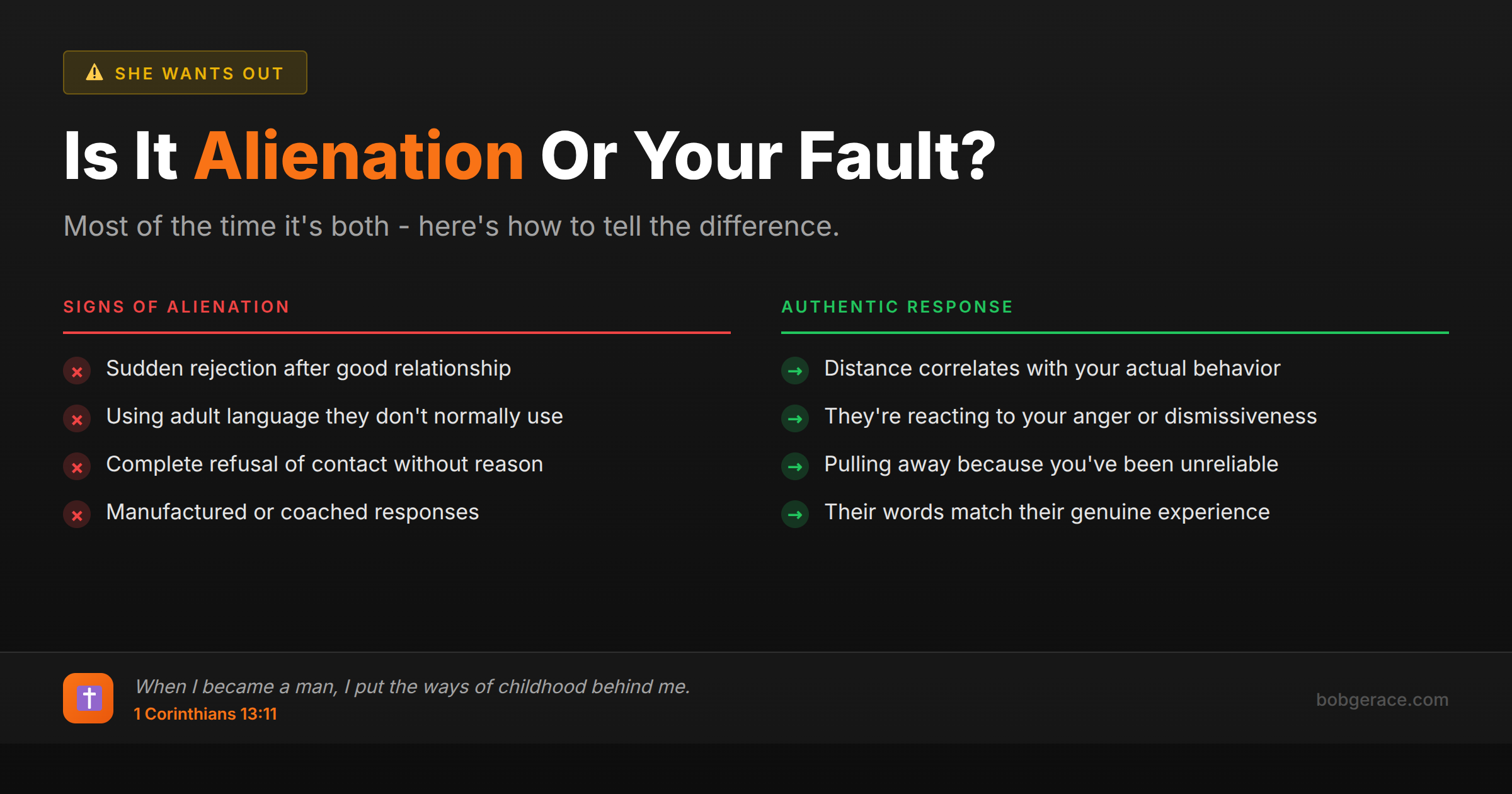
The difference comes down to consistency and your role in creating the distance. Alienation happens when your child's rejection feels manufactured - sudden changes, using adult language they wouldn't normally use, or refusing contact despite previously good relationships. Authentic response is when your child's behavior directly correlates with your actual actions - they're distant because you've been angry, dismissive, or unreliable. Here's the hard truth: most of the time, it's both. Yes, your ex might be influencing them, but kids usually have legitimate reasons for pulling away. The question isn't whether alienation exists - it's whether you're giving your children reasons to be receptive to it. When you focus on fixing your own behavior first, you remove the fuel that makes alienation effective.
The Full Picture
True alienation involves systematic manipulation where one parent deliberately undermines the child's relationship with the other parent. Signs include:
• Sudden, dramatic changes in your child's attitude with no corresponding incident • Adult language and concepts your child wouldn't naturally use • Rigid, absolute thinking - you're "all bad" with no acknowledgment of positive history • Fear or anxiety about being seen enjoying time with you • Parroting specific phrases that sound like your ex's voice
Authentic responses stem from your actual behavior and its impact on your child:
• Proportional reactions to specific incidents or patterns • Age-appropriate language when they express their feelings • Willingness to engage when you demonstrate real change • Specific examples when asked about their concerns • Inconsistent attitudes that fluctuate based on recent interactions
The crucial distinction is this: alienated children reject you despite your good behavior, while authentically responding children reject you because of your problematic behavior. Most situations involve elements of both, which is why the solution isn't legal action - it's becoming the father your children need you to be.
Your ex may be planting seeds, but those seeds only grow in fertile soil. When you're consistently safe, present, and emotionally mature, alienation attempts lose their power.
What's Really Happening
From a clinical perspective, children's responses to divorce and separation exist on a spectrum. Pure parental alienation syndrome, while real, is less common than situations where children are responding to multiple complex factors simultaneously.
Children's attachment systems are highly attuned to safety and consistency. When parents separate, children instinctively align with whoever feels safest and most predictable. If a child consistently experiences a parent as angry, unpredictable, or emotionally unavailable, their nervous system will naturally create distance as a protective mechanism.
Research shows that children's resistance to contact typically stems from multiple sources: their own experiences, developmental factors, loyalty conflicts, and yes, sometimes influence from the other parent. The key therapeutic insight is that children's emotional responses are always communicating something important about their internal experience.
When evaluating your situation, consider these clinical markers: Alienation tends to be more global and absolute, while authentic responses are usually specific and conditional. Alienated children often struggle to give concrete examples of problems, while children responding authentically can typically articulate specific behaviors or incidents that upset them.
The most effective therapeutic approach focuses on rebuilding safety and trust rather than challenging the child's current perspective. Children need to experience consistent, emotionally regulated interactions over time before they'll risk vulnerability with a parent they've distanced from.
What Scripture Says
Scripture calls us to honest self-examination before pointing fingers elsewhere. 1 Corinthians 13:11 reminds us, "When I was a child, I talked like a child, I thought like a child, I reasoned like a child. When I became a man, I put the ways of childhood behind me." Our children need us to respond with maturity, not defensiveness.
Matthew 7:3-5 directly addresses this situation: "Why do you look at the speck of sawdust in your brother's eye and pay no attention to the plank in your own eye?" Before focusing on your ex's influence, God calls you to examine your own contribution to the relationship breakdown.
Ephesians 6:4 gives fathers specific instructions: "Do not exasperate your children; instead, bring them up in the training and instruction of the Lord." The word "exasperate" means to provoke to anger or frustration. Ask yourself honestly: have your words, tone, or actions exasperated your children?
Proverbs 27:6 teaches us that "wounds from a friend can be trusted, but an enemy multiplies kisses." Sometimes our children's rejection, though painful, contains truth we need to hear. James 1:19 instructs us to be "quick to listen, slow to speak and slow to become angry."
Luke 15:20 shows us the father's heart in the prodigal son story - he ran to his returning son with compassion. Your role is to remain the safe harbor your children can return to, regardless of their current attitude. Focus on becoming the father God calls you to be, trusting Him with the results.
What To Do Right Now
-
1
Document specific incidents objectively without emotional commentary to identify patterns in your child's responses
-
2
Ask your children directly what they need from you to feel safe and heard, then listen without defending
-
3
Examine your own behavior honestly - identify moments when you've been angry, dismissive, or emotionally unavailable
-
4
Commit to consistent, predictable interactions regardless of your child's current attitude toward you
-
5
Stop discussing the other parent or the divorce with your children - focus solely on your relationship with them
-
6
Seek professional help to develop emotional regulation skills and co-parenting strategies that prioritize your children's wellbeing
Related Questions
- What is 'parental alienation' and is it happening?
- How do I document concerning behavior without being paranoid?
- She's turning the kids against me
- How do I not badmouth her when I'm furious?
- How do I support their relationship with her when she's hurting me?
- What if she's genuinely unsafe and I'm not being paranoid?
- I can't control my anger
- Why do I rage at the people I love?
- What role did my childhood play in my anger patterns?
- How do I become emotionally intelligent?
Also find Bob on
Subscribe for weekly videos on Christian marriage.
Your Kids. Your Story. A Coach Who Gets Both.
You're not dealing with a textbook case—you're dealing with your actual children and the specific ways you've shown up. A coach helps you see what you can't see alone and build the plan that fits your situation.
Talk to Bob →