What's the difference between acceptance and approval?
6 min read
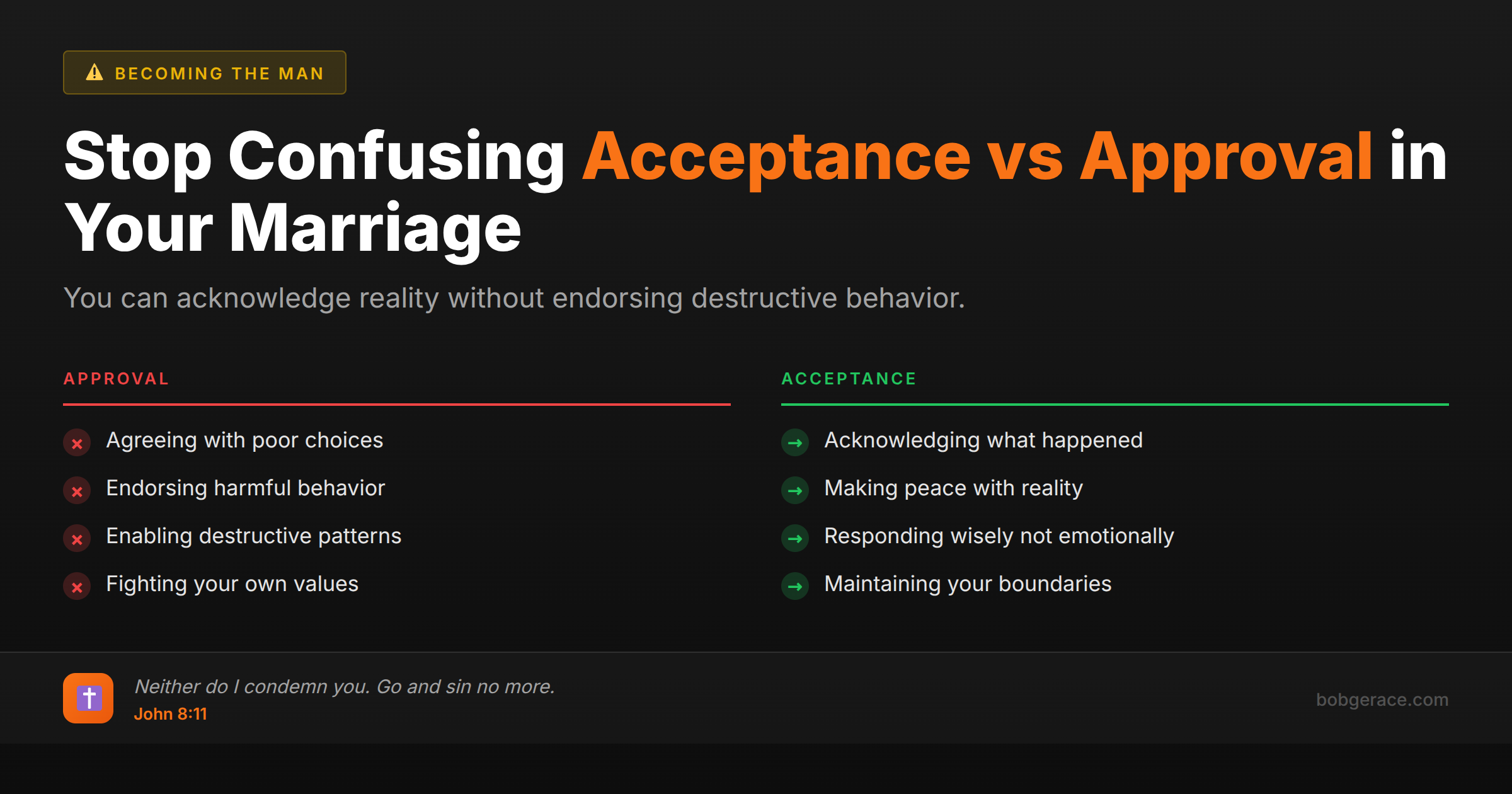
Acceptance means acknowledging reality without fighting against it, while approval means agreeing with or endorsing something. You can accept that your husband made a poor choice without approving of his behavior. Acceptance is about making peace with what is so you can respond wisely, not emotionally. Approval, on the other hand, implies agreement and often enables continued harmful behavior. This distinction is crucial in marriage because it allows you to stop the exhausting cycle of fighting reality while still maintaining your values and boundaries. When you accept what happened, you can focus your energy on healthy responses rather than wasting it on denial or wishful thinking.
The Full Picture
The confusion between acceptance and approval keeps many women stuck in cycles of emotional turmoil. They think accepting their husband's behavior means they have to like it, agree with it, or stop setting boundaries around it. This misunderstanding leads to either constant fighting against reality or passive resignation that enables destructive patterns.
Acceptance is about reality. It's saying "this happened" or "this is where we are" without the emotional charge of denial, bargaining, or wishful thinking. When you accept, you're not saying the behavior was right - you're simply acknowledging what actually occurred so you can deal with it effectively.
Approval is about agreement. When you approve of something, you're giving it your endorsement. You're saying "this is okay" or "I support this decision." Approval often comes with emotional investment in the outcome and can lead to enabling harmful behavior.
Consider this example: Your husband has been having an emotional affair. Acceptance means acknowledging "My husband has been having an emotional affair. This is our reality right now." Approval would mean saying "It's understandable that he needed emotional connection elsewhere" or "I can see why he did this."
The power of acceptance is that it frees you from the exhausting work of fighting reality. When you stop spending emotional energy on denial ("This can't be happening"), anger at the situation ("This shouldn't have happened"), or bargaining ("If only I had done X differently"), you can focus on wise, measured responses.
Acceptance also doesn't mean resignation or giving up. You can fully accept that something happened while still setting firm boundaries about what you will and won't tolerate going forward. In fact, acceptance often makes your boundaries cleaner and more effective because they're not clouded by emotional reactivity.
What's Really Happening
From a psychological perspective, the struggle between acceptance and approval often stems from attachment patterns formed in childhood. Women who grew up in environments where love was conditional on approval may unconsciously believe that accepting their husband's behavior equals endorsing it, which feels like betrayal of their own values.
This creates what we call "cognitive fusion" - the inability to separate thoughts and feelings from reality. When you're fused with the situation, you can't step back and see it objectively. Acceptance breaks this fusion by creating psychological distance between you and the event.
Neurologically, resistance to acceptance activates the brain's threat detection system, keeping you in a state of chronic stress. Your amygdala stays activated, making it difficult to access the prefrontal cortex where wise decision-making happens. True acceptance actually calms the nervous system, allowing for clearer thinking.
The therapeutic concept of "radical acceptance" doesn't mean liking what happened - it means fully acknowledging reality without the additional suffering of resistance. This is particularly important when dealing with betrayal or disappointment in marriage. The pain of the actual event is difficult enough without adding the extra layer of suffering that comes from fighting reality.
I often see women exhaust themselves trying to change their husband's past decisions or current attitudes. This is where the serenity prayer becomes psychologically profound: accepting what you cannot change frees up energy to focus on what you can change - your responses, your boundaries, and your choices moving forward.
What Scripture Says
Scripture makes a clear distinction between acknowledging reality and endorsing sin. Jesus himself demonstrated perfect acceptance of people while never approving of destructive behavior. He accepted the woman caught in adultery exactly where she was - "Neither do I condemn you" - while clearly not approving of her actions - "Go and sin no more" (John 8:11).
Ecclesiastes 3:1 reminds us "There is a time for everything, and a season for every activity under the heavens." This includes a time to accept what has happened so you can respond wisely rather than reactively.
Romans 12:2 tells us "Do not conform to the pattern of this world, but be transformed by the renewing of your mind." Part of this renewal involves learning to see situations clearly rather than through the lens of what we wish were true.
Proverbs 27:5-6 says "Better is open rebuke than hidden love. Wounds from a friend can be trusted, but an enemy multiplies kisses." True love sometimes requires accepting hard truths about our spouse while refusing to approve of harmful behavior.
Matthew 10:16 instructs us to be "as shrewd as snakes and as innocent as doves." This wisdom requires accepting the reality of your situation (shrewdness) while maintaining pure motives (innocence). You can't be shrewd if you're still in denial about what's actually happening.
1 Peter 3:1 speaks to wives whose husbands are disobedient to the word, suggesting they can be won over "without words by the behavior of their wives." This requires accepting your husband's current spiritual state while not approving of his disobedience - and responding with wisdom rather than constant verbal confrontation.
What To Do Right Now
-
1
Acknowledge the facts without emotional language. Write down exactly what happened using only factual, observable statements - no interpretations or emotional charges.
-
2
Practice the phrase 'This is what happened.' When you feel yourself fighting reality, simply state the facts and add 'This is what happened' to ground yourself in acceptance.
-
3
Separate your values from your circumstances. List your core values and confirm that accepting reality doesn't require changing what you believe is right and wrong.
-
4
Set boundaries from acceptance, not anger. Once you've accepted the situation, determine what boundaries you need going forward - these will be cleaner and more effective than reactive boundaries.
-
5
Stop explaining why something shouldn't have happened. Notice when you're spending energy on 'should have' or 'shouldn't have' statements and redirect that energy toward your response.
-
6
Ask 'What now?' instead of 'Why?' Focus your mental energy on your next right step rather than trying to understand or justify what already happened.
Related Questions
Ready to Stop Fighting Reality and Start Responding Wisely?
Learning the difference between acceptance and approval can transform your marriage. Let me help you develop the clarity and strength to handle difficult situations with wisdom.
Get Support →