What does Paul mean by 'what I don't want to do, I do'?
6 min read
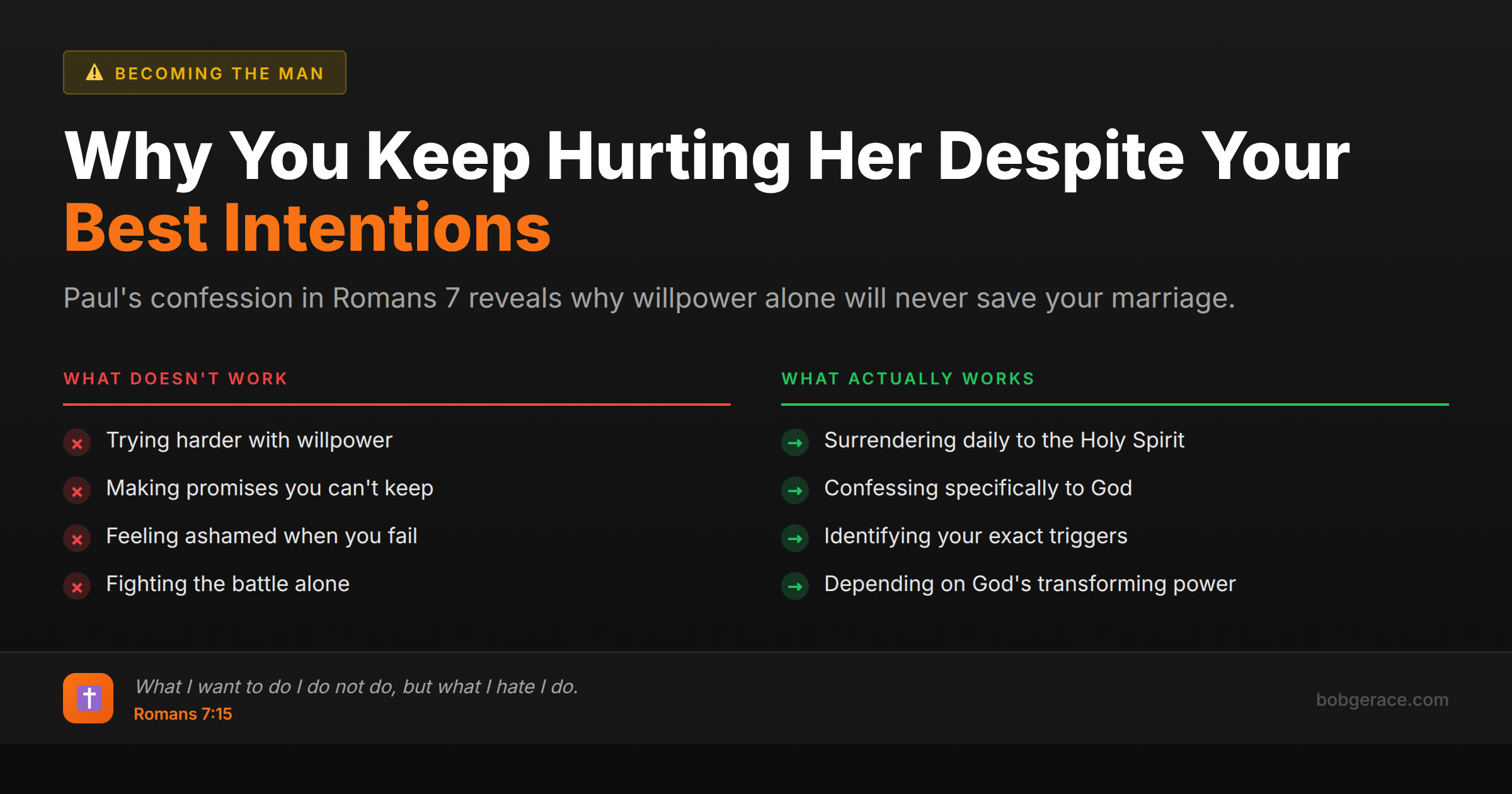
Paul's statement in Romans 7:15 captures the universal human struggle between knowing what's right and actually doing it. He's describing the war between our renewed mind that wants to honor God and our flesh that pulls us toward selfish, destructive behaviors. In marriage, this shows up as the pattern of hurting the person we love most, even when we desperately want to stop. This isn't about making excuses for bad behavior—it's about understanding the real battle. Paul reveals that willpower alone isn't enough to overcome ingrained patterns. The solution isn't trying harder; it's recognizing our dependence on the Holy Spirit and God's transforming power to change us from the inside out.
The Full Picture
Romans 7:15-25 gives us one of the most honest descriptions of the Christian struggle ever written. Paul, arguably the greatest apostle, admits he can't consistently do what he knows is right. This isn't a cop-out—it's reality.
In marriage, this battle plays out daily. You know you shouldn't raise your voice, but you do. You know criticism destroys intimacy, but the words come out anyway. You know your spouse needs encouragement, but you withhold it. You know pornography is destroying your marriage, but you keep going back. Sound familiar?
Here's what Paul understood that many miss: The problem isn't lack of knowledge or even lack of desire to change. The problem is that our fallen nature is at war with our renewed spirit. Paul calls this the "law of sin" working in our members—patterns so deeply ingrained they feel automatic.
But Paul doesn't leave us hopeless. Romans 8 provides the answer. What the law couldn't do (change our hearts through rules), God did by sending His Son. The same Spirit that raised Jesus from the dead lives in us, giving us power to overcome these destructive patterns.
This understanding changes everything about how we approach marriage problems. Instead of relying on behavior modification or trying harder, we learn to walk in the Spirit. Instead of shame spirals when we fail, we run to grace and get back up. Instead of expecting perfection from ourselves or our spouse, we extend the same patience God shows us.
The goal isn't sinless perfection—it's progress through dependence on God's power, not our own.
What's Really Happening
Paul's description aligns perfectly with what we understand about neuroplasticity and habit formation. When we repeatedly engage in certain behaviors—whether criticism, withdrawal, or defensiveness—we create neural pathways that become our default responses. This is why you can 'know better' but still react the same way under stress.
The brain's limbic system, which governs emotional responses, operates much faster than the prefrontal cortex where rational thinking occurs. In heated moments with your spouse, your emotional brain hijacks your good intentions before your rational mind can intervene. This isn't a character flaw—it's human neurology affected by the fall.
What's remarkable is that Paul's spiritual solution—walking in the Spirit—actually rewires the brain. Practices like prayer, meditation on Scripture, and deliberate gratitude create new neural pathways. The Holy Spirit works through these spiritual disciplines to literally renew our minds, as Romans 12:2 promises.
In marriage therapy, I see couples get stuck in shame cycles because they don't understand this dynamic. They think repeated failures mean they're hopeless or don't really want to change. Understanding Paul's struggle normalizes the process and shifts focus from perfect performance to consistent dependence on God's transforming power.
Recovery from destructive marriage patterns requires both spiritual and practical elements—confession, accountability, new habits, and most importantly, daily surrender to the Holy Spirit's work in our lives.
What Scripture Says
Romans 7:15, 19-20 - "I do not understand what I do. For what I want to do I do not do, but what I hate I do... For I do not do the good I want to do, but the evil I do not want to do—this I keep on doing. Now if I do what I do not want to do, it is no longer I who do it, but it is sin living in me that does it."
Paul identifies the source: indwelling sin creating patterns that feel beyond our control.
Romans 8:3-4 - "For what the law was powerless to do because it was weakened by the flesh, God did by sending his own Son in the likeness of sinful flesh to be a sin offering. And so he condemned sin in the flesh, in order that the righteous requirement of the law might be fully met in us, who do not live according to the flesh but according to the Spirit."
God's solution: the Spirit's power, not human effort.
Galatians 5:16-17 - "So I say, walk by the Spirit, and you will not gratify the desires of the flesh. For the flesh desires what is contrary to the Spirit, and the Spirit what is contrary to the flesh. They are in conflict with each other, so that you are not to do whatever you want."
The ongoing battle requires daily dependence on the Spirit.
2 Corinthians 12:9 - "But he said to me, 'My grace is sufficient for you, for my power is made perfect in weakness.'"
Our weakness becomes the place where God's strength is most evident.
Philippians 2:13 - "For it is God who works in you to will and to act in order to fulfill his good purpose."
God provides both the desire and ability to change.
1 John 1:9 - "If we confess our sins, he is faithful and just and will forgive us our sins and purify us from all unrighteousness."
Failure isn't final—confession leads to cleansing and fresh starts.
What To Do Right Now
-
1
Stop the shame spiral - Recognize that struggling with repeated patterns is normal, not proof you're hopeless or don't really want to change
-
2
Confess specifically to God - Name the exact behaviors and ask for forgiveness, knowing His grace is greater than your failure
-
3
Identify your triggers - What situations, emotions, or circumstances typically lead to your unwanted behaviors in marriage?
-
4
Start each day surrendering to the Holy Spirit - Literally pray 'I can't do this on my own strength - I need Your power today'
-
5
Create accountability with your spouse - Share your struggle honestly and ask them to pray for you, not shame you when you fail
-
6
Replace old patterns with Spirit-led responses - When you feel the old reaction coming, pause and ask 'What would love do here?' then act on that prompting
Related Questions
- I keep making the same mistakes
- Why do I repeat patterns I hate?
- I know what to do but can't do it
- Why can't I just change?
- What is the role of the flesh vs. spirit?
- What does 'renewing of the mind' actually require?
- Can I forgive before I'm ready?
- What does 'godly sorrow' look like in practice?
- How do I not lose my mind right now?
- What is the relationship between grace and effort?
Also find Bob on
Subscribe for weekly videos on Christian marriage.
You Don't Have to Keep Repeating This
A coach who knows your marriage can help you see why you keep doing what you don't want to do—and what actually changes the pattern in your specific situation.
Talk to Bob →